
Why Nature Lovers Are Obsessed With Sage Green & Oak Bathrooms
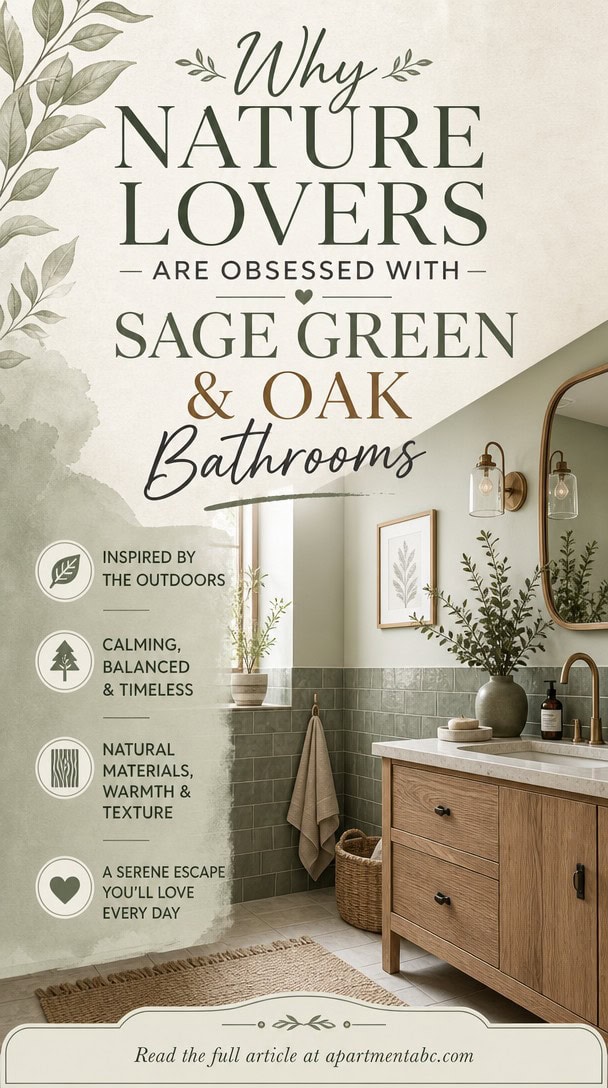
Search volume for “sage green bathroom” jumped nearly 90% last year, and it’s not random. You’ve probably scrolled past a dozen white bathrooms feeling nothing, then stopped cold on one painted Benjamin Moore Saybrook Sage HC-114 with oak shelving. That’s not decorating taste. That’s your nervous system recognizing something older than trends—and once you see why, you can’t unsee it.
What Makes Sage Green and Oak So Appealing?
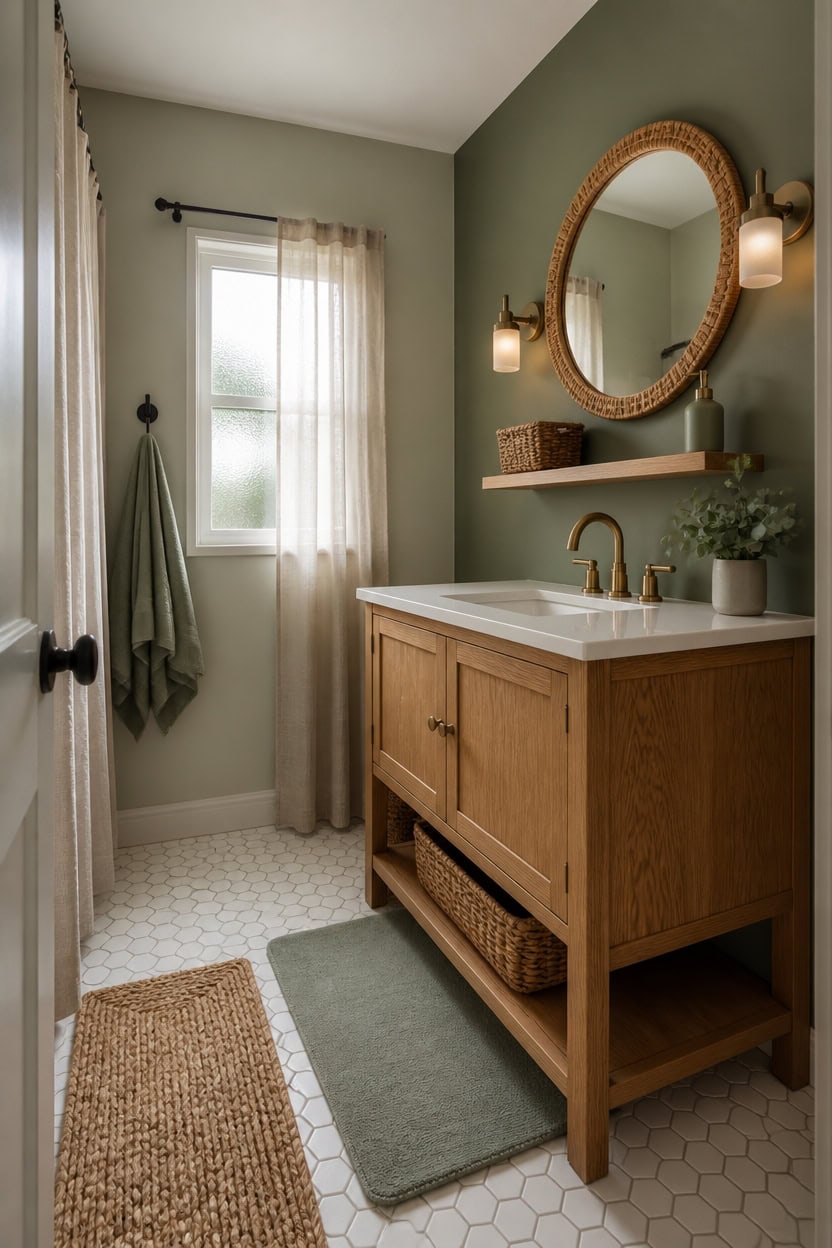
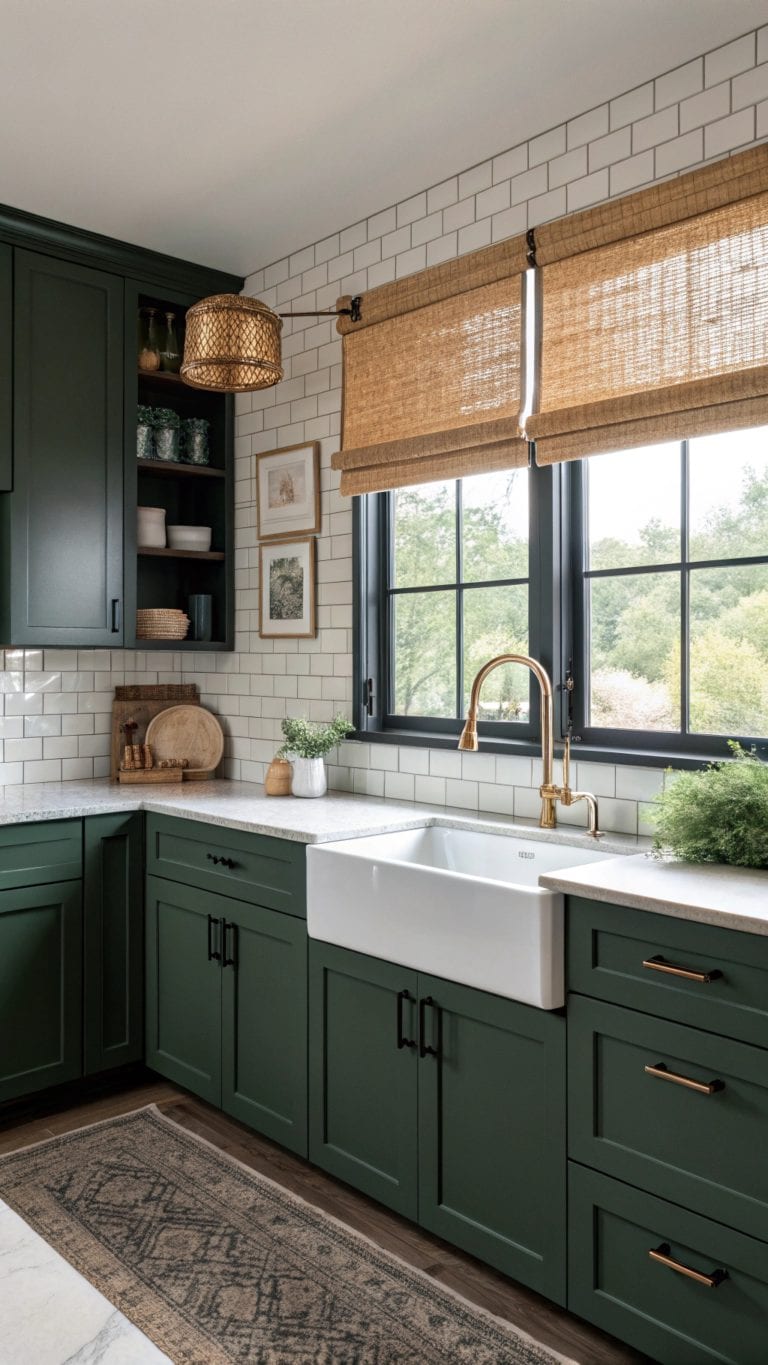
Sage green and oak work together because both draw from the same earthy source material — living plants and cut wood — so the pairing reads as gathered rather than decorated. Walls painted in “October Mist” (1495) give the room a soft, muted backdrop that lets the natural grain of an oak vanity stand out instead of competing with it. Keep the green matte and low-saturation on walls, then let the oak carry warmth through the vanity and any open shelving.
Match saturation levels: Choose a muted, grayed-down green so it doesn’t fight the warm tone of the oak.
Let oak stay unpainted: Treat the wood as the accent material and reserve paint for walls and trim.
Layer in texture: Add woven baskets or a jute mat so the room doesn’t feel like two flat colors.
Use metal sparingly: Brass or matte black fixtures bridge the green and oak without adding a third dominant color.
a soft, grayed sage that keeps the room calm and lets the oak vanity read as the focal point. [light]
a deeper, mossier green that grounds the space and frames the oak tones nearby. [mid-tone]
 IFGET 30 Inch Bathroom Vanity with Sink, Arched Fluted Design, Natural Oak
View Price
IFGET 30 Inch Bathroom Vanity with Sink, Arched Fluted Design, Natural Oak
View Price
 COZYART Luxury Bath Towel Set 6 Pcs, Sage Green 100% Turkish Cotton 650 GSM
View Price
COZYART Luxury Bath Towel Set 6 Pcs, Sage Green 100% Turkish Cotton 650 GSM
View Price
 SiliFine Seagrass Bathroom Woven Storage Basket Set of 4, Natural Color
View Price
SiliFine Seagrass Bathroom Woven Storage Basket Set of 4, Natural Color
View Price
 INGOFIN 3 Pcs Ceramic Bathroom Accessory Set - Liquid Soap Dispenser, Toothbrush Holder & Tray, Bathroom Counter Set, Countertop Essentials for Home, Guest Bathroom, or Office Use, Matte Green
View Price
INGOFIN 3 Pcs Ceramic Bathroom Accessory Set - Liquid Soap Dispenser, Toothbrush Holder & Tray, Bathroom Counter Set, Countertop Essentials for Home, Guest Bathroom, or Office Use, Matte Green
View Price
 Champagne Brass Bathroom Wall Sconce: Set of 2 Modern Gold Decor Lighting
View Price
Champagne Brass Bathroom Wall Sconce: Set of 2 Modern Gold Decor Lighting
View Price
 Vercraft 24 Inch Round Rattan Wicker Mirror, Rustic Boho & Farmhouse Style Handmade Woven Frame, Decorative Wall Mirror for Bathroom, Living Room, Bedroom, Entryway, Nursery Decor
View Price
Vercraft 24 Inch Round Rattan Wicker Mirror, Rustic Boho & Farmhouse Style Handmade Woven Frame, Decorative Wall Mirror for Bathroom, Living Room, Bedroom, Entryway, Nursery Decor
View Price
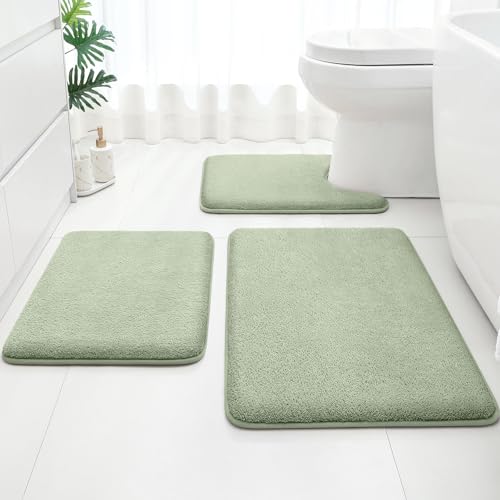 HOMEIDEAS Bathroom Rugs Sets 3 Piece, Absorbent Bath Mat, Sage Green
View Price
HOMEIDEAS Bathroom Rugs Sets 3 Piece, Absorbent Bath Mat, Sage Green
View Price
 Velener 2 Pcs Small Fake Plants Eucalyptus, Artificial Plants Indoor for Shelf, Potted Eucalyptus Plants for Home/Bathroom/Pottery Barn/Desk/Farmhouse/Coffee Table Decor (Sage Green)
View Price
Velener 2 Pcs Small Fake Plants Eucalyptus, Artificial Plants Indoor for Shelf, Potted Eucalyptus Plants for Home/Bathroom/Pottery Barn/Desk/Farmhouse/Coffee Table Decor (Sage Green)
View Price
The Psychology Behind Sage Green and Oak
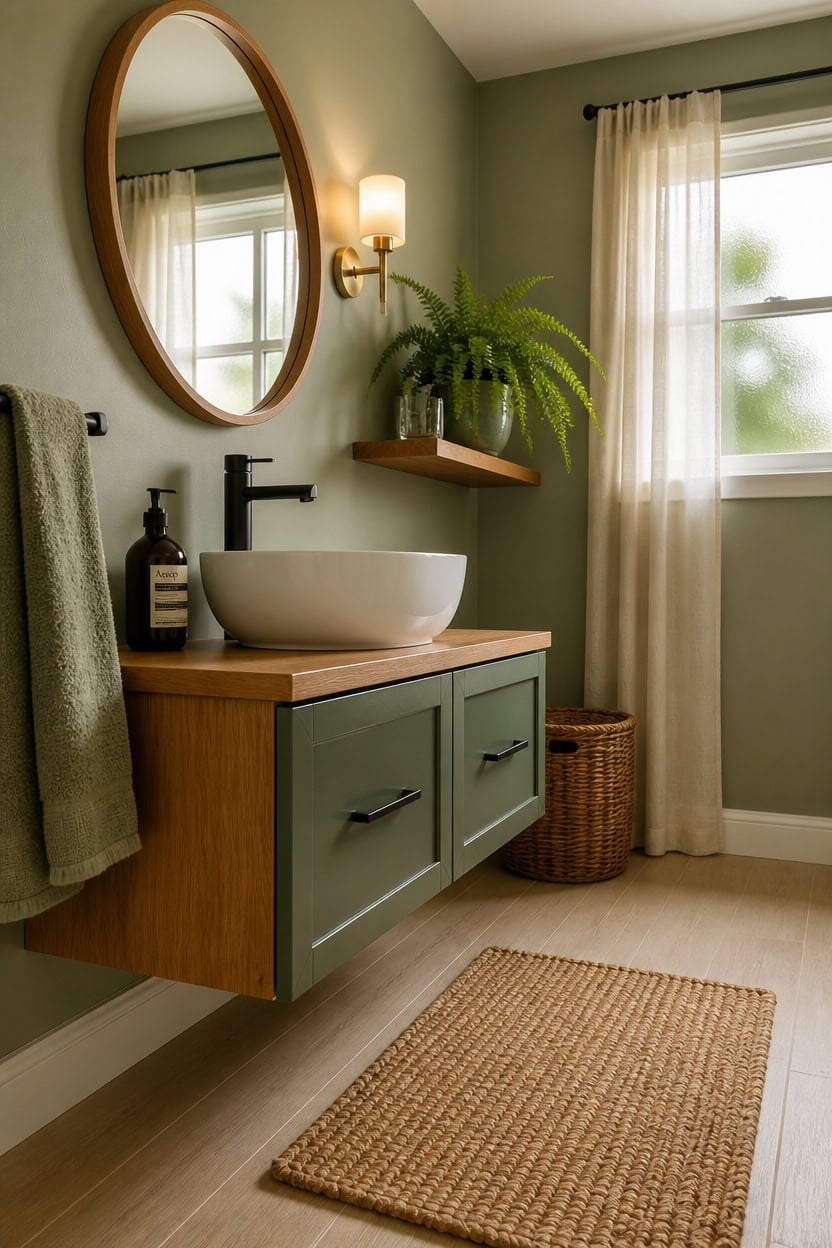
Color psychology explains why sage green and oak calm the nervous system faster than brighter palette pairings. Sage sits close to gray on the color wheel, so the brain reads it as restful rather than stimulating, while oak’s warm undertone keeps the room from feeling cold or clinical. Paint the walls in “October Mist” (1495) to anchor this effect, since its low saturation reduces visual noise the moment someone enters the bathroom.
Lower the saturation: A grayed-down green triggers less visual excitement than a true green, which supports relaxation.
Balance warm and cool: Oak’s warmth offsets sage’s coolness so the room doesn’t feel sterile or overly muted.
Limit color count: Stick to green, oak, and one neutral so the eye doesn’t have to process competing signals.
Add soft lighting: Warm-toned bulbs keep the sage from turning gray or flat under bright overhead light.
a muted sage that keeps the room’s baseline calm and unobtrusive. [mid-tone]
a slightly deeper green that grounds the lower half of the room and pairs with warm oak accents. [mid-tone]
 Cotton Paradise 100% Cotton Turkish Towel Set, Soft Absorbent Quick Dry, 4 Piece Hand Towel Set, Sage Green
View Price
Cotton Paradise 100% Cotton Turkish Towel Set, Soft Absorbent Quick Dry, 4 Piece Hand Towel Set, Sage Green
View Price
 KES Bathroom Vessel Sink, 16" x 13" Oval Vessel Sink for Bathroom Vanity Countertop, Glossy White Ceramic Bowl Sink Egg Shape Above Counter, Modern Look, Crafted to Endure, BVS124
View Price
KES Bathroom Vessel Sink, 16" x 13" Oval Vessel Sink for Bathroom Vanity Countertop, Glossy White Ceramic Bowl Sink Egg Shape Above Counter, Modern Look, Crafted to Endure, BVS124
View Price
 SAFAVIEH Natural Fiber Accent Rug 2x3 Jute Knotted, Natural NF447A
View Price
SAFAVIEH Natural Fiber Accent Rug 2x3 Jute Knotted, Natural NF447A
View Price
 USHOWER Matte Black Towel Bar, 24-Inch Towel Racks for Bathroom
View Price
USHOWER Matte Black Towel Bar, 24-Inch Towel Racks for Bathroom
View Price
 DuHouse Artificial Fern Potted Plant Fake Greenery Plants(Sage Green)
View Price
DuHouse Artificial Fern Potted Plant Fake Greenery Plants(Sage Green)
View Price
 10"×6"×1" Bathroom Vanity Tray for Countertop- Ceramic Decorative Organizer Tray for Dresser Tops, Toilet, Perfume, Sponge Holder Soap Dish Dispenser for Kitchen Counter- Kiln-Transformed Green
View Price
10"×6"×1" Bathroom Vanity Tray for Countertop- Ceramic Decorative Organizer Tray for Dresser Tops, Toilet, Perfume, Sponge Holder Soap Dish Dispenser for Kitchen Counter- Kiln-Transformed Green
View Price
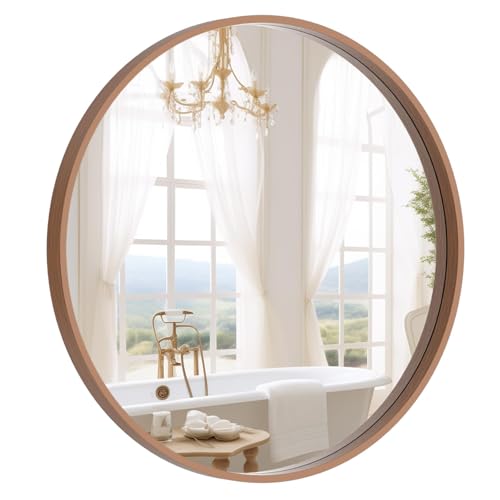 WallBeyond Wood Round Mirror with Wood Frame 24 inch Circle Wall Mirror for Bathroom Round Wall Mirror for Wall Decor, Vanity, Entryway Living Room (Walnut)
View Price
WallBeyond Wood Round Mirror with Wood Frame 24 inch Circle Wall Mirror for Bathroom Round Wall Mirror for Wall Decor, Vanity, Entryway Living Room (Walnut)
View Price
Our Favorite Bathroom Accessories
 Balch 6-Piece Bathroom Accessory Set
View Price
Balch 6-Piece Bathroom Accessory Set
View Price
 Vicini Bathroom Accessory Set
View Price
Vicini Bathroom Accessory Set
View Price
 Creative Scents 6-Piece Bathroom Accessory Set
View Price
Creative Scents 6-Piece Bathroom Accessory Set
View Price
 simplehuman 9 oz Touch-Free Rechargeable Sensor Soap Pump
View Price
simplehuman 9 oz Touch-Free Rechargeable Sensor Soap Pump
View Price
 Avanti Seaglass Lotion and Soap Dispenser
View Price
Avanti Seaglass Lotion and Soap Dispenser
View Price
 simplehuman 14 oz Liquid Sensor Pump with Caddy
View Price
simplehuman 14 oz Liquid Sensor Pump with Caddy
View Price
 Abermarle Bathroom Storage Container
View Price
Abermarle Bathroom Storage Container
View Price
 Umbra CASA Tissue Box Cover
View Price
Umbra CASA Tissue Box Cover
View Price
 Ice Cotton Swab Storage Container
View Price
Ice Cotton Swab Storage Container
View Price
 Kowalsky Bathroom Accessory Tray
View Price
Kowalsky Bathroom Accessory Tray
View Price
 Jazaya Decorative Vanity Tray
View Price
Jazaya Decorative Vanity Tray
View Price
 Imalee Bathroom Accessory Tray
View Price
Imalee Bathroom Accessory Tray
View Price
 Joseph Joseph EasyStore Large Toothbrush Holder
View Price
Joseph Joseph EasyStore Large Toothbrush Holder
View Price
 Jarmazing Mason Jar Toothbrush Holder
View Price
Jarmazing Mason Jar Toothbrush Holder
View Price
 Blomus SONO Tumbler Toothbrush Holder
View Price
Blomus SONO Tumbler Toothbrush Holder
View Price
Why Sage Green Echoes a Quiet Forest Retreat
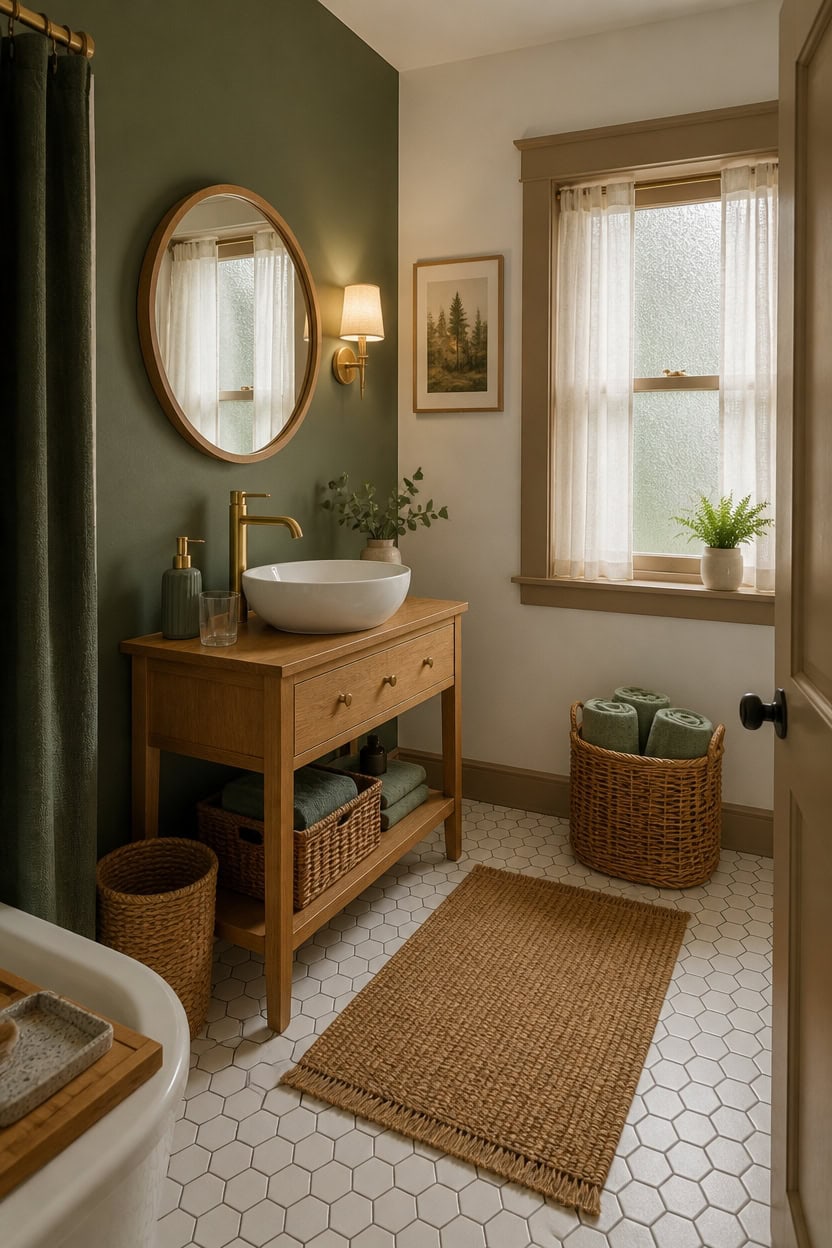
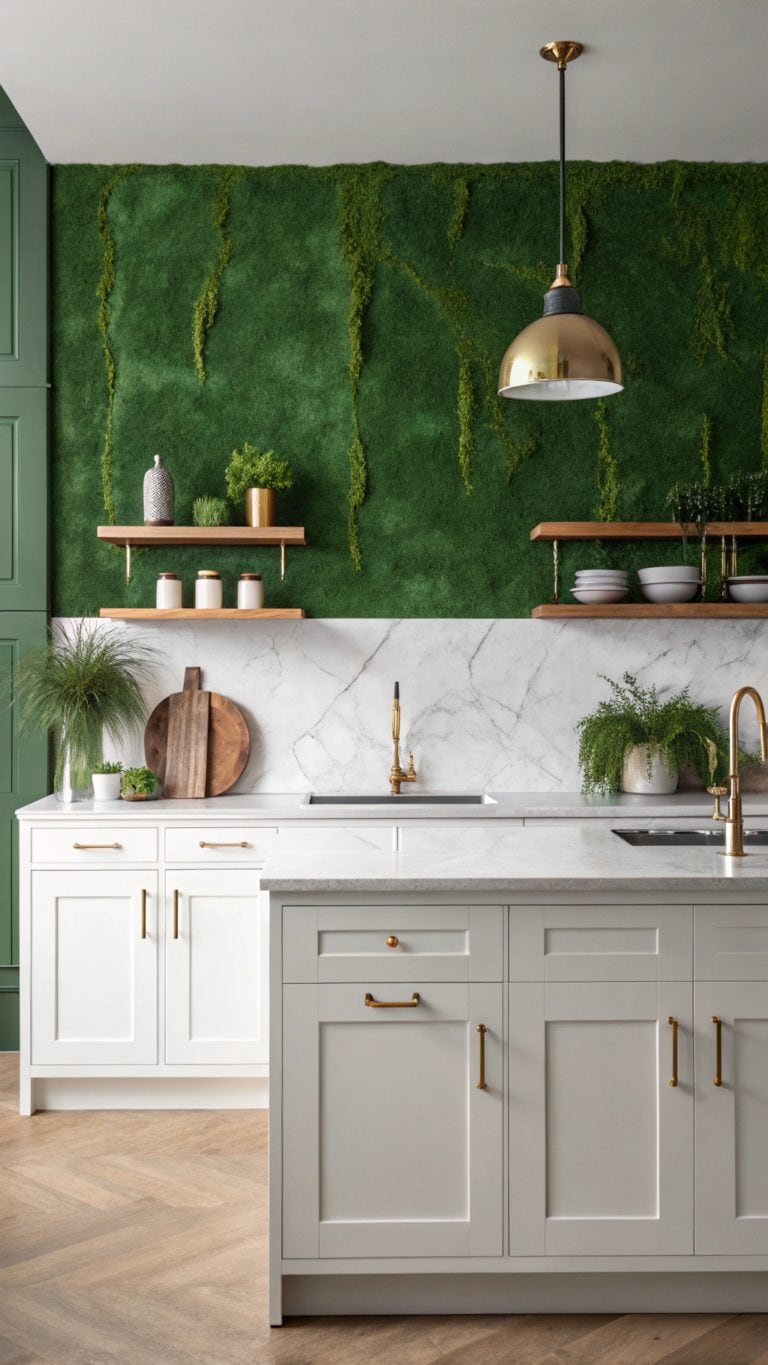
Sage green pulls its calming power from mirroring what the eye sees in a real forest — moss, lichen, and shaded undergrowth all sit in this same grayed-green range. Paint the accent wall in “Misted Fern” (482) to bring that woodland depth into the room without making it feel dark. This works because low-light forest greens carry less blue than true green, so they read as earthy instead of cold.
Mimic natural shade: Choose a green with gray undertones, since forest floors rarely show pure saturated color.
Layer textures: Add rattan, jute, or stone to echo bark and moss alongside the paint.
Keep light natural: Sheer window coverings let daylight shift the green subtly through the day, like sunlight through leaves.
Avoid overdoing green: One wall or feature is enough — too much reads as a themed room instead of a calming one.
a dense, muted green that recalls a forest canopy. [mid-tone]
a warm tan that echoes oak’s natural warmth against the green. [mid-tone]
 RQYIXI Ceramic Bathroom Accessories Set,Sage Green,4 Piece,Embossed Design
View Price
RQYIXI Ceramic Bathroom Accessories Set,Sage Green,4 Piece,Embossed Design
View Price
 Whalehub Natural Rectangular Rattan Storage Baskets (Set of 3), Hand Woven Food and Fruit Serving Baskets, Wicker Organizer for Living Room, Bedroom, Kitchen
View Price
Whalehub Natural Rectangular Rattan Storage Baskets (Set of 3), Hand Woven Food and Fruit Serving Baskets, Wicker Organizer for Living Room, Bedroom, Kitchen
View Price
 Waffle Weave Shower Curtain Heavyweight Cotton Fabric Dark Green 72Wx72L
View Price
Waffle Weave Shower Curtain Heavyweight Cotton Fabric Dark Green 72Wx72L
View Price
 ROYAL CRAFT WOOD Premium Foldable Bathtub Tray Caddy - Wood Bath Tray for Tub, Bamboo Shelf, Expandable Bath Table Trays, Bathtub & Bathroom Accessories for New Home & Mothers, Birthday Gifts for Mom
View Price
ROYAL CRAFT WOOD Premium Foldable Bathtub Tray Caddy - Wood Bath Tray for Tub, Bamboo Shelf, Expandable Bath Table Trays, Bathtub & Bathroom Accessories for New Home & Mothers, Birthday Gifts for Mom
View Price
 Coferset 2 Pack Small Fake Plants Eucalyptus Potted,Sage Green
View Price
Coferset 2 Pack Small Fake Plants Eucalyptus Potted,Sage Green
View Price
 StorageWorks Seagrass Bathroom Trash Can, Wicker Waste Basket for Bedroom
View Price
StorageWorks Seagrass Bathroom Trash Can, Wicker Waste Basket for Bedroom
View Price
 Utopia Towels 8 Piece Majestic Plush Luxury Towel Set, Cotton, Sage Green
View Price
Utopia Towels 8 Piece Majestic Plush Luxury Towel Set, Cotton, Sage Green
View Price
 WallBeyond Round Wood Mirror 24 inch Circle Wall Mirror for Bathroom Round Wall Mirror for Wall Decor, Vanity, Entryway Living Room (Natural)
View Price
WallBeyond Round Wood Mirror 24 inch Circle Wall Mirror for Bathroom Round Wall Mirror for Wall Decor, Vanity, Entryway Living Room (Natural)
View Price
Our Favorite Bath Rugs and Mats
 Croley Luxury Chenille Non-Slip Bath Rug
View Price
Croley Luxury Chenille Non-Slip Bath Rug
View Price
 Chenault Soft Chenille Bathroom Rug
View Price
Chenault Soft Chenille Bathroom Rug
View Price
 Mersin Gradient Chenille Plush Bath Rug
View Price
Mersin Gradient Chenille Plush Bath Rug
View Price
 Aighan 3-Piece Memory Foam Bath Rug Set
View Price
Aighan 3-Piece Memory Foam Bath Rug Set
View Price
 Mccluney 3-Piece Ultra Soft Bath Rug Set
View Price
Mccluney 3-Piece Ultra Soft Bath Rug Set
View Price
 Steph Luxury Memory Foam Bath Rug Set
View Price
Steph Luxury Memory Foam Bath Rug Set
View Price
 Hardcastle 3-Piece Bath Rug, Contour Mat and Lid Cover Set
View Price
Hardcastle 3-Piece Bath Rug, Contour Mat and Lid Cover Set
View Price
 Hardee 3-Piece Bath Rug Set
View Price
Hardee 3-Piece Bath Rug Set
View Price
 Chatteris Floral 3-Piece Bath Rug Set
View Price
Chatteris Floral 3-Piece Bath Rug Set
View Price
 Timmins 100% Cotton Non-Slip Bath Rug
View Price
Timmins 100% Cotton Non-Slip Bath Rug
View Price
 Rozanne Reversible Cotton Bath Rug
View Price
Rozanne Reversible Cotton Bath Rug
View Price
 Castille 100% Cotton Non-Slip Bath Rug
View Price
Castille 100% Cotton Non-Slip Bath Rug
View Price
 Emera Solid Wood Bath Mat
View Price
Emera Solid Wood Bath Mat
View Price
 Petties Anti-Slip Teak Wood Bath Mat
View Price
Petties Anti-Slip Teak Wood Bath Mat
View Price
 Arthetta Non-Slip Slatted Bamboo Bath Mat
View Price
Arthetta Non-Slip Slatted Bamboo Bath Mat
View Price
How Oak’s Warmth Balances Sage Green’s Cool Tones
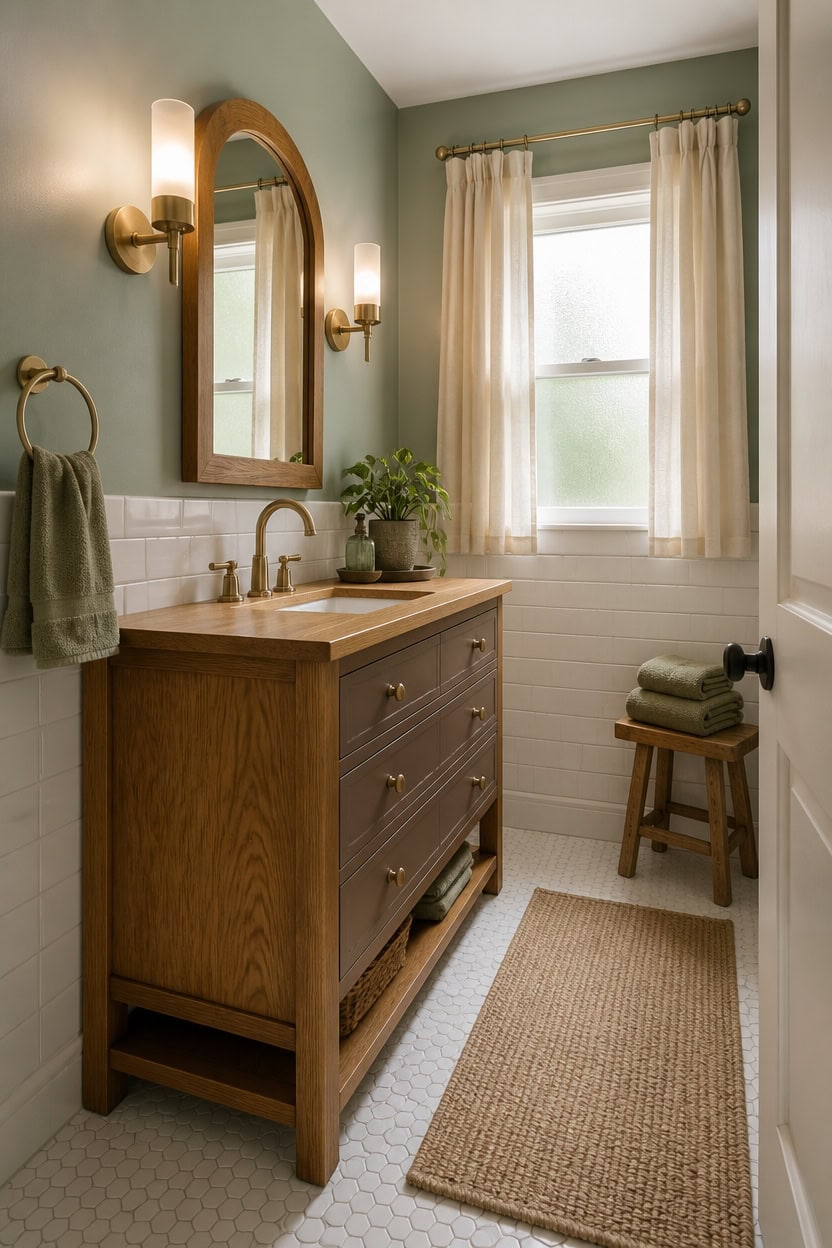
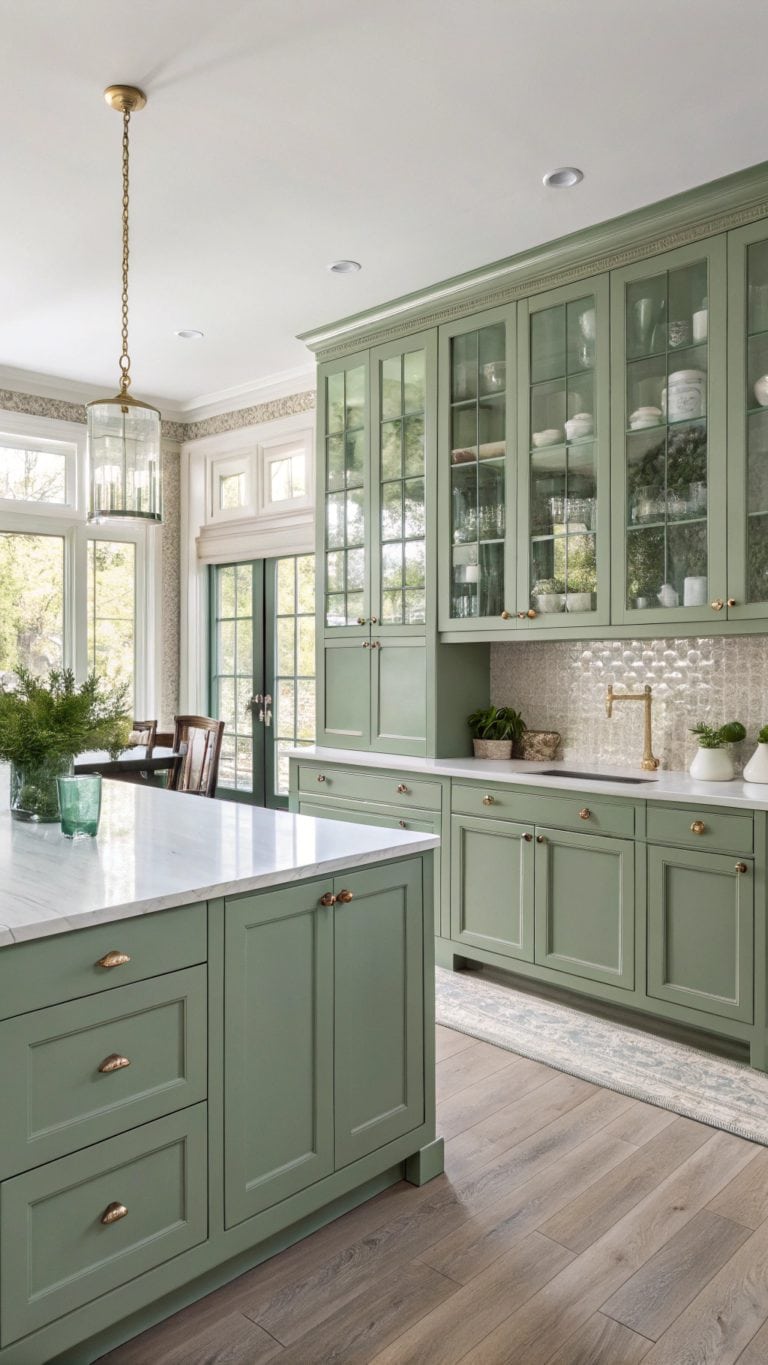
A 70/30 ratio keeps sage green as the backdrop while oak-toned wood grounds the room with warmth. Oak’s amber pull sits opposite sage green’s blue-gray cast on the color wheel, which is why the wood’s warmth offsets the paint rather than fighting it. Paint the walls in a light sage such as “Antique Jade,” then let a stained oak vanity or shelf carry the counterbalancing warm tone.
Balance the ratio: Keep sage green on the walls and let oak pieces like the vanity or a shelf supply the warm counterweight.
Match wood grain: Choose oak with visible grain, since flat-toned wood looks plastic against painted walls.
Add metal warmth: Brass or brushed gold fixtures bridge the gap between sage’s coolness and oak’s warmth.
Limit oak features: Cap warm wood accents at two or three pieces so the sage tone stays the focus.
a soft, grayed sage that keeps the room calm without reading dark. [light]
a warm oak-toned brown that grounds the sage walls with earthy contrast. [mid-tone]
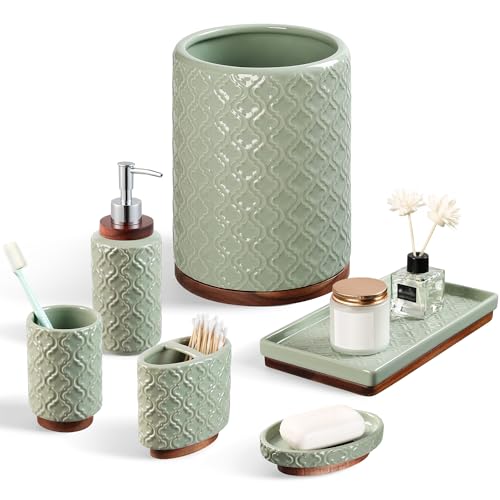 RQYIXI Ceramic Bathroom Accessories Set,Sage Green,6 Piece,with Trash Can
View Price
RQYIXI Ceramic Bathroom Accessories Set,Sage Green,6 Piece,with Trash Can
View Price
 Trygoal 40" Bathroom Vanity with Ceramic Sink, Freestanding Bathroom Vanity with 2-Soft-Close Door, Soft-Closing Hinges & Hidden Handles for Home, Farmhouse, Easy to Clean Design, Imitative Oak
View Price
Trygoal 40" Bathroom Vanity with Ceramic Sink, Freestanding Bathroom Vanity with 2-Soft-Close Door, Soft-Closing Hinges & Hidden Handles for Home, Farmhouse, Easy to Clean Design, Imitative Oak
View Price
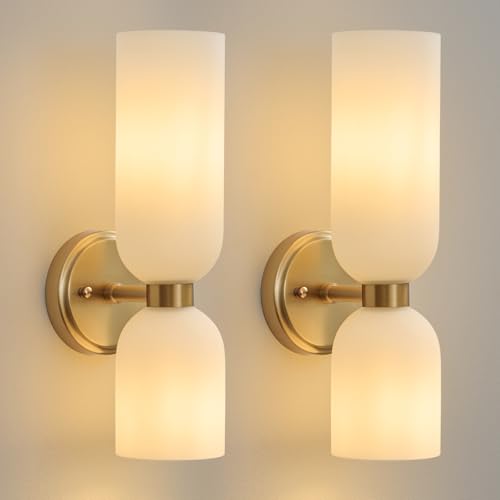 Mid Century Bathroom Wall Sconce: Set of 2 Gold Brass Milk Glass Decor
View Price
Mid Century Bathroom Wall Sconce: Set of 2 Gold Brass Milk Glass Decor
View Price
 24"x36" Arch Wall Mirror for Wall, Wall Mounted Vanity Mirror for Bedroom, Wood Grain Finish Frame Mirror with Tempered Glass, Vintage Decorative for Bathroom, Entryway, Living Room, Walnut
View Price
24"x36" Arch Wall Mirror for Wall, Wall Mounted Vanity Mirror for Bedroom, Wood Grain Finish Frame Mirror with Tempered Glass, Vintage Decorative for Bathroom, Entryway, Living Room, Walnut
View Price
 Modern Threads 6 Piece Bath Towel Set – Bathroom Set with 2 Bath Towels, 2 Hand Towels, and 2 Wash Cloths – 100% Cotton, Super Absorbent & Extra Soft – Reversible Botanical Vine (Sage Green)
View Price
Modern Threads 6 Piece Bath Towel Set – Bathroom Set with 2 Bath Towels, 2 Hand Towels, and 2 Wash Cloths – 100% Cotton, Super Absorbent & Extra Soft – Reversible Botanical Vine (Sage Green)
View Price
 Youeon 9 Inch Small Wooden Step Stool, Non-Slip One Step Stool for Adults, Holds up to 300 Lbs, Portable & Sturdy, Footstool for Bedroom, Bathroom, Kitchen, Easy to Assemble
View Price
Youeon 9 Inch Small Wooden Step Stool, Non-Slip One Step Stool for Adults, Holds up to 300 Lbs, Portable & Sturdy, Footstool for Bedroom, Bathroom, Kitchen, Easy to Assemble
View Price
 TYUU Waffle Bath Mat, Boho Bathroom Rugs Non Slip Washable, 30x20 Khaki
View Price
TYUU Waffle Bath Mat, Boho Bathroom Rugs Non Slip Washable, 30x20 Khaki
View Price
 Haturi Glass Bathroom Accessories Set, Sage Green Bathroom Set, 4 Pcs
View Price
Haturi Glass Bathroom Accessories Set, Sage Green Bathroom Set, 4 Pcs
View Price
Our Favorite Shower Curtains
 Basics by Wayfair Microban PEVA Shower Curtain Liner
View Price
Basics by Wayfair Microban PEVA Shower Curtain Liner
View Price
 Basics by Wayfair 70" Shower Liner
View Price
Basics by Wayfair 70" Shower Liner
View Price
 Falko Shower Curtain Liner with Weighted Hem
View Price
Falko Shower Curtain Liner with Weighted Hem
View Price
 Erie Floral Single Shower Curtain
View Price
Erie Floral Single Shower Curtain
View Price
 Strayer Polyester Floral Shower Curtain
View Price
Strayer Polyester Floral Shower Curtain
View Price
 Chanelle Floral Shower Curtain
View Price
Chanelle Floral Shower Curtain
View Price
 Haskell Boho Bouquet Shower Curtain by Laural Home
View Price
Haskell Boho Bouquet Shower Curtain by Laural Home
View Price
 Abstract Shower Curtain No Borders by PI Creative Art
View Price
Abstract Shower Curtain No Borders by PI Creative Art
View Price
 Strayer Polyester Abstract Marble Shower Curtain
View Price
Strayer Polyester Abstract Marble Shower Curtain
View Price
 Brookhurst Cotton Blend Geometric Shower Curtain
View Price
Brookhurst Cotton Blend Geometric Shower Curtain
View Price
 Enciso Striped Shower Curtain
View Price
Enciso Striped Shower Curtain
View Price
 Maurine Stripes Single Shower Curtain
View Price
Maurine Stripes Single Shower Curtain
View Price
 Ramjani Waffle Weave Shower Curtain with Snap-In Liner
View Price
Ramjani Waffle Weave Shower Curtain with Snap-In Liner
View Price
 Linen Textured Shower Curtain and Hooks Set
View Price
Linen Textured Shower Curtain and Hooks Set
View Price
 Cotton Blend Honeycomb Waffle Shower Curtain with Snap-In Liner
View Price
Cotton Blend Honeycomb Waffle Shower Curtain with Snap-In Liner
View Price
Sage Green vs Other Popular Bathroom Colors
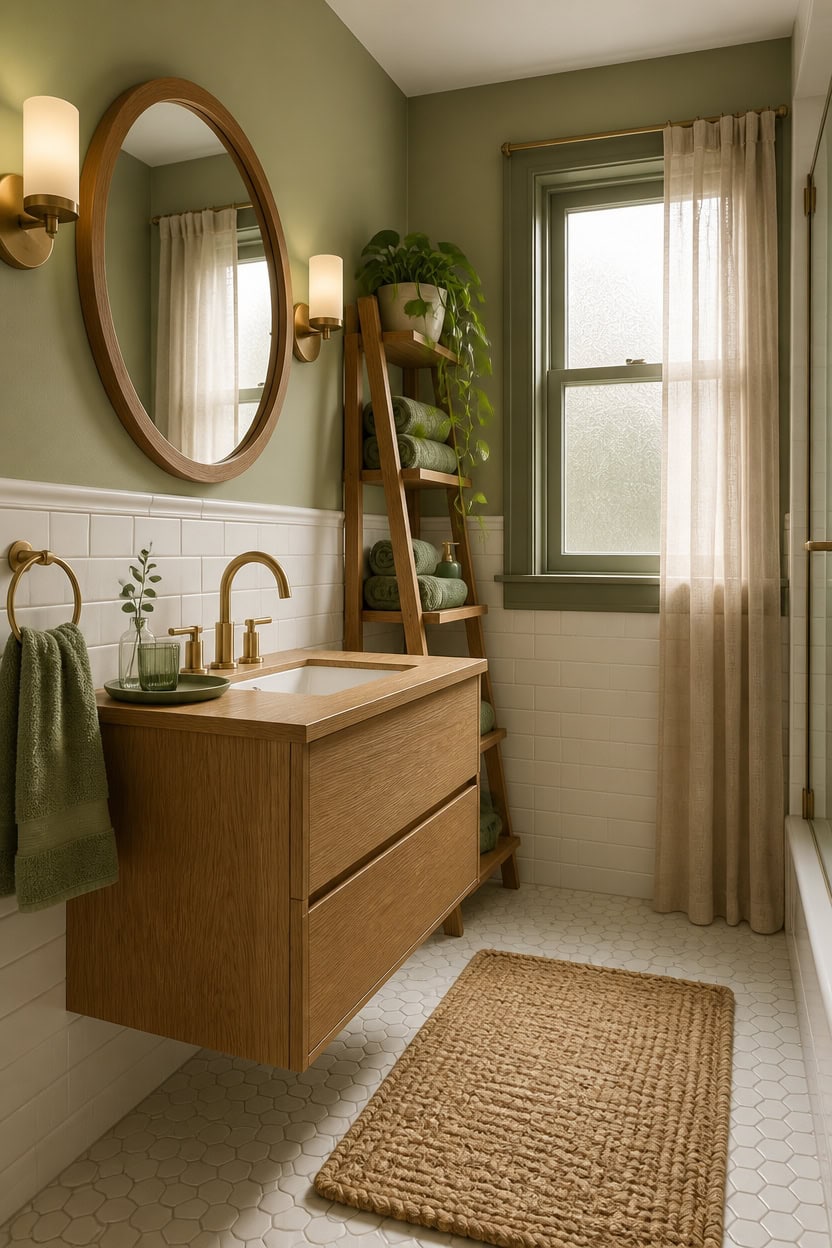
Sage green out-performs cool gray and stark white in small bathrooms because its yellow undertone keeps rooms feeling warm under both daylight and vanity bulbs. Blue-based grays and true blacks can turn a windowless bath sterile, while sage holds steady warmth no matter the light source. Paint the main wall in “Misted Fern” for a shade that reads calm without drifting toward mint or olive.
Gray reads cold: Swap flat gray tile or paint for sage green to add warmth without losing a neutral base.
Blue feels clinical: Choose sage over navy or slate blue for a softer look that avoids a sterile, spa-clinic feel.
Beige looks dated: Replace plain tan walls with sage green plus oak accents for a more current palette.
Pink skews juvenile: Use sage green instead of pastel pink to keep the room feeling grounded and adult.
a balanced sage that stays warm instead of reading minty or gray. [mid-tone]
a soft oak-toned neutral that echoes the wood accents without repeating the wall color. [light]
 InnJoey Bathroom Set, 10PC Bathroom Accessory Set, Sage Green Bathroom Accessories, Sage Green Bathroom Set with Trash Can, Soap Dispensers
View Price
InnJoey Bathroom Set, 10PC Bathroom Accessory Set, Sage Green Bathroom Accessories, Sage Green Bathroom Set with Trash Can, Soap Dispensers
View Price
 Abruzzo 60 in Single Sink Floating Bathroom Vanity, Natural Oak
View Price
Abruzzo 60 in Single Sink Floating Bathroom Vanity, Natural Oak
View Price
 A1A9 3-Light Bathroom Vanity Light, Modern Brushed Gold Wall Lights with Clear Glass Shades, Bathroom Wall Sconce Lamp for Mirror Living Room Bedroom Hallway
View Price
A1A9 3-Light Bathroom Vanity Light, Modern Brushed Gold Wall Lights with Clear Glass Shades, Bathroom Wall Sconce Lamp for Mirror Living Room Bedroom Hallway
View Price
 WallBeyond Round Wood Mirror, 36" Round Modern Decoration Large Circle Wall Mirror for Bathroom Living Room Bedroom Entryway, Walnut
View Price
WallBeyond Round Wood Mirror, 36" Round Modern Decoration Large Circle Wall Mirror for Bathroom Living Room Bedroom Entryway, Walnut
View Price
 Madison Park Splendor Reversible 100% Cotton Bath Rug, 17 x 24, Natural
View Price
Madison Park Splendor Reversible 100% Cotton Bath Rug, 17 x 24, Natural
View Price
 2-Pack Green Hand Soap Dispenser with Gold Stainless Steel Pump, Refillable Glass Soap Dispenser for Bathroom, Vintage Kitchen Soap Dispenser for Liquid Hand Soap, Lotion, Body Wash (14 OZ)
View Price
2-Pack Green Hand Soap Dispenser with Gold Stainless Steel Pump, Refillable Glass Soap Dispenser for Bathroom, Vintage Kitchen Soap Dispenser for Liquid Hand Soap, Lotion, Body Wash (14 OZ)
View Price
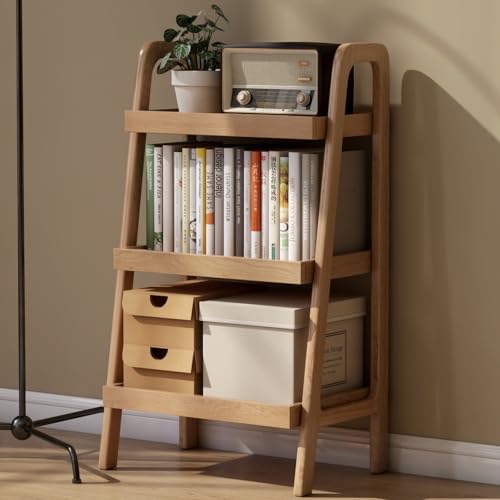 Small Bookshelf for Small Spaces, Oak Ladder Shelf, Solid Wood Bookcase
View Price
Small Bookshelf for Small Spaces, Oak Ladder Shelf, Solid Wood Bookcase
View Price
How to Choose the Right Sage Green Shade
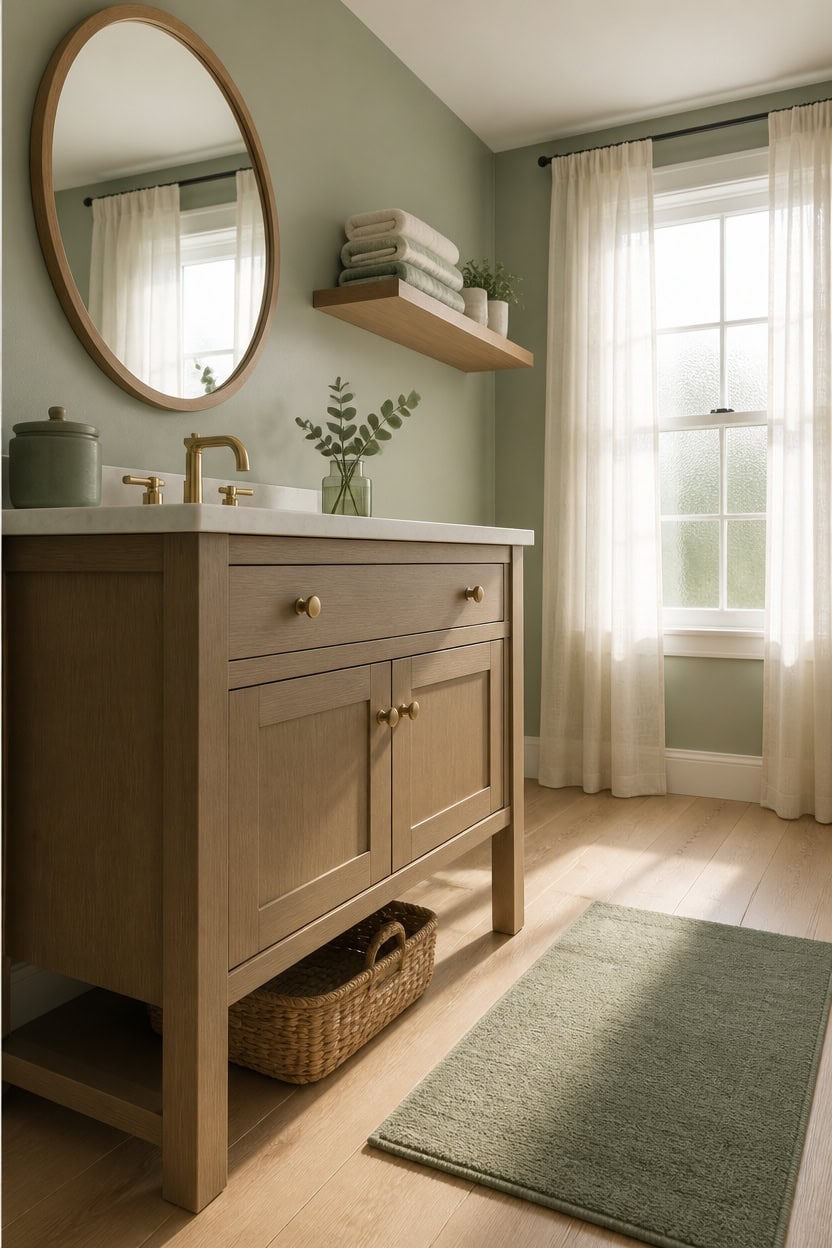
Choosing the correct sage tone starts with checking its undertone against your existing tile and hardware, since a green with too much gray can look faded next to warm oak. “Antique Jade” reads soft and balanced because its muted green sits close to true sage without tipping blue or yellow. Test a sample on the wall facing your main light source before committing to the full room.
Check undertones first: Hold the swatch next to natural light and vanity light to spot hidden gray or yellow shifts.
Match to oak warmth: Pick a sage with enough yellow base to sit comfortably next to golden oak tones.
Test at different times: Sage shifts from cool to warm as daylight changes, so view it morning and night.
Avoid high-saturation greens: A muted, grayed-down sage wears better long term than a bright, saturated version.
a muted, balanced sage that stays soft under both daylight and vanity light. [light]
a warm, oak-toned neutral that grounds the sage walls without competing. [mid-tone]
 TTU Tabletops Gallery Ceramic Canister Collection- Stoneware Designed Kitchen Storage Acacia Wood White Set, 3 Piece Green Leaf Canister Set
View Price
TTU Tabletops Gallery Ceramic Canister Collection- Stoneware Designed Kitchen Storage Acacia Wood White Set, 3 Piece Green Leaf Canister Set
View Price
 IFBUY 30 Inch Arched Bathroom Vanity with Sink, Fluted Design, Natural Oak
View Price
IFBUY 30 Inch Arched Bathroom Vanity with Sink, Fluted Design, Natural Oak
View Price
 Modern Threads 6 Piece Bath Towel Set – Bathroom Towel Set with 2 Bath Towels, 2 Hand Towels & 2 Washcloths – 100% Cotton, Soft & Absorbent – Classic Border Stripe (Green)
View Price
Modern Threads 6 Piece Bath Towel Set – Bathroom Towel Set with 2 Bath Towels, 2 Hand Towels & 2 Washcloths – 100% Cotton, Soft & Absorbent – Classic Border Stripe (Green)
View Price
 WallBeyond Round Mirror with Wood Frame, 28" Circle Modern Decoration Large Home Decor Mirror for Bathroom Living Room Bedroom Entryway (28" Diameter, Natural Wood)
View Price
WallBeyond Round Mirror with Wood Frame, 28" Circle Modern Decoration Large Home Decor Mirror for Bathroom Living Room Bedroom Entryway (28" Diameter, Natural Wood)
View Price
 4PCs Heavy Weight Decent Glass Bathroom Accessories Set with Decorative Pressed Pattern - Includes Hand Soap Dispenser & Tumbler & Soap Dish & Toothbrush Holder (Green)
View Price
4PCs Heavy Weight Decent Glass Bathroom Accessories Set with Decorative Pressed Pattern - Includes Hand Soap Dispenser & Tumbler & Soap Dish & Toothbrush Holder (Green)
View Price
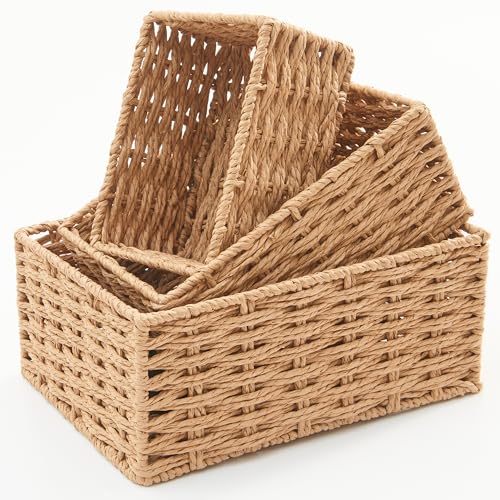 Small Wicker Basket for Organizing, Woven Storage Basket Sets of 3
View Price
Small Wicker Basket for Organizing, Woven Storage Basket Sets of 3
View Price
 Solid Wood Floating Shelves for Wall 30 Inches Long, Natural Wood Shelf
View Price
Solid Wood Floating Shelves for Wall 30 Inches Long, Natural Wood Shelf
View Price
Our Favorite Shower Caddies
 simplehuman Adjustable Hanging Shower Caddy
View Price
simplehuman Adjustable Hanging Shower Caddy
View Price
 Umbra Cubiko Hanging Shower Caddy
View Price
Umbra Cubiko Hanging Shower Caddy
View Price
 Stiefel Hanging Shower Caddy
View Price
Stiefel Hanging Shower Caddy
View Price
 simplehuman Tension Pole Shower Caddy
View Price
simplehuman Tension Pole Shower Caddy
View Price
 simplehuman 8' Tension Shower Caddy
View Price
simplehuman 8' Tension Shower Caddy
View Price
 Yamazaki Tower Free-Standing Shower Caddy
View Price
Yamazaki Tower Free-Standing Shower Caddy
View Price
 Livsey Adhesive Stainless Steel Shower Caddy
View Price
Livsey Adhesive Stainless Steel Shower Caddy
View Price
 Clara Clark Adhesive Stainless Steel Shower Caddy
View Price
Clara Clark Adhesive Stainless Steel Shower Caddy
View Price
 Bendeguz Adhesive Stainless Steel Shower Caddy
View Price
Bendeguz Adhesive Stainless Steel Shower Caddy
View Price
 Saraih Stainless Steel Tension Corner Shower Caddy
View Price
Saraih Stainless Steel Tension Corner Shower Caddy
View Price
 simplehuman Corner Shower Caddy
View Price
simplehuman Corner Shower Caddy
View Price
 Wall-Mounted Stainless Steel Corner Shower Basket
View Price
Wall-Mounted Stainless Steel Corner Shower Basket
View Price
 Aquala Extendable Bathtub Caddy Tray
View Price
Aquala Extendable Bathtub Caddy Tray
View Price
How to Choose the Right Oak Finish
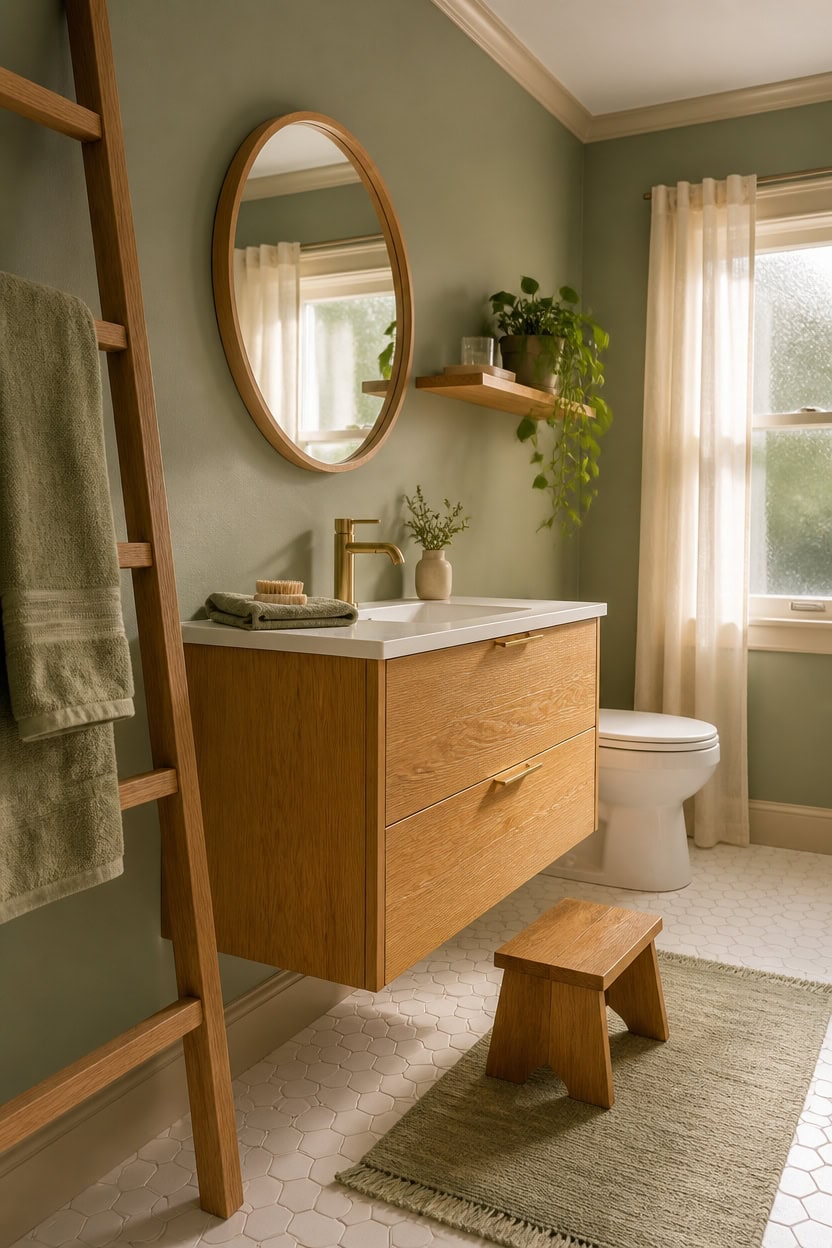
Oak finish choice depends on matching the wood’s warmth to your fixture metal and wall color. Golden and honey oak tones carry yellow undertones that sit well against sage green walls like “Misted Fern” (482), keeping the room warm instead of cold. Test an oak sample against the wall swatch and faucet finish before buying the full vanity.
Match warmth to metal: Pair honey oak with brass or gold fixtures, and gray-toned oak with chrome or nickel.
Check grain visibility: Choose a finish that shows grain clearly if you want a natural, textured look.
Test under vanity light: Oak can shift color under warm bulbs, so check swatches under your actual lighting.
Consider sheen level: A satin or matte finish hides water spots better than a high-gloss oak surface.
a muted sage that keeps golden oak tones from reading too yellow. [mid-tone]
a warm, oak-toned neutral that links the woodwork and walls together. [mid-tone]
 Modway Render Vanity Floor, 24 Inch, Oak/White Sink
View Price
Modway Render Vanity Floor, 24 Inch, Oak/White Sink
View Price
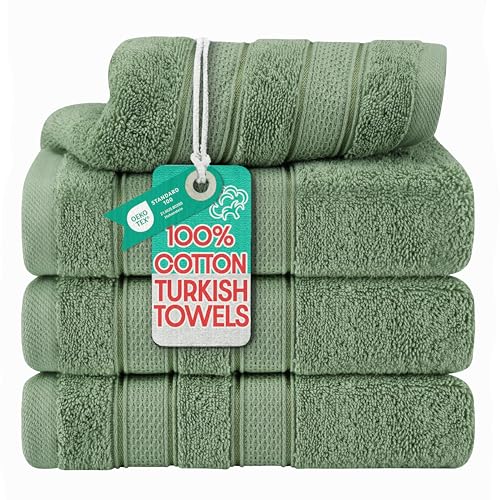 American Soft Linen Salem 100% Cotton Turkish 4 Piece Hand Towels for Bathroom, 600 GSM Soft Absorbent Quickdry Hand Face Towel Set, Sage Green
View Price
American Soft Linen Salem 100% Cotton Turkish 4 Piece Hand Towels for Bathroom, 600 GSM Soft Absorbent Quickdry Hand Face Towel Set, Sage Green
View Price
 Standing Towel Rack for Bathroom, 39.4''H Bamboo Blanket Racks with Shelf
View Price
Standing Towel Rack for Bathroom, 39.4''H Bamboo Blanket Racks with Shelf
View Price
 Madison Park Sanctuary 100% Cotton Non-Slip Bath Rug for Bathroom, Bedroom & Entryway, 17x24 Inch Low-Profile Soft Absorbent Woven Bathroom Rug, Machine Washable, Sage Green
View Price
Madison Park Sanctuary 100% Cotton Non-Slip Bath Rug for Bathroom, Bedroom & Entryway, 17x24 Inch Low-Profile Soft Absorbent Woven Bathroom Rug, Machine Washable, Sage Green
View Price
 BEE&OAK 13.4 Inch Heavy Duty Wooden Step Stools for Adults - Non Slip, 300 LBS Capacity, Easy Assembly - Ideal Step Stool for High Beds, Kitchen, Bathroom, Office, Garden (Natural)
View Price
BEE&OAK 13.4 Inch Heavy Duty Wooden Step Stools for Adults - Non Slip, 300 LBS Capacity, Easy Assembly - Ideal Step Stool for High Beds, Kitchen, Bathroom, Office, Garden (Natural)
View Price
Our Favorite Bath Towels
 Renata 8-Piece 800 GSM Egyptian Cotton Towel Set
View Price
Renata 8-Piece 800 GSM Egyptian Cotton Towel Set
View Price
 Darcelle 100% Cotton Premium Turkish 6-Piece Bath Towel Set
View Price
Darcelle 100% Cotton Premium Turkish 6-Piece Bath Towel Set
View Price
 Scotia Egyptian Cotton Bath Towel Set
View Price
Scotia Egyptian Cotton Bath Towel Set
View Price
 Edison Turkish Cotton Quick-Drying Hand Towels
View Price
Edison Turkish Cotton Quick-Drying Hand Towels
View Price
 Hannu 450 GSM Sustainable Cotton Hand Towel Set
View Price
Hannu 450 GSM Sustainable Cotton Hand Towel Set
View Price
 Renata 800 GSM Egyptian Cotton Luxury Hand Towels
View Price
Renata 800 GSM Egyptian Cotton Luxury Hand Towels
View Price
 Renata 800 GSM Egyptian Cotton Luxury Washcloths
View Price
Renata 800 GSM Egyptian Cotton Luxury Washcloths
View Price
 Basics by Wayfair Essential 100% Cotton Washcloth Set
View Price
Basics by Wayfair Essential 100% Cotton Washcloth Set
View Price
 Darcelle 100% Cotton 4-Piece Turkish Washcloth Set
View Price
Darcelle 100% Cotton 4-Piece Turkish Washcloth Set
View Price
 Fralick Ribbed Turkish Cotton Bath Sheet Set
View Price
Fralick Ribbed Turkish Cotton Bath Sheet Set
View Price
 Hannu 450 GSM Eco-Friendly Ringspun Cotton Bath Sheet
View Price
Hannu 450 GSM Eco-Friendly Ringspun Cotton Bath Sheet
View Price
 Darcelle 100% Cotton 35x70 Jumbo Bath Sheet
View Price
Darcelle 100% Cotton 35x70 Jumbo Bath Sheet
View Price
Sage Green Tile and Oak Vanity Pairings
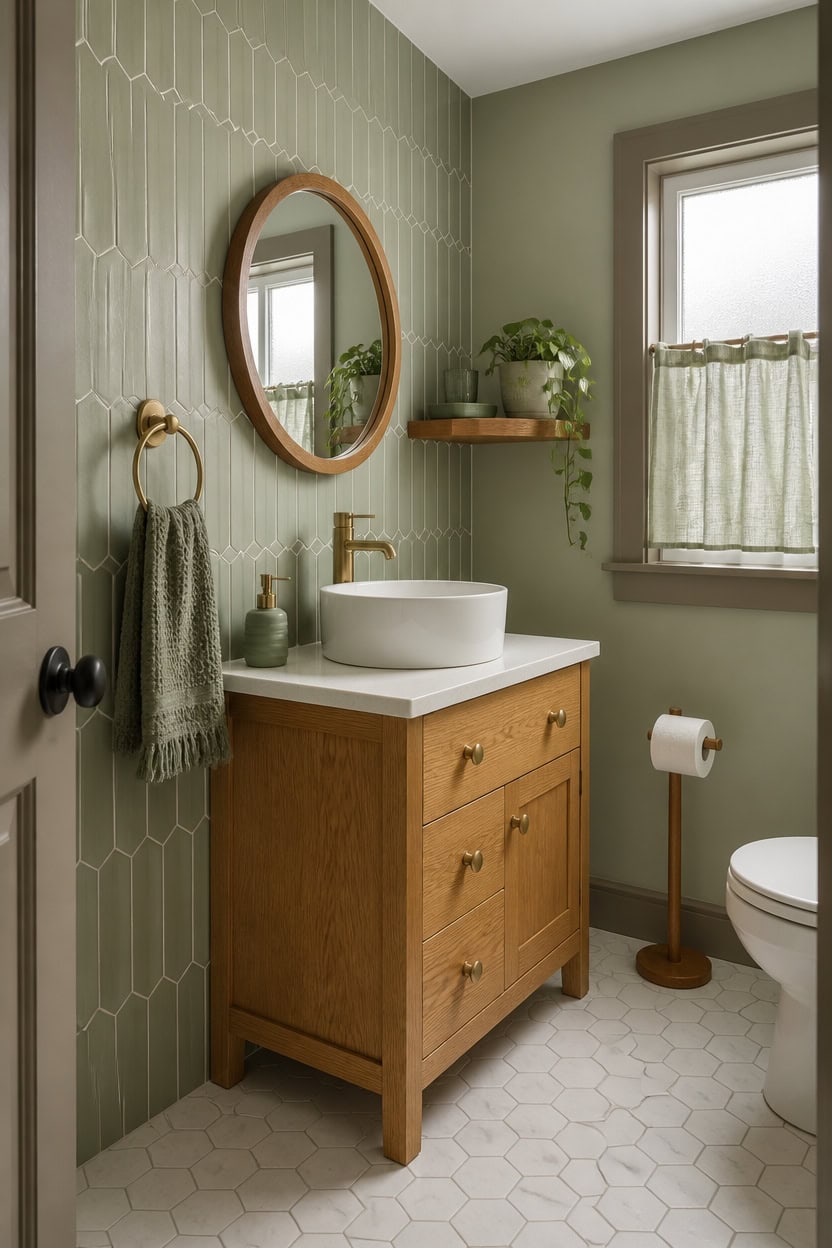
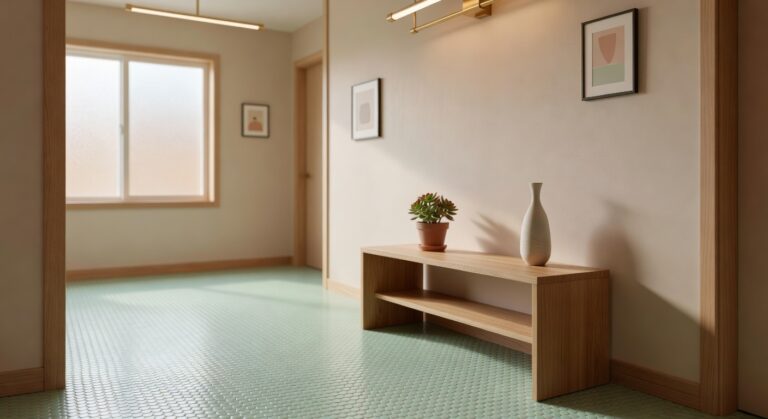
Choose a matte sage green tile, in a picket or subway shape, paired with a light oak vanity to balance cool and warm tones in a small bathroom. The tile’s muted green pulls warmth from the oak’s honey grain, so neither surface competes for attention. Paint the accent wall behind the vanity in “Tea Light” (471) to link the tile and wood without adding another pattern.
Match tile tone to grain: Choose a green tile with warm undertones so it doesn’t clash with the oak’s yellow cast.
Pick a low-sheen tile: Matte or honed tile finishes read as natural stone, softening the look next to wood grain.
Keep grout light: A pale grout keeps the sage tile from feeling too dark against a light oak vanity.
Balance scale: Use a smaller tile shape on walls if the vanity is large, so the room doesn’t feel busy.
a soft sage that echoes the tile without repeating it exactly. [light]
a warm neutral that pulls the oak vanity’s tones into the wall color. [mid-tone]
 Livelynine Waterproof Wallpaper Peel and Stick Contact Paper Sage Green 15.8x394 Mosaic Tile Bathroom Wallpaper Stick on Vinyl Wrap Self Adhesive Wall Paper Roll for Kitchen Backsplash Shower
View Price
Livelynine Waterproof Wallpaper Peel and Stick Contact Paper Sage Green 15.8x394 Mosaic Tile Bathroom Wallpaper Stick on Vinyl Wrap Self Adhesive Wall Paper Roll for Kitchen Backsplash Shower
View Price
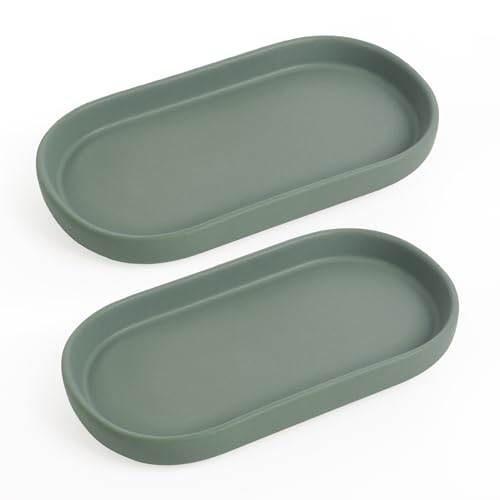 INGOFIN 7" Ceramic Bathroom Vanity Tray Set- 2 Pcs Bathroom Organizer Countertop Tray for Perfume, Jewelry, Small Kitchen Counter Soap Tray, Decorative for Bathroom Vanity and Toilet Tank, Green
View Price
INGOFIN 7" Ceramic Bathroom Vanity Tray Set- 2 Pcs Bathroom Organizer Countertop Tray for Perfume, Jewelry, Small Kitchen Counter Soap Tray, Decorative for Bathroom Vanity and Toilet Tank, Green
View Price
 LVMU Round Oak Woodgrain Frame Wall Mirror 20 Inch Rustic Farmhouse
View Price
LVMU Round Oak Woodgrain Frame Wall Mirror 20 Inch Rustic Farmhouse
View Price
 HomeBurg Luxe 6-Piece Hand Towel Set – Soft & Absorbent Cotton, Hotel Quality, Quick-Drying, Easy Care, 16 x 28 in (Sage Green)
View Price
HomeBurg Luxe 6-Piece Hand Towel Set – Soft & Absorbent Cotton, Hotel Quality, Quick-Drying, Easy Care, 16 x 28 in (Sage Green)
View Price
 Green Bathroom Accessories 5 Pcs, Glass Bathroom Accessory Set, Vintage Green Bathroom Set, Sage Green Soap Dispenser and Toothbrush Holder Set, Qtip Holder, Small Flower Vase, Modern Bathroom Decor
View Price
Green Bathroom Accessories 5 Pcs, Glass Bathroom Accessory Set, Vintage Green Bathroom Set, Sage Green Soap Dispenser and Toothbrush Holder Set, Qtip Holder, Small Flower Vase, Modern Bathroom Decor
View Price
 Wealone 4-in-1 Bamboo Toilet Paper Holder Stand with Storage Shelf Box
View Price
Wealone 4-in-1 Bamboo Toilet Paper Holder Stand with Storage Shelf Box
View Price
Our Favorite Bathroom Shelves
 Wickes 3-Piece Floating Shelf Set
View Price
Wickes 3-Piece Floating Shelf Set
View Price
 Taylorsville Asymmetrical Floating Shelves
View Price
Taylorsville Asymmetrical Floating Shelves
View Price
 2-Piece Solid Wood Rectangle Floating Shelf
View Price
2-Piece Solid Wood Rectangle Floating Shelf
View Price
 Saveliy 5-Tier Corner Wall Shelf
View Price
Saveliy 5-Tier Corner Wall Shelf
View Price
 Bonnay 3-Tier Industrial Pipe Wall Shelf
View Price
Bonnay 3-Tier Industrial Pipe Wall Shelf
View Price
 Brakebill 5-Tier Wall Shelf
View Price
Brakebill 5-Tier Wall Shelf
View Price
 Intersecting Cube Accent Wall Shelf
View Price
Intersecting Cube Accent Wall Shelf
View Price
 Aberdeen 3-Piece Circle Solid Wood Wall Shelf
View Price
Aberdeen 3-Piece Circle Solid Wood Wall Shelf
View Price
 Jimeny Rectangular Metal Wall Shelf
View Price
Jimeny Rectangular Metal Wall Shelf
View Price
 Deans 2-Piece Tiered Shelf with Towel Bar
View Price
Deans 2-Piece Tiered Shelf with Towel Bar
View Price
 Delta Cassidy 18" Glass Shelf with Towel Bar
View Price
Delta Cassidy 18" Glass Shelf with Towel Bar
View Price
Sage Green Paint and Oak Flooring Combinations
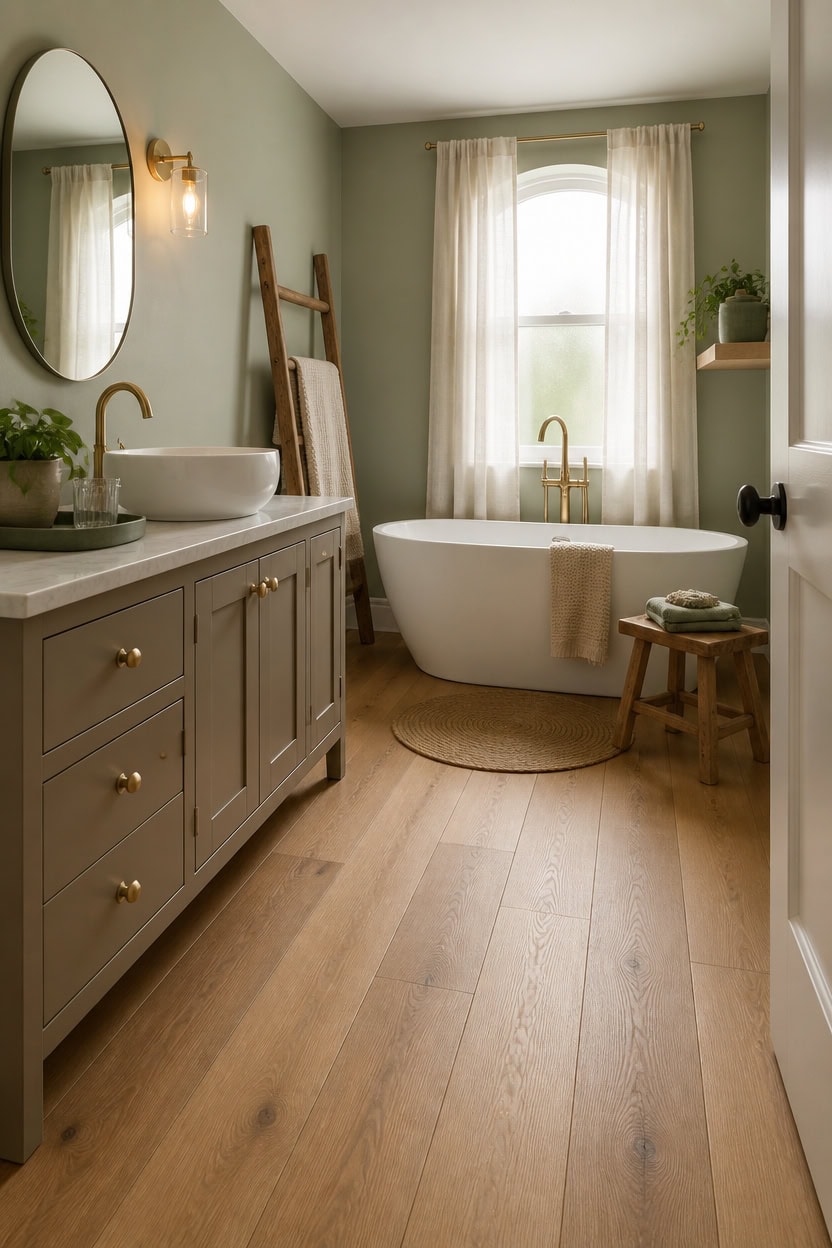
Paint the walls in “Antique Jade” (465), a soft sage green with a gray cast, then let honey-toned oak flooring anchor the room from below. The gray undertone in the paint keeps the green from turning minty next to oak’s warm yellow tones. Keep the flooring’s finish matte or satin so light doesn’t bounce unevenly across the wood grain.
Match paint tone to floor undertone: Choose a green with a warm gray base so it doesn’t fight oak’s yellow cast.
Let flooring carry the neutral: Oak planks ground the room while the wall color does the work of adding tone.
Test in natural light: Sage green shifts warmer or cooler through the day, so sample paint near the floor.
Keep trim white: A white trim separates the wall color from the flooring without adding competition.
a muted sage green that echoes the flooring’s cool undertone without matching it exactly. [light]
a warm neutral that pulls the oak flooring’s honey tones into the cabinetry. [mid-tone]
 Bath Mat for Luxury Shower - Non-Slip Bamboo Sturdy Water Proof Bathroom Carpet for Indoor or Outdoor Use
View Price
Bath Mat for Luxury Shower - Non-Slip Bamboo Sturdy Water Proof Bathroom Carpet for Indoor or Outdoor Use
View Price
 DII Kitchen Accessories Collection, Textured Matte Ceramic Canister Set, Sage, Dimple, 2 Piece
View Price
DII Kitchen Accessories Collection, Textured Matte Ceramic Canister Set, Sage, Dimple, 2 Piece
View Price
 Jowels Sage Green Linen Fabric Shower Curtains for Bathroom, 72x72
View Price
Jowels Sage Green Linen Fabric Shower Curtains for Bathroom, 72x72
View Price
 CONSDAN 9-Inch Round Step Stool for Adults & Kids, USA Grown Solid Oak Hardwood, Sturdy Small Foot Stool for Kitchen, Bedroom, Bathroom, Shoe Changing, Plant Stand, Fully Assembled (Natural)
View Price
CONSDAN 9-Inch Round Step Stool for Adults & Kids, USA Grown Solid Oak Hardwood, Sturdy Small Foot Stool for Kitchen, Bedroom, Bathroom, Shoe Changing, Plant Stand, Fully Assembled (Natural)
View Price
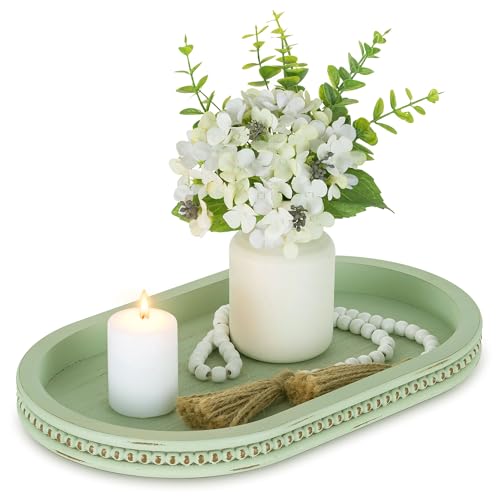 Hanobe 15" Sage Green Decorative Trays for Coffee Table Decor, Beaded Edge
View Price
Hanobe 15" Sage Green Decorative Trays for Coffee Table Decor, Beaded Edge
View Price
 46" Extra Large Freestanding Towel Rack Stand for Bathroom, 3 Tier
View Price
46" Extra Large Freestanding Towel Rack Stand for Bathroom, 3 Tier
View Price
Our Favorite Towel Bars
 Moen Align 24" Wall Mounted Towel Bar
View Price
Moen Align 24" Wall Mounted Towel Bar
View Price
 Delta Trinsic Wall Mount Towel Bar
View Price
Delta Trinsic Wall Mount Towel Bar
View Price
 AngleSimple 23.75" Stainless Steel Towel Bar
View Price
AngleSimple 23.75" Stainless Steel Towel Bar
View Price
 Moen Align 9" Modern Hand Towel Bar
View Price
Moen Align 9" Modern Hand Towel Bar
View Price
 Moen Triva 9" Wall Mounted Towel Bar
View Price
Moen Triva 9" Wall Mounted Towel Bar
View Price
 Moen Align 18" Wall Mounted Towel Bar
View Price
Moen Align 18" Wall Mounted Towel Bar
View Price
 Moen Brantford 24" Wall Mounted Towel Bar
View Price
Moen Brantford 24" Wall Mounted Towel Bar
View Price
 Moen Preston 24" Wall Mounted Towel Bar
View Price
Moen Preston 24" Wall Mounted Towel Bar
View Price
 Delta Cassidy 24" Wall Mounted Towel Bar
View Price
Delta Cassidy 24" Wall Mounted Towel Bar
View Price
 Kohler Alteo Wall Mounted Towel Bar
View Price
Kohler Alteo Wall Mounted Towel Bar
View Price
 Moen Genta LX 24" Wall Mounted Towel Bar
View Price
Moen Genta LX 24" Wall Mounted Towel Bar
View Price
 Kohler Elate Wall Mounted Round Towel Bar
View Price
Kohler Elate Wall Mounted Round Towel Bar
View Price
 Delta Trinsic 24" Double Wall Mount Towel Bar
View Price
Delta Trinsic 24" Double Wall Mount Towel Bar
View Price
 Moen Wynford Double 24" Wall Mounted Towel Bar
View Price
Moen Wynford Double 24" Wall Mounted Towel Bar
View Price
Best Hardware Finishes for Sage Green and Oak Bathrooms
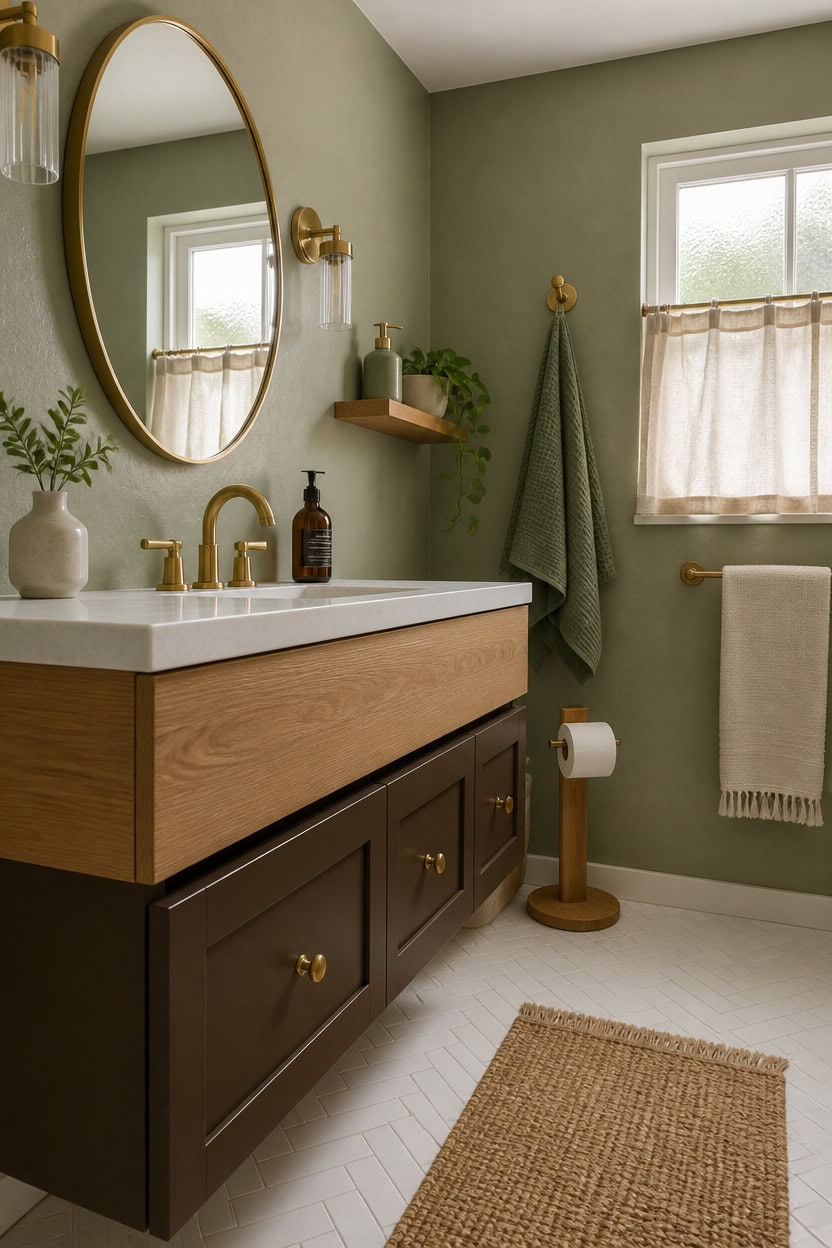
Hardware finishes carry more weight than people expect in a sage green and oak bathroom, since metal tones either bridge the two materials or compete with them. Warm finishes like brushed brass or matte gold pick up oak’s honey undertones and keep the space from feeling cold. Cooler finishes like matte black or brushed nickel work too, but only if you repeat that same finish on every fixture so the room reads as intentional rather than mismatched.
Pick one metal family: Choose brass, black, or nickel and use it on faucets, hooks, and towel bars for consistency.
Warm metals suit oak: Brushed brass and matte gold pull out the honey tones already in the flooring.
Cool metals need contrast: Matte black or nickel reads best against a lighter sage rather than a deep forest green.
Match mirror frame to fixtures: A mirror frame in the same finish as the faucet ties the wall and vanity together visually.
a lighter sage that lets warm hardware finishes stand out without competing. [mid-tone]
a deep, oak-toned brown that grounds the room and pairs naturally with brass or black hardware. [dark]
 Delta Arvo Brushed Gold Bathroom Faucet 1 Hole, Single Hole Bathroom Sink Faucet for Vanity, Push-Pop Drain Assembly, Champagne Bronze 15840LF-CZ
View Price
Delta Arvo Brushed Gold Bathroom Faucet 1 Hole, Single Hole Bathroom Sink Faucet for Vanity, Push-Pop Drain Assembly, Champagne Bronze 15840LF-CZ
View Price
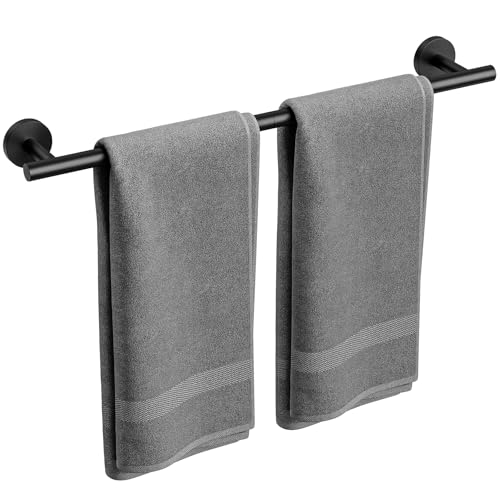 Matte Black Towel Bar, 24 Inch Bathroom Towel Rack, Modern Bathroom Decor
View Price
Matte Black Towel Bar, 24 Inch Bathroom Towel Rack, Modern Bathroom Decor
View Price
 Winnker Round Mirror 30 inch Gold, Circle Mirror, Brushed Gold Metal Frame
View Price
Winnker Round Mirror 30 inch Gold, Circle Mirror, Brushed Gold Metal Frame
View Price
 Unlacquered Solid Brass Wall Hooks Set of 2, Antique Brass Coat Hooks Wall Mount for Entryway, Bathroom & Kitchen, Gold Brass Towel Hook for Towels, Robes, Hats & Bags, Handcrafted Heavy Duty
View Price
Unlacquered Solid Brass Wall Hooks Set of 2, Antique Brass Coat Hooks Wall Mount for Entryway, Bathroom & Kitchen, Gold Brass Towel Hook for Towels, Robes, Hats & Bags, Handcrafted Heavy Duty
View Price
 BosilunLife Dish Soap Dispenser - Sage Green Ceramic Kitchen Soap Dispenser with Sponge Holder Matte Ceramic Soap Daddy Dispenser 20oz for Kitchen Soap Pump and Sponges Caddy
View Price
BosilunLife Dish Soap Dispenser - Sage Green Ceramic Kitchen Soap Dispenser with Sponge Holder Matte Ceramic Soap Daddy Dispenser 20oz for Kitchen Soap Pump and Sponges Caddy
View Price
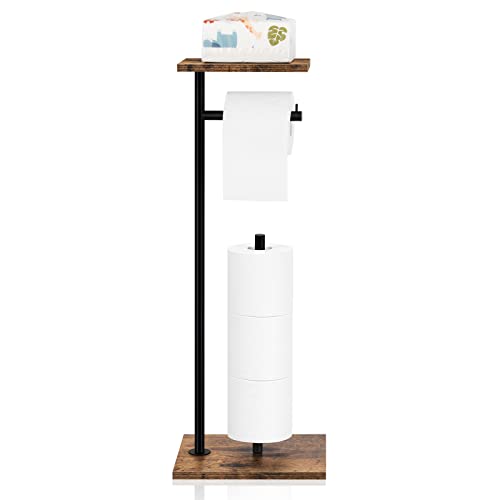 Toilet Paper Holder Stand with Shelf Toilet Paper Roll Holder with Reserve Free Standing TP Holder Rustic Toilet Paper Stand with Shelf for Bathroom Holds Wipe, Mobile Phone, Mega Rolls, Rustic Brown
View Price
Toilet Paper Holder Stand with Shelf Toilet Paper Roll Holder with Reserve Free Standing TP Holder Rustic Toilet Paper Stand with Shelf for Bathroom Holds Wipe, Mobile Phone, Mega Rolls, Rustic Brown
View Price
Our Favorite Bathroom Wall Art
 "Bathroom" Textual Art Print
View Price
"Bathroom" Textual Art Print
View Price
 "My Aim Is To Keep This Bathroom Clean" Print on Wood
View Price
"My Aim Is To Keep This Bathroom Clean" Print on Wood
View Price
 "Bathroom Rules" Wrapped Canvas Textual Art
View Price
"Bathroom Rules" Wrapped Canvas Textual Art
View Price
 Mallon "Love Embracing" by Rikki Drotar Print
View Price
Mallon "Love Embracing" by Rikki Drotar Print
View Price
 Luxury Bath "Bain De Luxe III" by Daphne Brissonnet
View Price
Luxury Bath "Bain De Luxe III" by Daphne Brissonnet
View Price
 Donkey Green Tub White Print
View Price
Donkey Green Tub White Print
View Price
 "Wash Your Paws" by Marla Rae Wrapped Canvas
View Price
"Wash Your Paws" by Marla Rae Wrapped Canvas
View Price
 Stupell Country Washroom Still Life Stretched Canvas
View Price
Stupell Country Washroom Still Life Stretched Canvas
View Price
 "Brady Wash Your Hands" by Jennifer Pugh Print on Wood
View Price
"Brady Wash Your Hands" by Jennifer Pugh Print on Wood
View Price
 Classic Bathroom Prints by Gregory Gorham 2-Piece Canvas Set
View Price
Classic Bathroom Prints by Gregory Gorham 2-Piece Canvas Set
View Price
 Stupell Chic Bathroom Interior 2-Piece Framed Art Set
View Price
Stupell Chic Bathroom Interior 2-Piece Framed Art Set
View Price
Small Bathroom Ideas for Sage Green and Oak Fans
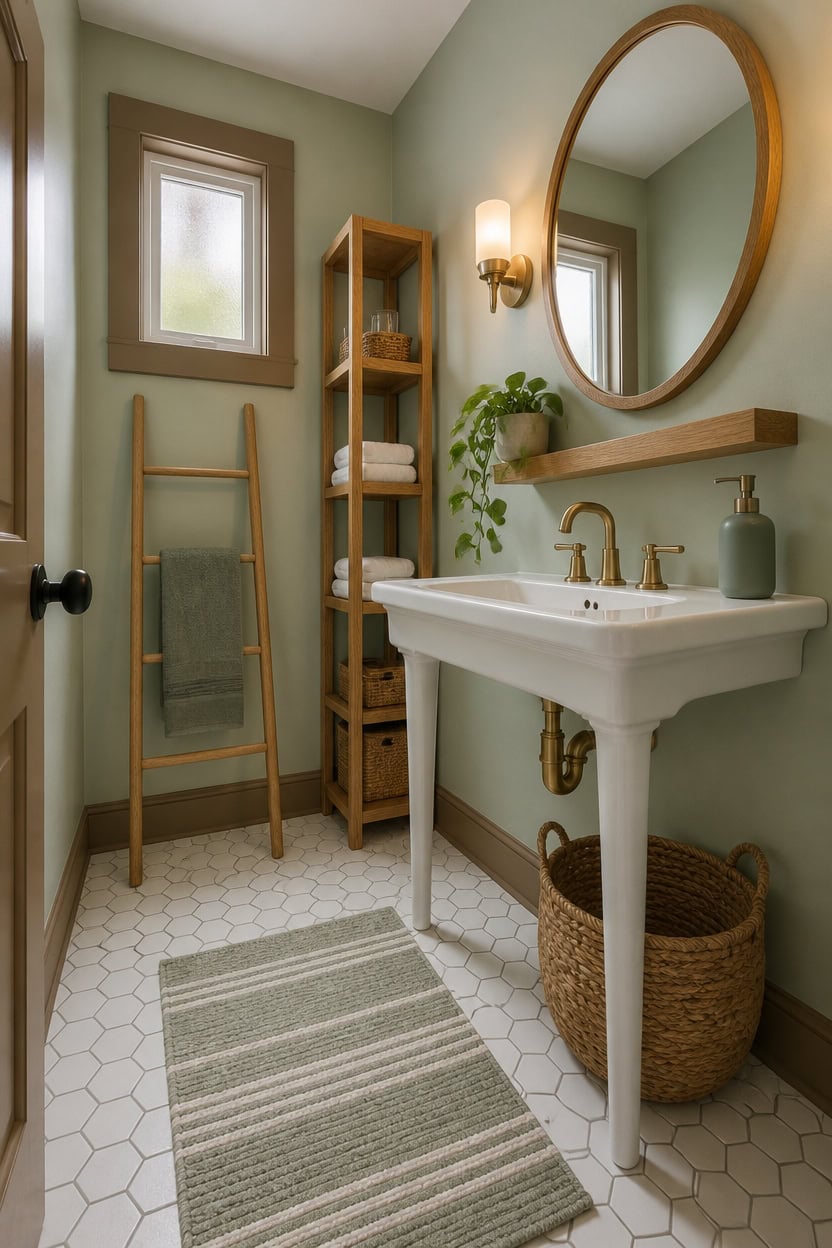
Small bathrooms benefit most from a two-tone strategy rather than a single flat color, since contrast between walls and trim creates depth without adding visual clutter. Painting trim in a warm oak tone against light sage walls tricks the eye into seeing more square footage than the room actually has. Keep flooring and larger fixtures pale so the eye travels upward instead of stopping at the floor.
Go vertical: Tall, narrow shelving units use wall space instead of floor space in a tight footprint.
Pick a compact vanity: A freestanding sink with open legs underneath reads lighter than a boxy cabinet.
Use one mirror, sized up: A single oversized mirror bounces more light than several small frames.
Keep textiles minimal: One or two sage accents avoid overwhelming a small palette of surfaces.
a soft, pale sage that keeps a compact room feeling open. [light]
a warm, honey-brown tone that echoes the oak accents without adding bulk. [mid-tone]
 ALBAD 16-Inch Modern Bathroom Vanity with Sink, Compact Bathroom Vanity Set with Storage, Freestanding Small Space Bath Cabinet, Single Sink Cabinet with Adjustable Shelf (White, 16 Inch)
View Price
ALBAD 16-Inch Modern Bathroom Vanity with Sink, Compact Bathroom Vanity Set with Storage, Freestanding Small Space Bath Cabinet, Single Sink Cabinet with Adjustable Shelf (White, 16 Inch)
View Price
 BAYKA Light Oak-Toned Floating Shelves 15.7in, Set of 3, Wall Mounted Shelf
View Price
BAYKA Light Oak-Toned Floating Shelves 15.7in, Set of 3, Wall Mounted Shelf
View Price
 Posprica Woven Storage Baskets for Organizing 6 Pack, Large&Small Storage Cube Bins Set for Bathroom, Storage Boxes Container for Drawer, Closet, Shelf, Dresser, Brown
View Price
Posprica Woven Storage Baskets for Organizing 6 Pack, Large&Small Storage Cube Bins Set for Bathroom, Storage Boxes Container for Drawer, Closet, Shelf, Dresser, Brown
View Price
 HOOBRO 3 Tier Ladder Shelf, Blanket Ladder, Bookcase Storage Rack Organizer, Bamboo Storage Shelf, Freestanding Shelving Unit, Farmhouse Ladder Rack for Living Room and Bedroom, Mocha MA123CJ01
View Price
HOOBRO 3 Tier Ladder Shelf, Blanket Ladder, Bookcase Storage Rack Organizer, Bamboo Storage Shelf, Freestanding Shelving Unit, Farmhouse Ladder Rack for Living Room and Bedroom, Mocha MA123CJ01
View Price
 Ceramic Soap Dispenser Green with Gold Pump,Simple Design Cylindrical Lotion Dispenser Bottle,Refillable Liquid Hand Soap Dispenser for Kitchen,Bathroom,Washroom
View Price
Ceramic Soap Dispenser Green with Gold Pump,Simple Design Cylindrical Lotion Dispenser Bottle,Refillable Liquid Hand Soap Dispenser for Kitchen,Bathroom,Washroom
View Price
 CozeCube Sage Green Striped 24"x16" Non Slip Washable Bath Mat
View Price
CozeCube Sage Green Striped 24"x16" Non Slip Washable Bath Mat
View Price
Our Favorite Wall Sconces
 Chrisitne 1-Light Dimmable Wall Sconce
View Price
Chrisitne 1-Light Dimmable Wall Sconce
View Price
 Rakhee Steel Flush Mounted Sconce
View Price
Rakhee Steel Flush Mounted Sconce
View Price
 Rooks 1-Light Dimmable Bath Sconce
View Price
Rooks 1-Light Dimmable Bath Sconce
View Price
 Jacoline 1-Light Dimmable Iron Armed Sconce
View Price
Jacoline 1-Light Dimmable Iron Armed Sconce
View Price
 Byers Steel Armed Sconce
View Price
Byers Steel Armed Sconce
View Price
 Wason 1-Light Dimmable Steel Armed Sconce
View Price
Wason 1-Light Dimmable Steel Armed Sconce
View Price
 Taunton 2-Light Dimmable Matte Black and Brushed Gold Sconce
View Price
Taunton 2-Light Dimmable Matte Black and Brushed Gold Sconce
View Price
 Dimmable Metal Wall Sconce with Petal Shaped Glass Shade
View Price
Dimmable Metal Wall Sconce with Petal Shaped Glass Shade
View Price
 Danthai Dimmable Wall Light
View Price
Danthai Dimmable Wall Light
View Price
 Rhem 1-Light Brass Armed Sconce
View Price
Rhem 1-Light Brass Armed Sconce
View Price
 Berlta 1-Light Dimmable Steel Armed Sconce
View Price
Berlta 1-Light Dimmable Steel Armed Sconce
View Price
 Hicklin 1-Light Dimmable Wall Sconce with Clear Glass Shade
View Price
Hicklin 1-Light Dimmable Wall Sconce with Clear Glass Shade
View Price
 Fayra Industrial Wall Sconce
View Price
Fayra Industrial Wall Sconce
View Price
 Abbiney 1-Light Hardwired Armed Sconce
View Price
Abbiney 1-Light Hardwired Armed Sconce
View Price
 Almine Dimmable Iron Armed Sconce with Glass Shade
View Price
Almine Dimmable Iron Armed Sconce with Glass Shade
View Price
 Kimberlee 1-Light Dimmable Armed Sconce
View Price
Kimberlee 1-Light Dimmable Armed Sconce
View Price
 Juliann 1-Light Dimmable Steel Wall Sconce with Striped Glass Shade
View Price
Juliann 1-Light Dimmable Steel Wall Sconce with Striped Glass Shade
View Price
 Elyse 17.5" 2-Light Dimmable Armed Sconce
View Price
Elyse 17.5" 2-Light Dimmable Armed Sconce
View Price
 Avoca 1-Light Dimmable Armed Sconce
View Price
Avoca 1-Light Dimmable Armed Sconce
View Price
 Scalloped Steel and Fabric Shade Recessed Wall Light
View Price
Scalloped Steel and Fabric Shade Recessed Wall Light
View Price
 Kaitlin 1-Light Dimmable Armed Sconce
View Price
Kaitlin 1-Light Dimmable Armed Sconce
View Price
 Summerdale 1-Light Dimmable Gold Swing Arm Sconce
View Price
Summerdale 1-Light Dimmable Gold Swing Arm Sconce
View Price
 Ronaldo Dimmable Globe Wall Sconce
View Price
Ronaldo Dimmable Globe Wall Sconce
View Price
 Kiyo Steel Flush Mounted Sconce
View Price
Kiyo Steel Flush Mounted Sconce
View Price
 Ria Dimmable Ribbed Glass and Metal Armed Sconce
View Price
Ria Dimmable Ribbed Glass and Metal Armed Sconce
View Price
 Paylor 1-Light Dimmable Armed Sconce
View Price
Paylor 1-Light Dimmable Armed Sconce
View Price
 Tiburon 7" Dimmable Iron Armed Sconce
View Price
Tiburon 7" Dimmable Iron Armed Sconce
View Price
 Bergeson Iron Armed Sconce with Gunmetal Backplate
View Price
Bergeson Iron Armed Sconce with Gunmetal Backplate
View Price
 Jessa 1-Light Dimmable Wall Sconce
View Price
Jessa 1-Light Dimmable Wall Sconce
View Price
 Avonia 1-Light Steel Hardwired Wall Sconce
View Price
Avonia 1-Light Steel Hardwired Wall Sconce
View Price
 Darrah 1-Light Wall Sconce in Matte Black and Natural Brass
View Price
Darrah 1-Light Wall Sconce in Matte Black and Natural Brass
View Price
 Gianni Plug-in Swing Arm Sconce
View Price
Gianni Plug-in Swing Arm Sconce
View Price
 Breena 1-Light Dimmable Armed Sconce
View Price
Breena 1-Light Dimmable Armed Sconce
View Price
 Bahwana Rattan Plug-in Swing Arm Sconce
View Price
Bahwana Rattan Plug-in Swing Arm Sconce
View Price
 2-Light Dimmable Up and Down Cone Armed Sconce
View Price
2-Light Dimmable Up and Down Cone Armed Sconce
View Price
 Zolee Dimmable Glass and Brass Wall Sconce
View Price
Zolee Dimmable Glass and Brass Wall Sconce
View Price
 Beesley 3-Light Dimmable Armed Sconce
View Price
Beesley 3-Light Dimmable Armed Sconce
View Price
 Dashiyah 1-Light Dimmable Swing Arm Wall Sconce
View Price
Dashiyah 1-Light Dimmable Swing Arm Wall Sconce
View Price
 Ernesta 1-Light Dimmable LED Crystal Wallchiere
View Price
Ernesta 1-Light Dimmable LED Crystal Wallchiere
View Price
 Haleigh 1-Light Dimmable Wall Sconce
View Price
Haleigh 1-Light Dimmable Wall Sconce
View Price
How Natural Light Transforms Sage Green and Oak Spaces
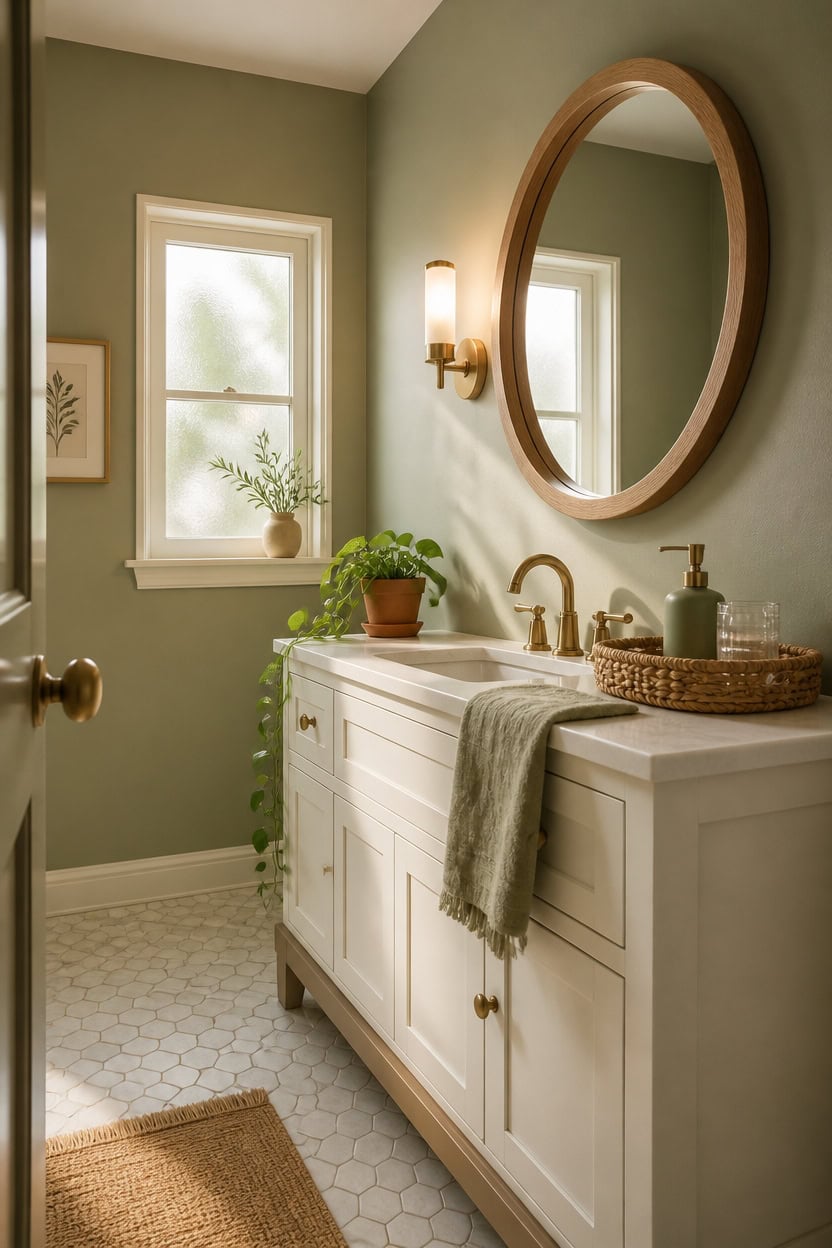
Morning light shifts sage green from cool gray to warm olive within hours, so test paint swatches at different times of day before committing. North-facing bathrooms flatten sage tones, making a lighter shade like October Mist read true without turning muddy. Position the vanity near the window so oak grain catches direct light instead of shadow.
Mirror placement: Hang the mirror opposite the window to double the natural light bouncing across sage walls.
Sheer window film: Use frosted privacy film instead of heavy curtains to keep daylight diffused evenly.
Warm-toned fixtures: Swap cool white bulbs for warm LED bulbs that match afternoon sunlight and oak tones.
Light-reflecting hardware: Choose brushed brass or nickel fixtures that catch and scatter available daylight.
a soft sage that shifts with the room’s daylight without turning dull. [light]
a warm oak-toned neutral that grounds the brighter walls under changing light. [mid-tone]
 30" White Shaker Bathroom Vanity Base with Drawers – Ready-to-Assemble Sink Cabinet, 2 Drawers and 1 Door, 30" W x 21" D x 34.5" H, Base Only
View Price
30" White Shaker Bathroom Vanity Base with Drawers – Ready-to-Assemble Sink Cabinet, 2 Drawers and 1 Door, 30" W x 21" D x 34.5" H, Base Only
View Price
 Dwersty Frosted Glass Window Privacy Film Decorative, 17.5" x 78.74"
View Price
Dwersty Frosted Glass Window Privacy Film Decorative, 17.5" x 78.74"
View Price
 GE Relax LED Light Bulbs, 60 Watt, Soft White, A19 (4 Pack)
View Price
GE Relax LED Light Bulbs, 60 Watt, Soft White, A19 (4 Pack)
View Price
 Bathroom Tray for Counter Top Organizer, Oak Wood Vanity Tray
View Price
Bathroom Tray for Counter Top Organizer, Oak Wood Vanity Tray
View Price
 BosilunLife Dish Soap Dispenser - Matte Green Ceramic Kitchen Soap Dispenser with Sponge Holder Matte Ceramic Soap Daddy Dispenser 20oz for Kitchen Soap Pump and Sponges Caddy
View Price
BosilunLife Dish Soap Dispenser - Matte Green Ceramic Kitchen Soap Dispenser with Sponge Holder Matte Ceramic Soap Daddy Dispenser 20oz for Kitchen Soap Pump and Sponges Caddy
View Price
Our Favorite Bathroom Hardware Sets
 Aplusee 4-Piece Bathroom Hardware Set
View Price
Aplusee 4-Piece Bathroom Hardware Set
View Price
 Forious 6-Piece Bathroom Hardware Set
View Price
Forious 6-Piece Bathroom Hardware Set
View Price
 Kokosiri 5-Piece Bathroom Hardware Set
View Price
Kokosiri 5-Piece Bathroom Hardware Set
View Price
 Kingston Brass Naples 5-Piece Bathroom Hardware Set
View Price
Kingston Brass Naples 5-Piece Bathroom Hardware Set
View Price
 Kingston Brass Provence 5-Piece Bathroom Hardware Set
View Price
Kingston Brass Provence 5-Piece Bathroom Hardware Set
View Price
 Kingston Brass American Classic 4-Piece Bathroom Hardware Set
View Price
Kingston Brass American Classic 4-Piece Bathroom Hardware Set
View Price
 Sure-Loc Ventura Series Bath Set
View Price
Sure-Loc Ventura Series Bath Set
View Price
 Lorinda 4-Piece Bathroom Hardware Set
View Price
Lorinda 4-Piece Bathroom Hardware Set
View Price
 Ufine Wall-Mounted 5-Piece Stainless Steel Hardware Set
View Price
Ufine Wall-Mounted 5-Piece Stainless Steel Hardware Set
View Price
 Delta Trinsic 4-Piece Bathroom Hardware Set
View Price
Delta Trinsic 4-Piece Bathroom Hardware Set
View Price
 Delta Cassidy 5-Piece Bath Hardware Set
View Price
Delta Cassidy 5-Piece Bath Hardware Set
View Price
 Moen Voss 4-Piece Bathroom Hardware Set
View Price
Moen Voss 4-Piece Bathroom Hardware Set
View Price
Sustainable Materials for a Sage Green and Oak Bathroom
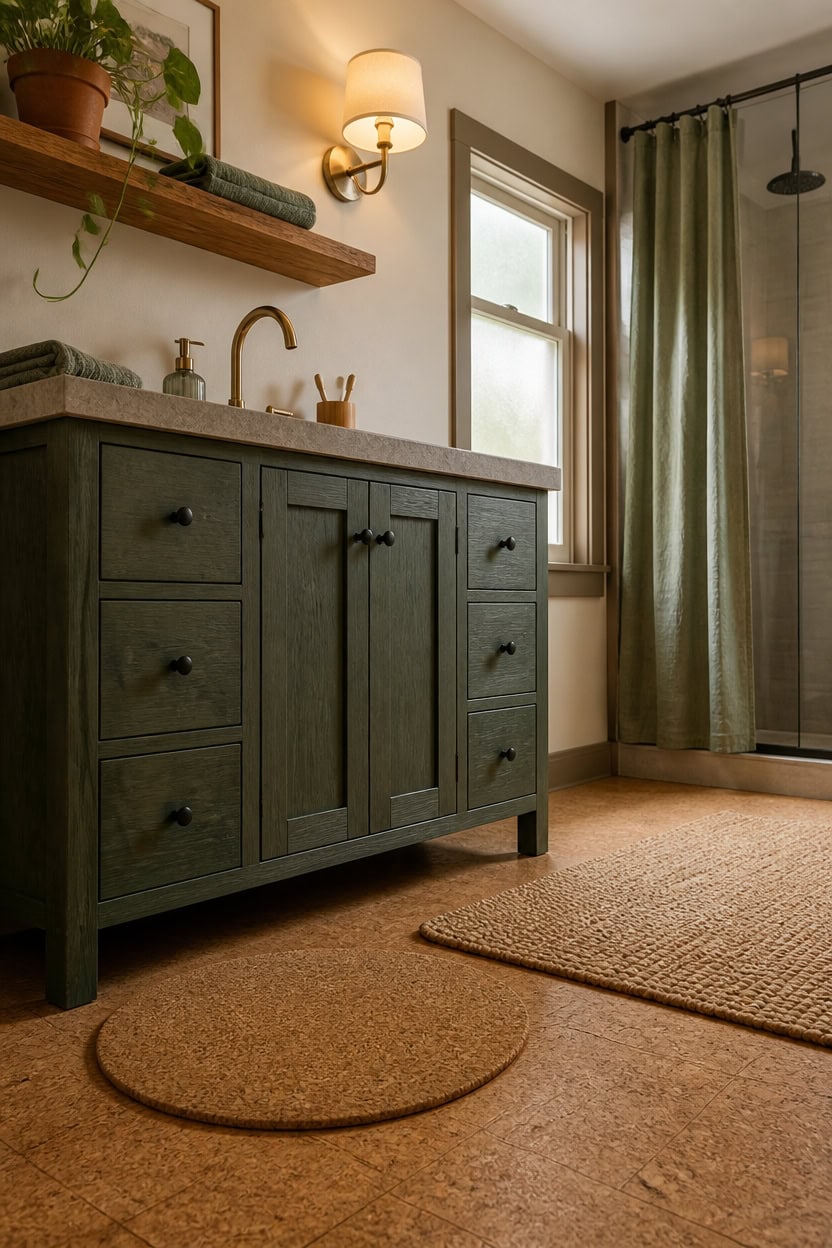
Reclaimed oak vanities cut down on new lumber demand while low-VOC paint keeps indoor air quality high during a full bathroom remodel. Cork flooring and FSC-certified oak shelving pair naturally with a deep sage vanity like Boreal Forest, since both share earthy, mineral undertones. Choose water-based finishes on any wood trim to avoid off-gassing in a small, humid space.
Reclaimed oak vanity: Choose a vanity built from salvaged oak instead of new-cut lumber.
Low-VOC paint: Pick zero or low-VOC paint to keep air quality safe in small spaces.
Cork flooring: Install cork tile flooring for a renewable, water-resistant surface underfoot.
FSC-certified accessories: Look for FSC-certified wood on shelves, trays, and trim pieces.
a deep, earthy sage that pairs naturally with reclaimed oak grain. [dark]
a warm, oak-toned neutral that softens the contrast against the vanity. [mid-tone]
 LUXOAK 24" Farmhouse Small Bathroom Vanity with Sink, Reclaimed Barnwood
View Price
LUXOAK 24" Farmhouse Small Bathroom Vanity with Sink, Reclaimed Barnwood
View Price
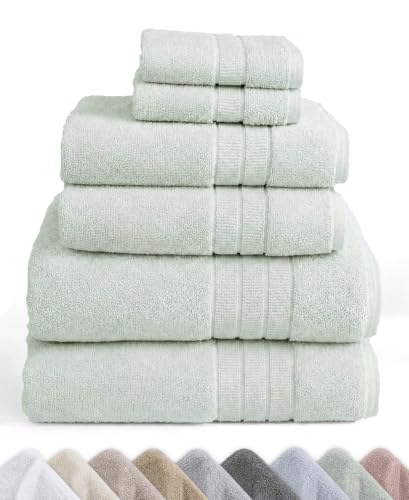 California Design Den Organic Cotton Towel & Washcloth Set of 6, Soft Sage
View Price
California Design Den Organic Cotton Towel & Washcloth Set of 6, Soft Sage
View Price
 Madison Park Casablanca Tufted Cotton Bath Rug Non-Slip, Round 25", Taupe
View Price
Madison Park Casablanca Tufted Cotton Bath Rug Non-Slip, Round 25", Taupe
View Price
 Picture Ledge Shelf, Long Floating Shelves for Wall, 56" W Set of 2, Oak
View Price
Picture Ledge Shelf, Long Floating Shelves for Wall, 56" W Set of 2, Oak
View Price
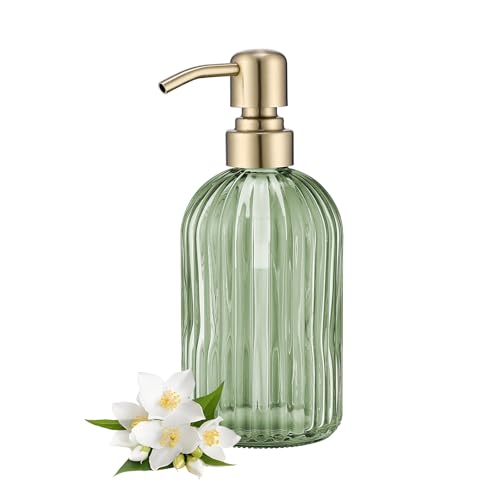 16Oz Green Glass Soap Dispenser with Rust Proof Stainless Steel Pump, Green Stripe Bathroom Hand Dish Lotion Dispensers with Brushed Gold Pump,Brushed Gold Glass Soap Dispenser
View Price
16Oz Green Glass Soap Dispenser with Rust Proof Stainless Steel Pump, Green Stripe Bathroom Hand Dish Lotion Dispensers with Brushed Gold Pump,Brushed Gold Glass Soap Dispenser
View Price
 2 Pcs Natural Bamboo Toothbrush Storage Holder Empty Reusable Portable Toothbrush Case with Cover Personal Cleaning Tools Container Organizer Tube for Travel Trip
View Price
SAFAVIEH Natural Fiber Accent Rug 2'6"x4', Jute Knotted Natural NF447A
View Price
2 Pcs Natural Bamboo Toothbrush Storage Holder Empty Reusable Portable Toothbrush Case with Cover Personal Cleaning Tools Container Organizer Tube for Travel Trip
View Price
SAFAVIEH Natural Fiber Accent Rug 2'6"x4', Jute Knotted Natural NF447A
View Price
 WOUVMA Sage Green Floral Shower Curtain Cottagecore
View Price
WOUVMA Sage Green Floral Shower Curtain Cottagecore
View Price
Our Favorite Vanity Lights
 Breena Dimmable Vanity Light
View Price
Breena Dimmable Vanity Light
View Price
 Averi 3-Light Dimmable Vanity Light
View Price
Averi 3-Light Dimmable Vanity Light
View Price
 Presler 3-Light Dimmable Vanity Light
View Price
Presler 3-Light Dimmable Vanity Light
View Price
 Rosser Dimmable Vanity Light
View Price
Rosser Dimmable Vanity Light
View Price
 Breakwater Bay Dimmable Globe Vanity Light
View Price
Breakwater Bay Dimmable Globe Vanity Light
View Price
 Drakeford Vanity Light
View Price
Drakeford Vanity Light
View Price
 Averi 32" 4-Light Dimmable Vanity Light
View Price
Averi 32" 4-Light Dimmable Vanity Light
View Price
 4-Light Dimmable Vanity Light with Clear Glass Shades
View Price
4-Light Dimmable Vanity Light with Clear Glass Shades
View Price
 Lark Manor 4-Light Dimmable Vanity Light
View Price
Lark Manor 4-Light Dimmable Vanity Light
View Price
 Angelina 1-Light Dimmable Wallchiere
View Price
Angelina 1-Light Dimmable Wallchiere
View Price
 Colada 1-Light Dimmable Armed Sconce
View Price
Colada 1-Light Dimmable Armed Sconce
View Price
 Haleigh 1-Light Dimmable Wall Sconce
View Price
Haleigh 1-Light Dimmable Wall Sconce
View Price
 Cailum 2-Light Dimmable Vanity Light
View Price
Cailum 2-Light Dimmable Vanity Light
View Price
 Averi 14.63" 2-Light Dimmable Vanity Light
View Price
Averi 14.63" 2-Light Dimmable Vanity Light
View Price
 Rooks 17" 2-Light Dimmable Steel Vanity Light
View Price
Rooks 17" 2-Light Dimmable Steel Vanity Light
View Price
Budget-Friendly Ways to Add Sage Green and Oak
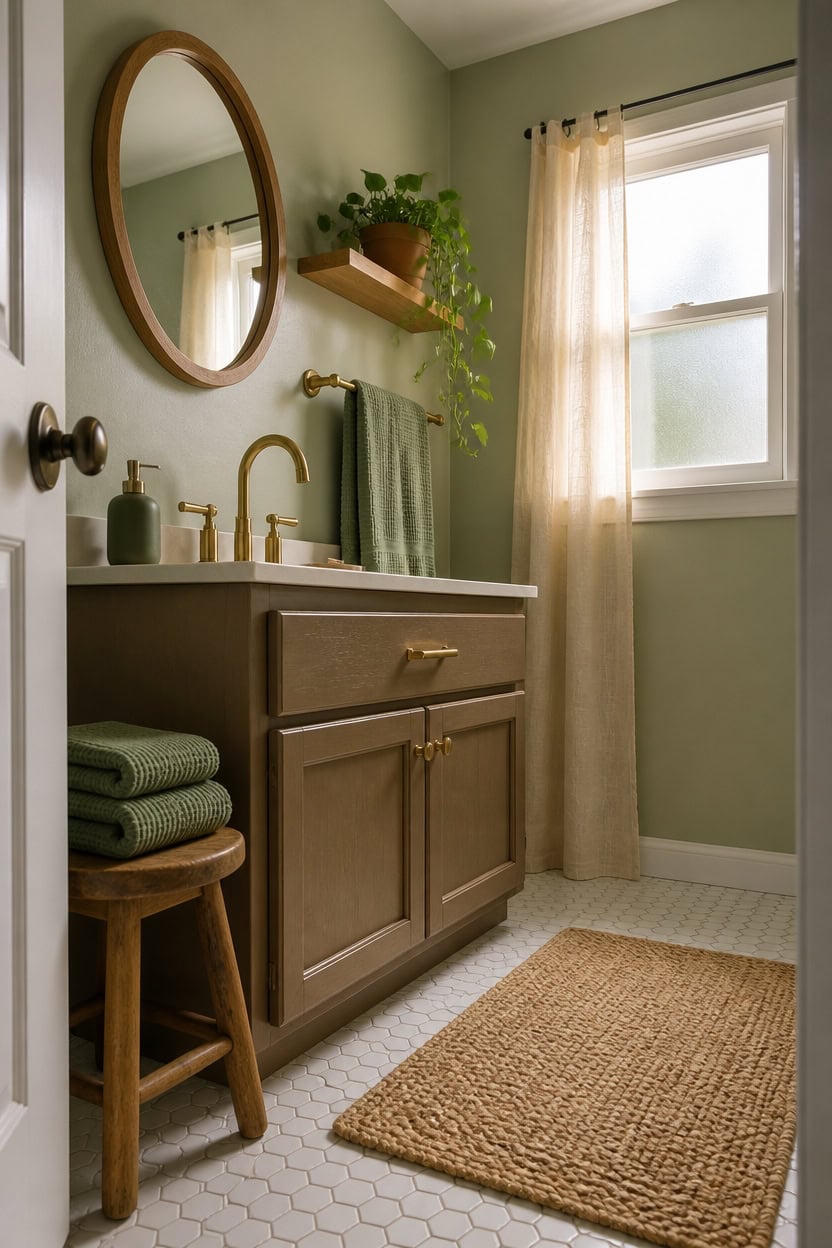
Small updates make the biggest difference when the budget is tight, and paint is the cheapest way to bring sage green and oak into a bathroom. A gallon of “October Mist” on the walls costs less than new tile or cabinetry, and it instantly sets a calm, earthy backdrop. Save the bigger spend for one statement piece, like an oak mirror frame, and let paint and textiles carry the rest of the room.
Paint before buying: Repaint walls first since color changes the whole room for the lowest cost.
Swap small hardware: Replace faucet handles or towel bars with brass or oak-toned pieces instead of full replacements.
Shop secondhand oak: Look for used oak shelves or stools at thrift stores and refinish them yourself.
Layer with textiles: Add sage towels, a bath mat, and a shower curtain for color without construction costs.
this muted sage brightens the room while keeping the earthy tone the title calls for. [light]
this warm, oak-toned brown grounds the space and mimics real wood grain at a fraction of the cost. [mid-tone]
 PADOOR Non-Slip Bath Mat, Braided Absorbent Bathroom Mat, 20''x32'' Beige
View Price
PADOOR Non-Slip Bath Mat, Braided Absorbent Bathroom Mat, 20''x32'' Beige
View Price
 XOGUIBO Sage Green Floral Shower Curtain,Vintage Cotton Cottagecore Shower Curtains for Bathroom, 72" W x 72" L
View Price
XOGUIBO Sage Green Floral Shower Curtain,Vintage Cotton Cottagecore Shower Curtains for Bathroom, 72" W x 72" L
View Price
 12" Wooden Step Stool, Small Wood Stool for Bathroom, Kitchen - White Oak
View Price
12" Wooden Step Stool, Small Wood Stool for Bathroom, Kitchen - White Oak
View Price
 MosJos Kitchen Towels, Cotton Hand Towels, Sage Green and Cream Ribbed - Mini Weaved Stitched Set of 4 Absorbent Hand Drying Cloths, 18 x 28 Kitchen Linens
View Price
MosJos Kitchen Towels, Cotton Hand Towels, Sage Green and Cream Ribbed - Mini Weaved Stitched Set of 4 Absorbent Hand Drying Cloths, 18 x 28 Kitchen Linens
View Price
Our Favorite Bathroom Mirrors
 Adorna Dimmable Backlit LED Vanity Mirror with Anti-Fog
View Price
Adorna Dimmable Backlit LED Vanity Mirror with Anti-Fog
View Price
 Aevar Tempered Glass and Aluminum Alloy Framed Wall Mirror
View Price
Aevar Tempered Glass and Aluminum Alloy Framed Wall Mirror
View Price
 Leaderville Bathroom Vanity Mirror with Tempered Glass and Aluminum Frame
View Price
Leaderville Bathroom Vanity Mirror with Tempered Glass and Aluminum Frame
View Price
 Chrisna Front and Backlit LED Bathroom Vanity Mirror
View Price
Chrisna Front and Backlit LED Bathroom Vanity Mirror
View Price
 Bathroom Vanity Mirror with Aluminum Frame and Tempered Glass
View Price
Bathroom Vanity Mirror with Aluminum Frame and Tempered Glass
View Price
 Kengston Modern & Contemporary Rectangular Bathroom Vanity Mirror
View Price
Kengston Modern & Contemporary Rectangular Bathroom Vanity Mirror
View Price
 Molly Tempered Glass and Metal Framed Bathroom Vanity Mirror
View Price
Molly Tempered Glass and Metal Framed Bathroom Vanity Mirror
View Price
 Tyro Decorative Corner-Hung Bathroom Mirror
View Price
Tyro Decorative Corner-Hung Bathroom Mirror
View Price
 Amara Tempered Glass and Aluminum Alloy Framed Wall Mirror
View Price
Amara Tempered Glass and Aluminum Alloy Framed Wall Mirror
View Price
 Modern Scalloped Corner Rectangle Bathroom Vanity Mirror, Stainless Steel Frame
View Price
Modern Scalloped Corner Rectangle Bathroom Vanity Mirror, Stainless Steel Frame
View Price
 UL Certified Front & Back LED Anti-Fog Bathroom Vanity Mirror - Basics by Wayfair™
View Price
UL Certified Front & Back LED Anti-Fog Bathroom Vanity Mirror - Basics by Wayfair™
View Price
 Lesamuel Filleted Corner Wall Mounted Bathroom Vanity Mirror with Aluminum Frame
View Price
Lesamuel Filleted Corner Wall Mounted Bathroom Vanity Mirror with Aluminum Frame
View Price
 Janica Shatterproof Beveled Frameless Bathroom Vanity Mirror
View Price
Janica Shatterproof Beveled Frameless Bathroom Vanity Mirror
View Price
 Aevar UL Certified Front & Back LED Anti-Fog Framed Bathroom Vanity Mirror
View Price
Aevar UL Certified Front & Back LED Anti-Fog Framed Bathroom Vanity Mirror
View Price
 UL Certified LED Anti-Fog Bathroom Vanity Mirror - Basics by Wayfair™
View Price
UL Certified LED Anti-Fog Bathroom Vanity Mirror - Basics by Wayfair™
View Price
 Lohoski Decorative Beveled Bathroom Vanity Mirror
View Price
Lohoski Decorative Beveled Bathroom Vanity Mirror
View Price
 UL Certified Front & Back LED Anti-Fog Framed Bathroom Vanity Mirror - Basics by Wayfair™
View Price
UL Certified Front & Back LED Anti-Fog Framed Bathroom Vanity Mirror - Basics by Wayfair™
View Price
Common Mistakes to Avoid With Sage Green and Oak
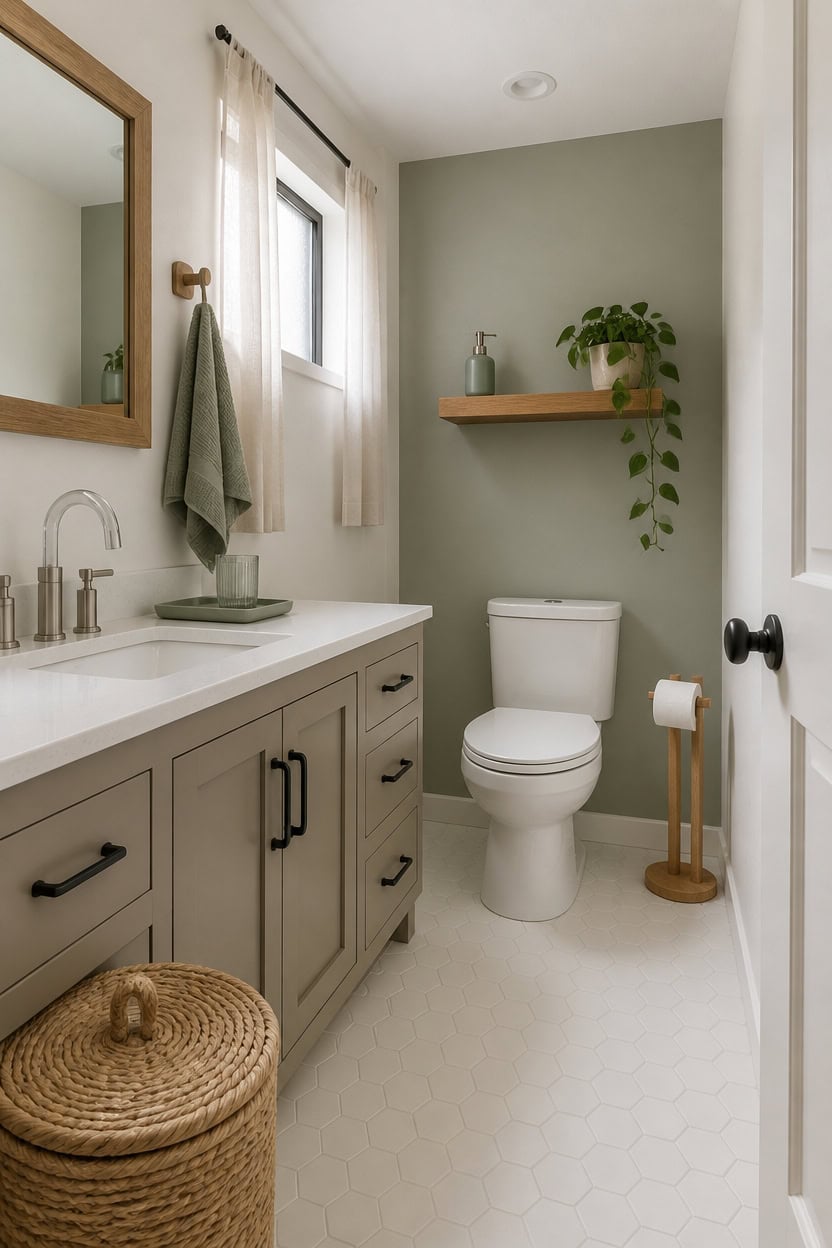
Sage green and oak fail together when the sage leans too pastel or the oak gets layered on too thick, flattening the natural contrast that makes the pairing work. “Antique Jade” on an accent wall keeps the green grounded and slightly gray, avoiding a minty or nursery-like cast. Balance depends on giving each material room to breathe rather than fighting for attention on every surface.
Overly pastel sage: Choose a muted, gray-leaning sage instead of a bright mint tone.
Too much oak: Limit oak to one or two pieces so it accents rather than dominates.
Mismatched undertones: Pair warm oak with warm-toned sage, not cool blue-green shades.
Wrong sheen choice: Use eggshell or satin on walls, not high-gloss, to keep the look soft.
this muted, gray-leaning green adds depth without turning the room minty. [light]
this warm, oak-adjacent tone mimics wood grain while staying versatile. [mid-tone]
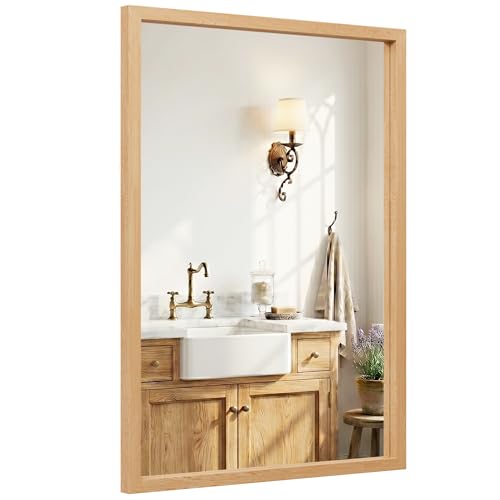 Pocetry 24" x 36" Natural Oak Bathroom Mirror, Moisture-Resistant Rectangular Vanity Mirror with Wood-Textured Frame, Shatterproof Tempered Glass, Japandi & Scandi Home Decor
View Price
Pocetry 24" x 36" Natural Oak Bathroom Mirror, Moisture-Resistant Rectangular Vanity Mirror with Wood-Textured Frame, Shatterproof Tempered Glass, Japandi & Scandi Home Decor
View Price
 Fujinzhu Wood Hooks Wall Mounted, Coat Hooks Vintage Single Wall Hooks Organizer Heavy Duty for Towel Hat Hanging 4 Pack Oak
View Price
Fujinzhu Wood Hooks Wall Mounted, Coat Hooks Vintage Single Wall Hooks Organizer Heavy Duty for Towel Hat Hanging 4 Pack Oak
View Price
 Great Bay Home Bath Towel Set - 100% Cotton 6 Piece Towel Set - Absorbent & Quick-Dry Towels for Bathroom (Sage Green)
View Price
Great Bay Home Bath Towel Set - 100% Cotton 6 Piece Towel Set - Absorbent & Quick-Dry Towels for Bathroom (Sage Green)
View Price
 OUTNILI Freestanding Toilet Paper Holder Stand with Lid, Acacia Wood Bathroom Storage Organizer, Rustic Farmhouse Toilet Paper Holder for Floor, Holds 3 Extra Large Rolls
View Price
OUTNILI Freestanding Toilet Paper Holder Stand with Lid, Acacia Wood Bathroom Storage Organizer, Rustic Farmhouse Toilet Paper Holder for Floor, Holds 3 Extra Large Rolls
View Price
 YOUDENOVA Jute Rope Laundry Hamper Basket, 58L Blanket Basket for Nursery
View Price
YOUDENOVA Jute Rope Laundry Hamper Basket, 58L Blanket Basket for Nursery
View Price
 zuxzmj Green Glass Foaming Hand Soap Dispenser
View Price
zuxzmj Green Glass Foaming Hand Soap Dispenser
View Price
Our Favorite Bathroom Storage Cabinets
 Brigit Free-Standing Bathroom Cabinet with Drawers
View Price
Brigit Free-Standing Bathroom Cabinet with Drawers
View Price
 Jalieah Free-Standing Wooden Bathroom Floor Cabinet
View Price
Jalieah Free-Standing Wooden Bathroom Floor Cabinet
View Price
 Cardonas Wooden Two-Door Floor Storage Cabinet
View Price
Cardonas Wooden Two-Door Floor Storage Cabinet
View Price
 Agassiz Metal Adjustable Over-the-Toilet Storage
View Price
Agassiz Metal Adjustable Over-the-Toilet Storage
View Price
 Manufactured Wood Over-the-Toilet Storage Cabinet
View Price
Manufactured Wood Over-the-Toilet Storage Cabinet
View Price
 Leliana Metal Over-the-Toilet Storage
View Price
Leliana Metal Over-the-Toilet Storage
View Price
 Olvera Linen Cabinet
View Price
Olvera Linen Cabinet
View Price
 Alicyn 5-Drawer Free-Standing Linen Cabinet
View Price
Alicyn 5-Drawer Free-Standing Linen Cabinet
View Price
 Arjae 72" Linen Cabinet
View Price
Arjae 72" Linen Cabinet
View Price
 Higuera Solid Wood Wall-Mounted Bathroom Cabinet
View Price
Higuera Solid Wood Wall-Mounted Bathroom Cabinet
View Price
 Dorset Wall-Mounted Bath Storage Cabinet with Open Shelf
View Price
Dorset Wall-Mounted Bath Storage Cabinet with Open Shelf
View Price
 Allura Wall-Mounted Bathroom Cabinet
View Price
Allura Wall-Mounted Bathroom Cabinet
View Price
 Zal Freestanding Corner Space-Saving Storage Cabinet
View Price
Zal Freestanding Corner Space-Saving Storage Cabinet
View Price
 Zal Removable Corner Wall Bathroom Cabinet with Shelving
View Price
Zal Removable Corner Wall Bathroom Cabinet with Shelving
View Price
 Noires Freestanding Corner Accent Floor Storage Cabinet
View Price
Noires Freestanding Corner Accent Floor Storage Cabinet
View Price
Sage Green and Oak Bathroom Styles to Try
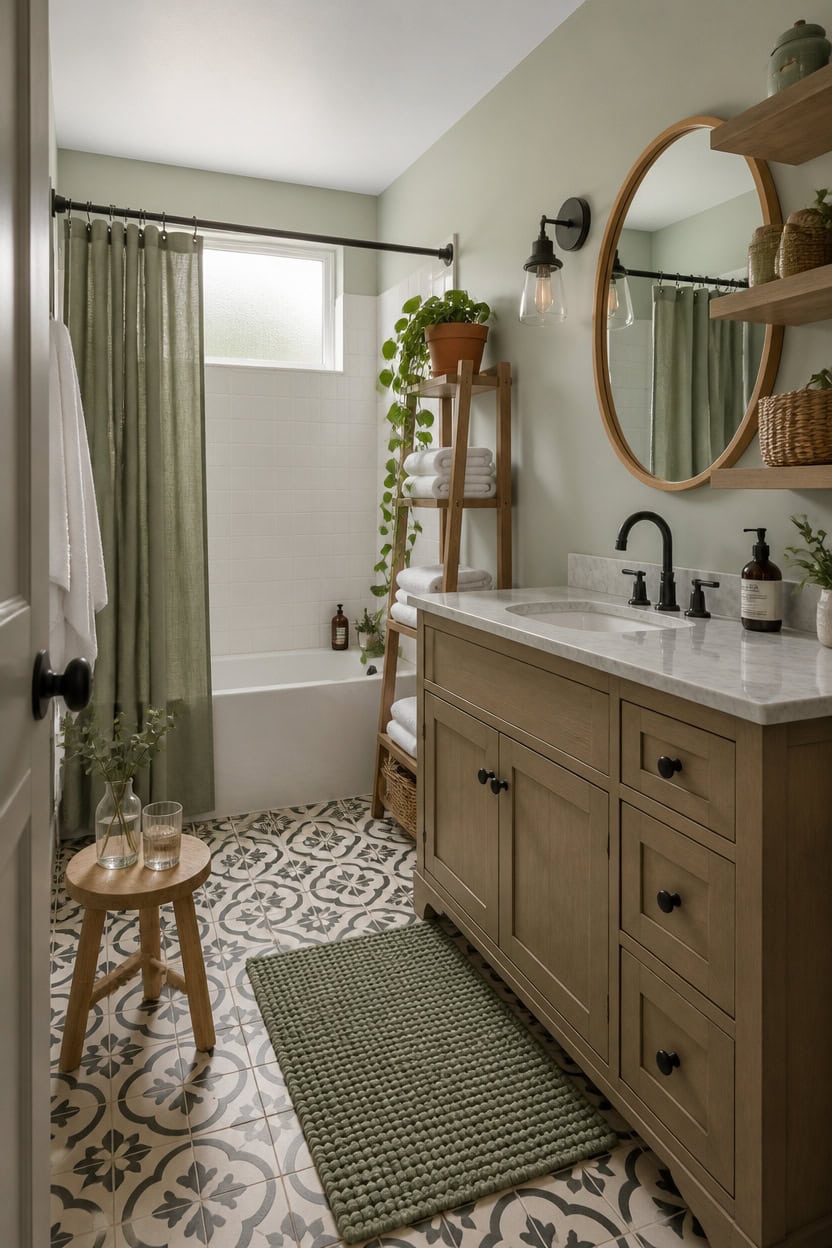
Sage green and oak adapt to several distinct design directions depending on how much warmth or coolness the room wants to carry. “Tea Light” on the main walls sets a soft, muted backdrop that lets oak furniture and sage textiles shift the mood from spa-like to farmhouse without repainting. Choosing one style direction first keeps hardware, textiles, and wood tones consistent throughout the room.
Coastal spa look: Pair light sage walls with bleached oak accents and woven textures for an airy, calm feel.
Modern farmhouse look: Combine deeper sage cabinetry with honey-toned oak shelving and matte black fixtures.
Japandi minimalism: Keep surfaces plain, use one oak piece as the focal point, and let sage stay muted and quiet.
Traditional cottage look: Layer sage patterned textiles with oak trim for a lived-in, collected feel.
this pale, gray-green tone gives the room a calm backdrop without going cold. [light]
this warm, oak-toned brown grounds the space and mimics natural wood grain. [mid-tone]
 VEVOR 4-Tier Bamboo Ladder Shelf, Trapezoid Open Bookcase, Display Storage Rack Organizer, Freestanding Flower Plant Stand, Ladder Bookshelf Ideal for Bathroom, Bedroom, Office, Study, Natural
View Price
VEVOR 4-Tier Bamboo Ladder Shelf, Trapezoid Open Bookcase, Display Storage Rack Organizer, Freestanding Flower Plant Stand, Ladder Bookshelf Ideal for Bathroom, Bedroom, Office, Study, Natural
View Price
 TYUU Bathroom Rugs Non Slip Washable, Super Absorbent Thin Bath Mat Small Quick Dry Low Pile Bathroom Rug, Sage Green 16"x24"
View Price
TYUU Bathroom Rugs Non Slip Washable, Super Absorbent Thin Bath Mat Small Quick Dry Low Pile Bathroom Rug, Sage Green 16"x24"
View Price
 BAMBOO LAND- Bamboo Shower Bench with Storage Shelf
View Price
BAMBOO LAND- Bamboo Shower Bench with Storage Shelf
View Price
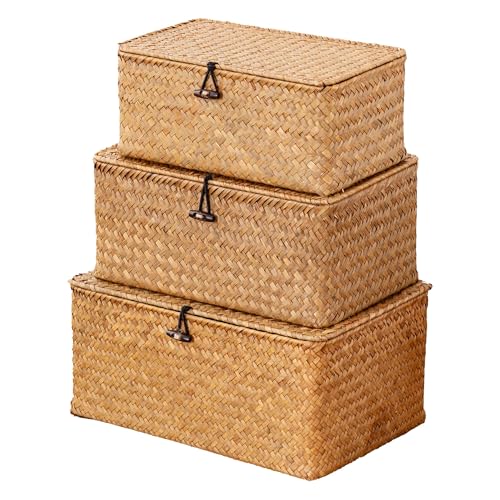 Nonam Wicker Storage Basket with Lid,Seagrass Shelf Basket Set of 3,Nautral
View Price
Nonam Wicker Storage Basket with Lid,Seagrass Shelf Basket Set of 3,Nautral
View Price
 LLEEMPI Sage Green Botanical Wall Art Set of 3, 16x24 Wood Framed Prints
View Price
LLEEMPI Sage Green Botanical Wall Art Set of 3, 16x24 Wood Framed Prints
View Price
Our Favorite Medicine Cabinets
 Gervon Rectangle Recessed Medicine Cabinet
View Price
Gervon Rectangle Recessed Medicine Cabinet
View Price
 Haslem Recessed Framed Medicine Cabinet with Mirror
View Price
Haslem Recessed Framed Medicine Cabinet with Mirror
View Price
 Garnes Recessed or Surface Mount Framed Medicine Cabinet
View Price
Garnes Recessed or Surface Mount Framed Medicine Cabinet
View Price
 Farmhouse Recessed Metal Medicine Cabinet with Mirror
View Price
Farmhouse Recessed Metal Medicine Cabinet with Mirror
View Price
 Voijin 24" x 36" Framed Metal Medicine Cabinet
View Price
Voijin 24" x 36" Framed Metal Medicine Cabinet
View Price
 Bryand Farmhouse Surface Mount Metal Medicine Cabinet
View Price
Bryand Farmhouse Surface Mount Metal Medicine Cabinet
View Price
 Cyrille Recessed & Surface Framed Medicine Cabinet with Mirror
View Price
Cyrille Recessed & Surface Framed Medicine Cabinet with Mirror
View Price
 Chouchanik 3-Door Framed Medicine Cabinet with Mirror
View Price
Chouchanik 3-Door Framed Medicine Cabinet with Mirror
View Price
 Lunara 2-Door Framed Medicine Cabinet with Mirror
View Price
Lunara 2-Door Framed Medicine Cabinet with Mirror
View Price
 Husai Aluminum Frameless Medicine Cabinet with Mirrored Door
View Price
Husai Aluminum Frameless Medicine Cabinet with Mirrored Door
View Price
 Gerding 31.5" Frameless Medicine Cabinet with Mirror
View Price
Gerding 31.5" Frameless Medicine Cabinet with Mirror
View Price
 Omeed Mirrored Aluminum Medicine Cabinet
View Price
Omeed Mirrored Aluminum Medicine Cabinet
View Price
 Kassady LED Lighted Medicine Cabinet with Defog Mirror
View Price
Kassady LED Lighted Medicine Cabinet with Defog Mirror
View Price
 Surface Mount Frameless Medicine Cabinet with LED Lighting
View Price
Surface Mount Frameless Medicine Cabinet with LED Lighting
View Price
 Livvia Frameless LED Medicine Cabinet with Anti-Fog
View Price
Livvia Frameless LED Medicine Cabinet with Anti-Fog
View Price
What’s Next for the Sage Green and Oak Trend?
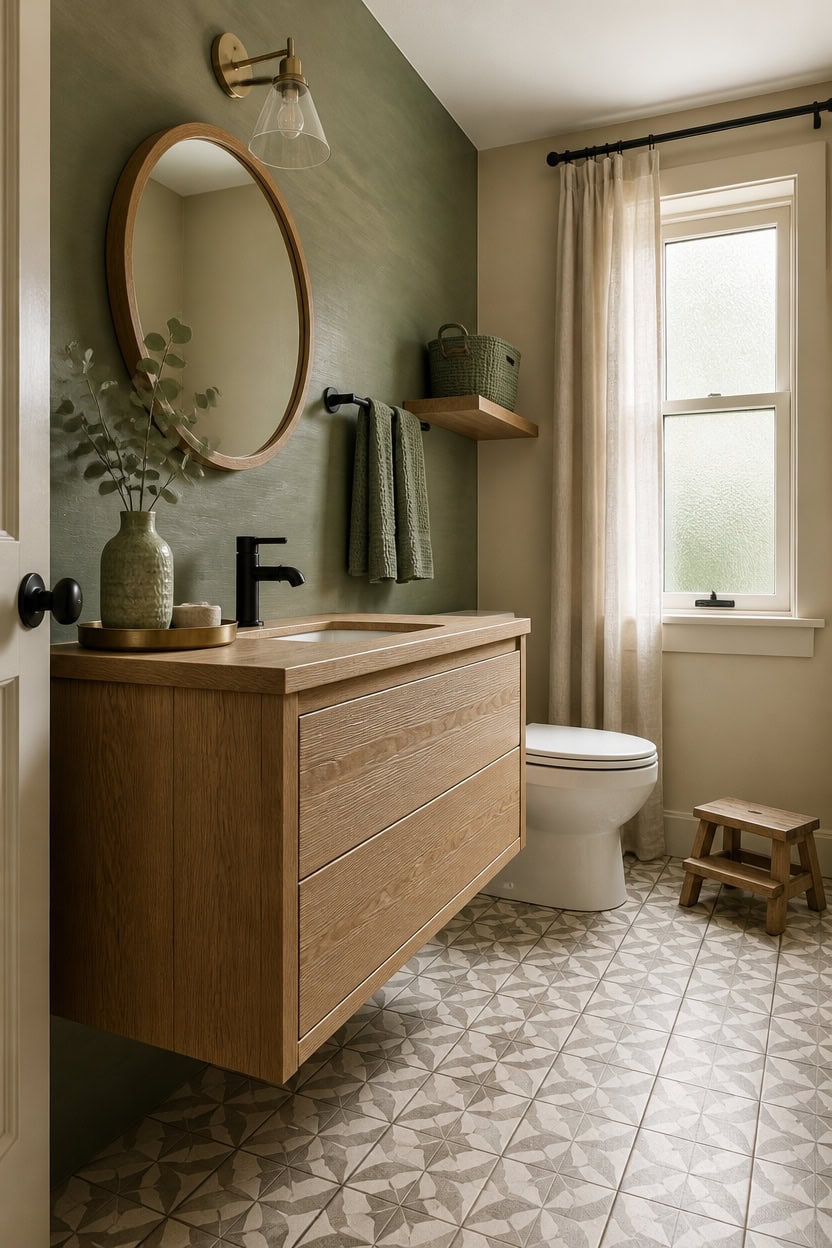
The sage and oak trend is shifting toward richer greens like Misted Fern paired with raw, textured oak instead of pale, flat combinations. Deeper green grounds the room while oak grain adds texture without extra color. Apply it by painting one accent wall in a deeper sage and keeping trim in a warm neutral that echoes oak tones.
Mix metal finishes: Combine matte black and brushed brass fixtures so the palette feels collected, not matched.
Layer textured oak: Choose wire-brushed or rift-cut oak pieces for grain that reads as intentional detail.
Deepen the green: Swap pale sage for a richer, muddier green on one wall to add depth.
Add warm neutrals: Introduce a warm neutral trim color to soften the contrast between green and oak.
this richer, muddier green adds depth without overwhelming the room. [mid-tone]
this warm, oak-toned neutral softens the contrast between wall and cabinetry. [light]
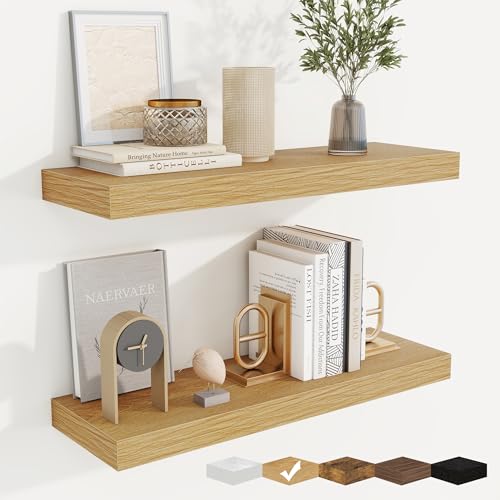 Floating Shelves for Wall, Wall Mounted Wood Shelves, Oak, Set of 2, 24in
View Price
Floating Shelves for Wall, Wall Mounted Wood Shelves, Oak, Set of 2, 24in
View Price
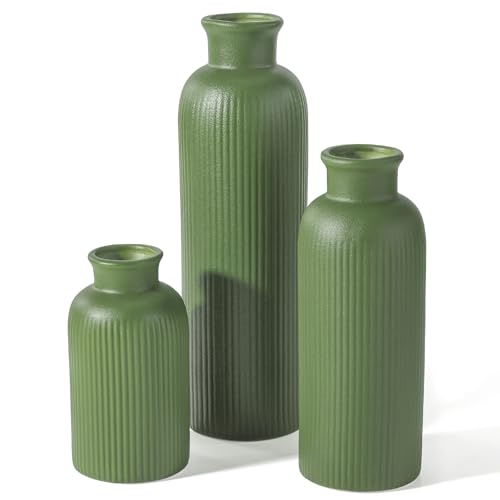 Small Sage Green Ceramic Vase Set of 3, Boho Modern Flower Vase Room Decor, Farmhouse Decor, Vases for Your Kitchen, Bathroom, Bedroom, Living Room, Office&Shelf Centerpiece Table Decorations
View Price
Small Sage Green Ceramic Vase Set of 3, Boho Modern Flower Vase Room Decor, Farmhouse Decor, Vases for Your Kitchen, Bathroom, Bedroom, Living Room, Office&Shelf Centerpiece Table Decorations
View Price
 JIAPAIDUO Double Towel Bar, 24Inch Towel Rack for Bathroom, Stainless Steel Double Bath Towel Bar, Wall Mounted Towel Holder, Double Towel Rod Towel Rail Hanger for Wall, Kitchen (Matte Black)
View Price
JIAPAIDUO Double Towel Bar, 24Inch Towel Rack for Bathroom, Stainless Steel Double Bath Towel Bar, Wall Mounted Towel Holder, Double Towel Rod Towel Rail Hanger for Wall, Kitchen (Matte Black)
View Price
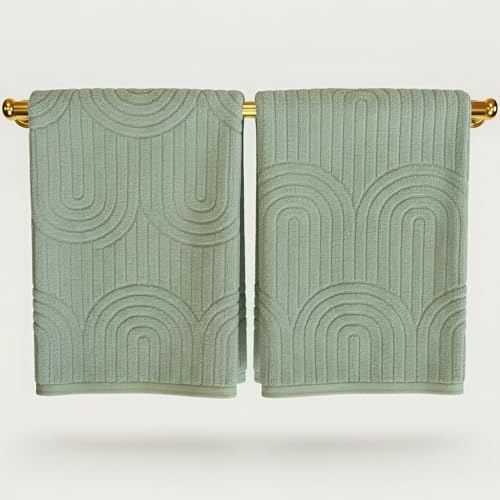 Decorative Hand Towels Set of 2 - Soft Boho Cotton for Bathroom or Kitchen
View Price
Decorative Hand Towels Set of 2 - Soft Boho Cotton for Bathroom or Kitchen
View Price
 TQKAG 5 Piece Bathroom Accessories Set Brushed Gold Bathroom Hardware Set 23.6 Inch Bath Towel Bar Set SUS304 Stainless Steel Towel Rack Set
View Price
TQKAG 5 Piece Bathroom Accessories Set Brushed Gold Bathroom Hardware Set 23.6 Inch Bath Towel Bar Set SUS304 Stainless Steel Towel Rack Set
View Price
 Acellegic Set of 4 Sage Green Small Wicker Basket, Classic
View Price
Acellegic Set of 4 Sage Green Small Wicker Basket, Classic
View Price
Our Favorite Bathroom Vanities
 Jewell 20" Single Bathroom Vanity Set
View Price
Jewell 20" Single Bathroom Vanity Set
View Price
 Lunette 24" Single Bathroom Vanity with Top
View Price
Lunette 24" Single Bathroom Vanity with Top
View Price
 Caitlyn 24" Single Bathroom Vanity with Ceramic Top
View Price
Caitlyn 24" Single Bathroom Vanity with Ceramic Top
View Price
 Ajhane 60" Single Bathroom Vanity Set
View Price
Ajhane 60" Single Bathroom Vanity Set
View Price
 Lisette 60" Single Bathroom Vanity Set
View Price
Lisette 60" Single Bathroom Vanity Set
View Price
 Gazsi 60" Single Bathroom Vanity with Engineered Stone Top
View Price
Gazsi 60" Single Bathroom Vanity with Engineered Stone Top
View Price
 Minnetrista 72" Double Bathroom Vanity with Marble Top
View Price
Minnetrista 72" Double Bathroom Vanity with Marble Top
View Price
 Ajhane 72" Double Bathroom Vanity Set
View Price
Ajhane 72" Double Bathroom Vanity Set
View Price
 Minnetrista 60" Double Bathroom Vanity with Marble Top
View Price
Minnetrista 60" Double Bathroom Vanity with Marble Top
View Price
 Jewell 30" Single Bathroom Vanity with Ceramic Top
View Price
Jewell 30" Single Bathroom Vanity with Ceramic Top
View Price
 Minnetrista 30" Single Bathroom Vanity with Marble Top
View Price
Minnetrista 30" Single Bathroom Vanity with Marble Top
View Price
 Jillian 36" Single Bathroom Vanity with Engineered Stone Top
View Price
Jillian 36" Single Bathroom Vanity with Engineered Stone Top
View Price
 Lisette 42" Single Bathroom Vanity Set
View Price
Lisette 42" Single Bathroom Vanity Set
View Price
 Hermes 48" Single Bathroom Vanity with Marble Top
View Price
Hermes 48" Single Bathroom Vanity with Marble Top
View Price
 Jillian 48" Single Bathroom Vanity with Engineered Stone Top
View Price
Jillian 48" Single Bathroom Vanity with Engineered Stone Top
View Price