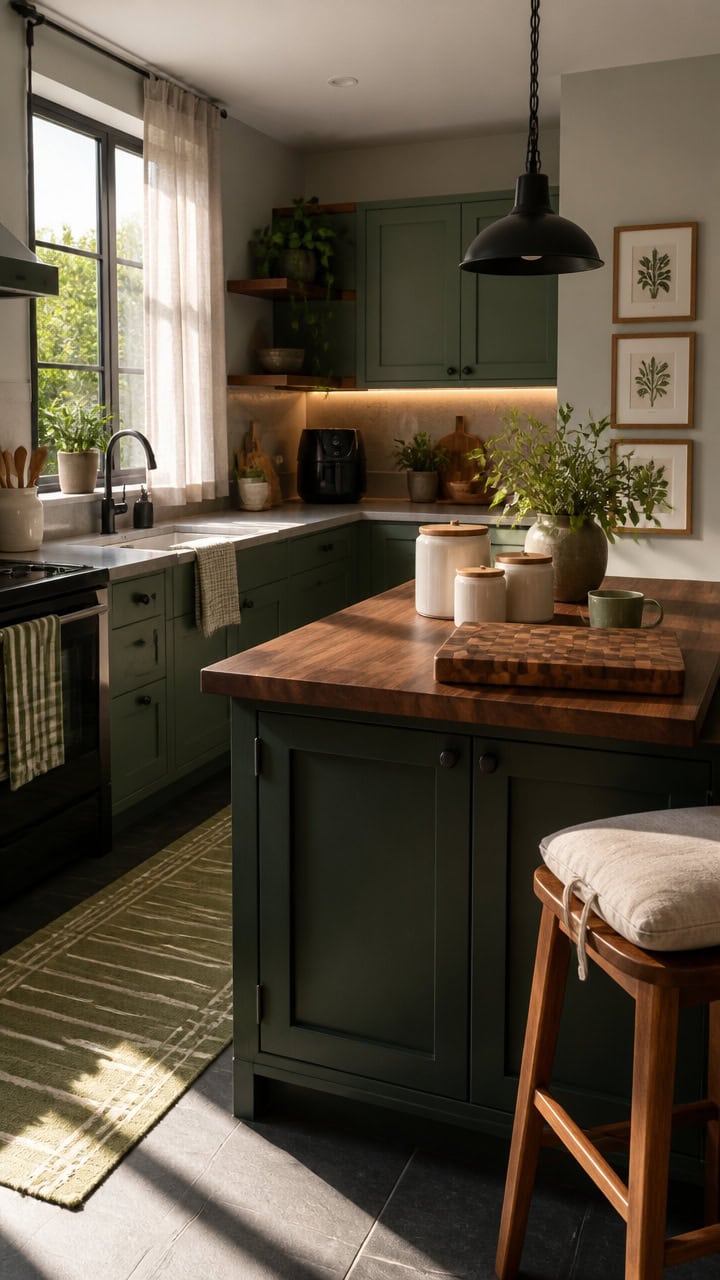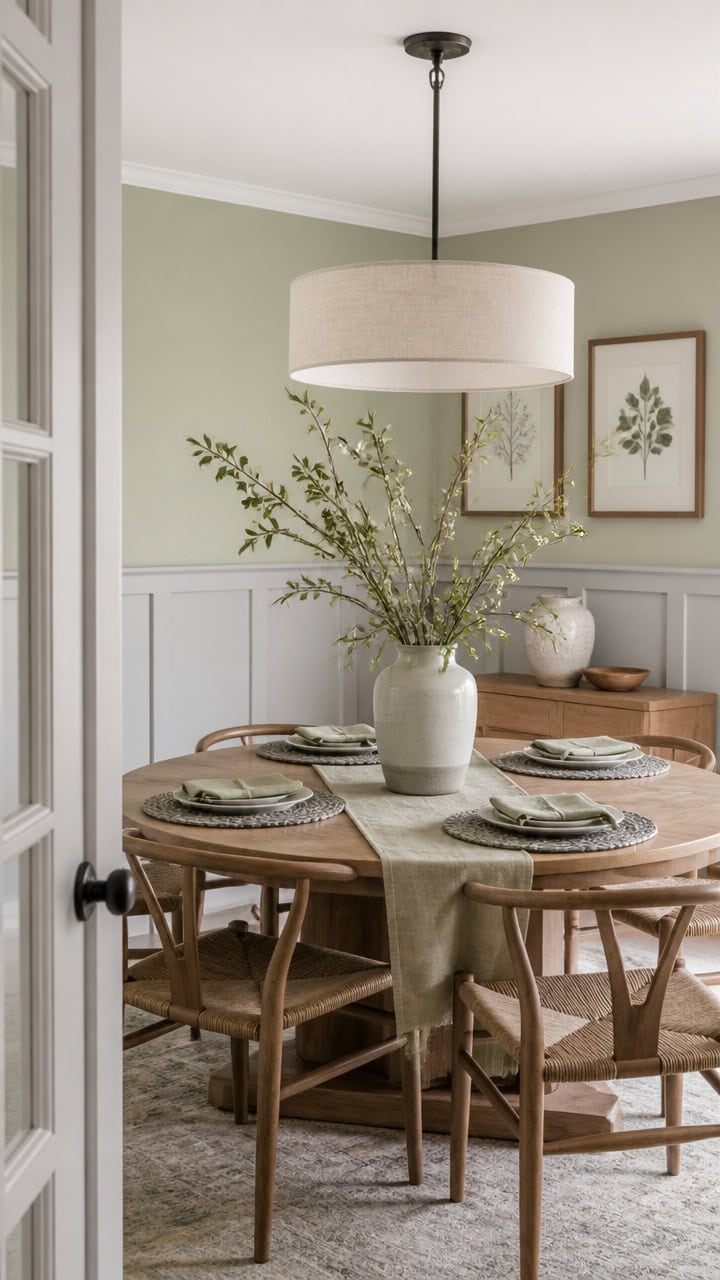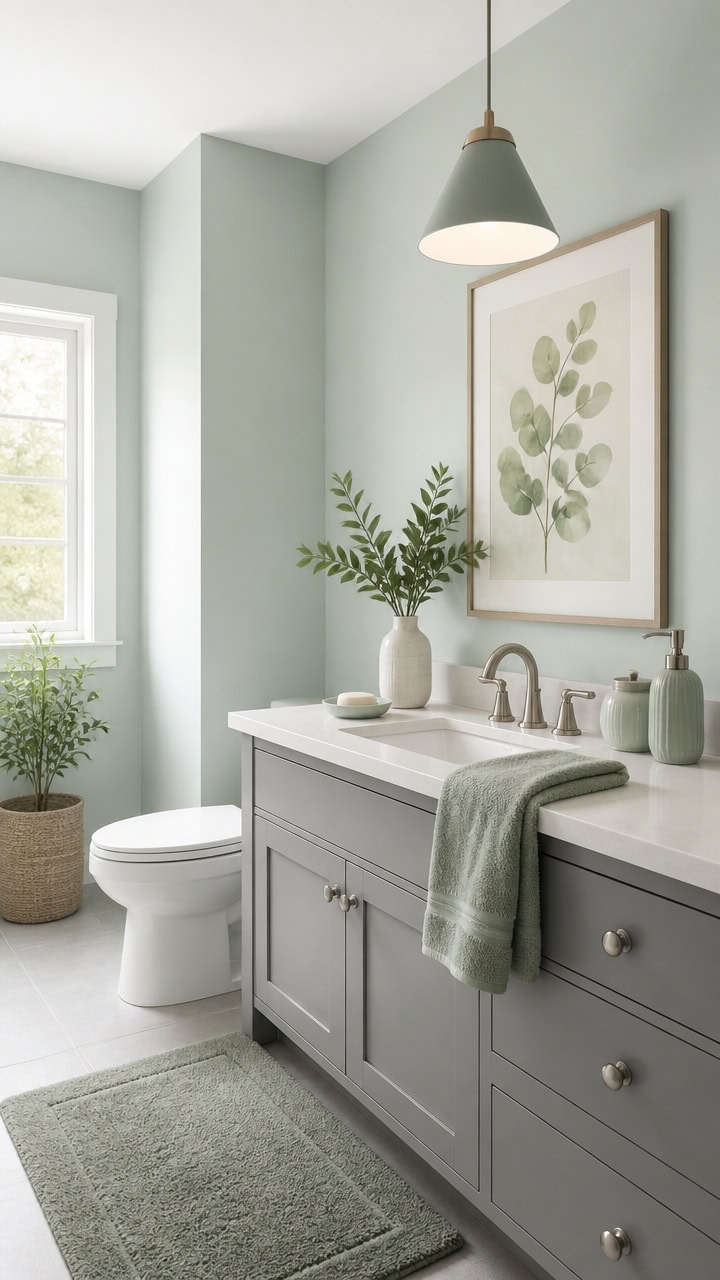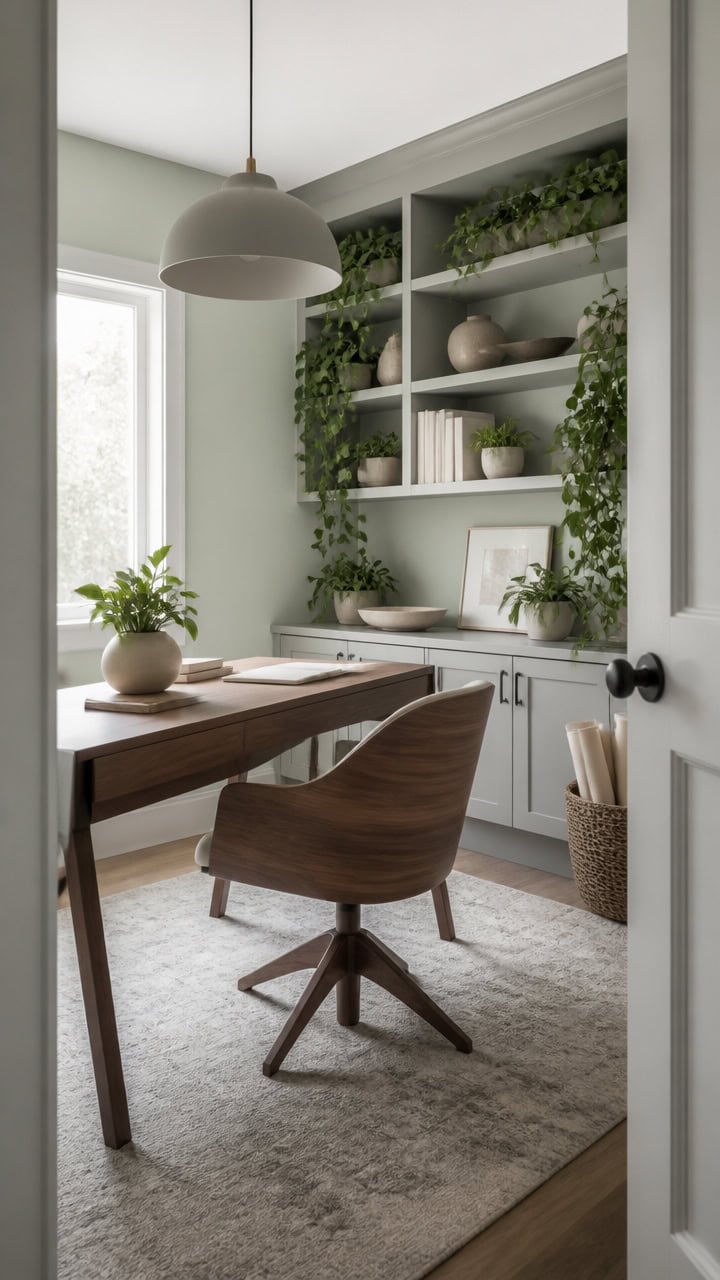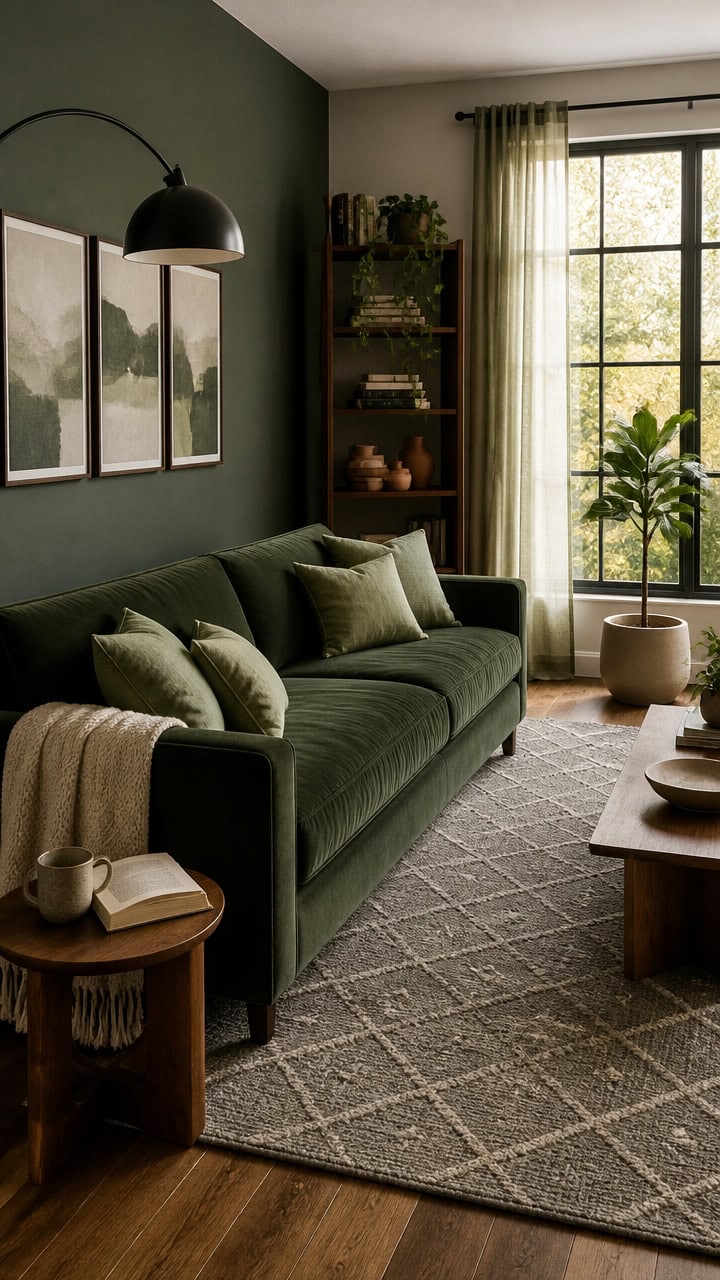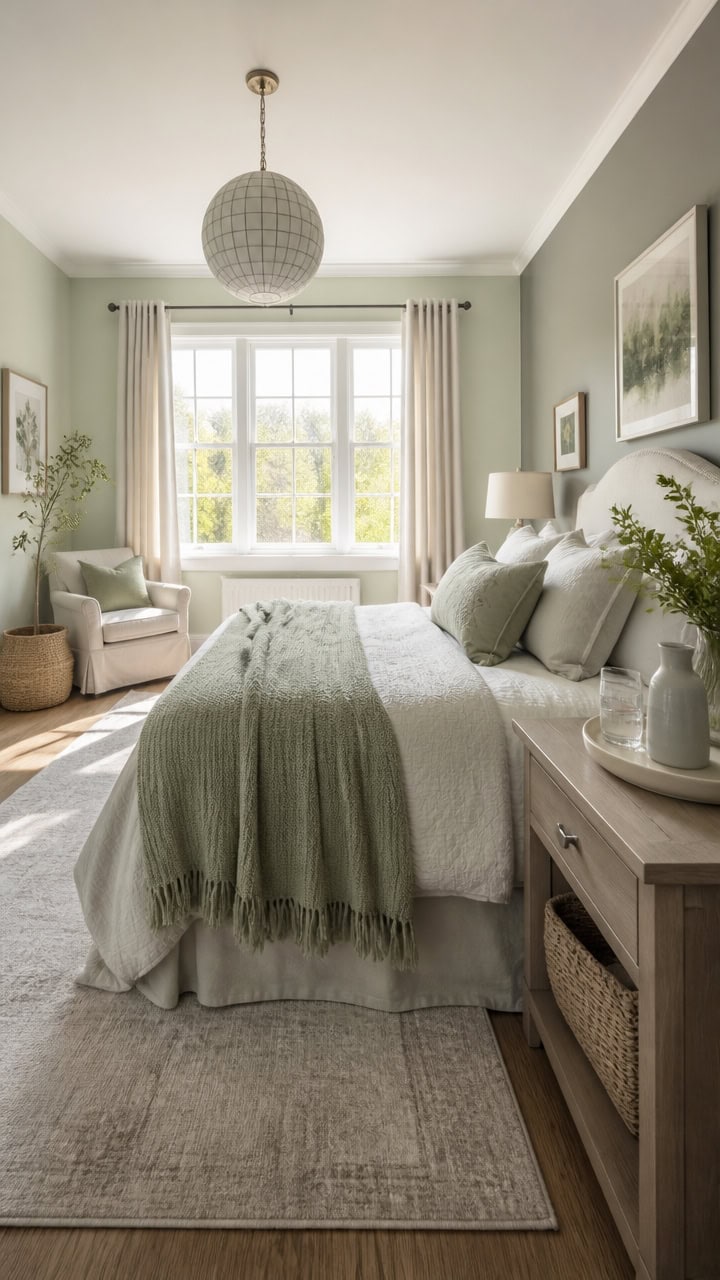

Gray and Green Mudrooms for Women Who Stopped Decorating for Guests
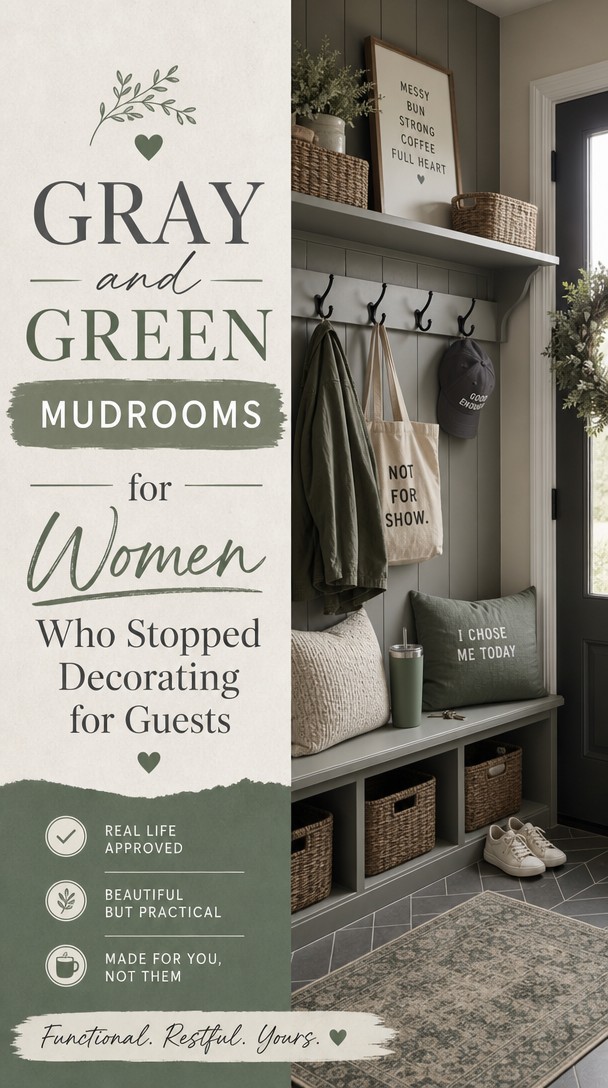
There’s a moment when you stop arranging your home for everyone else and start designing it for yourself. If your mudroom is next on that list, a gray and green palette might be exactly the grounding, beautiful combination you didn’t know you needed.
Let’s explore how to make this hardworking space feel authentically yours.
Why Gray and Green Work So Well Together
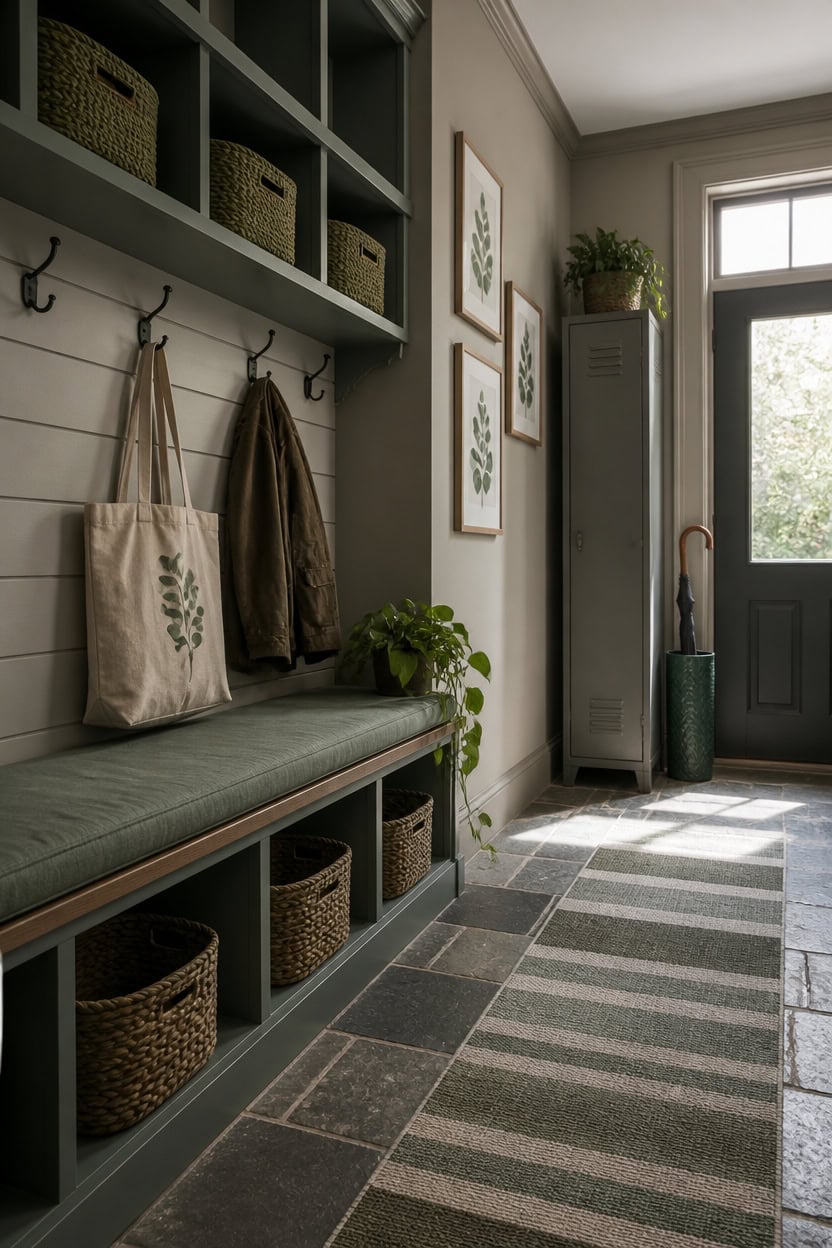
Gray absorbs green’s intensity while green rescues gray from looking cold and lifeless — that mutual correction is why the pairing feels effortless rather than forced. Both colors share blue undertones at their core, which means they don’t fight each other the way warm-cool combos do. In a mudroom, lean gray-dominant: use it on walls and built-in cubbies, then bring green in through hooks, baskets, and a bench cushion.
matched from the wall in this photo — the closest Benjamin Moore shade.
the deep sage tone gives the cubbies visual weight and anchors the gray walls with a grounded, nature-forward contrast.
Amazon · October 6–7
Prime Big Deal Days
We spotted these on sale at Amazon on October 6. The Prime member sale ends Wednesday night and deals can sell out sooner, so check the current price.
Shoe Racks


Entryway Benches


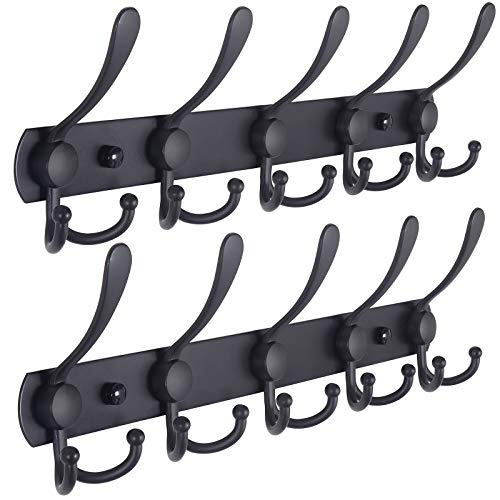
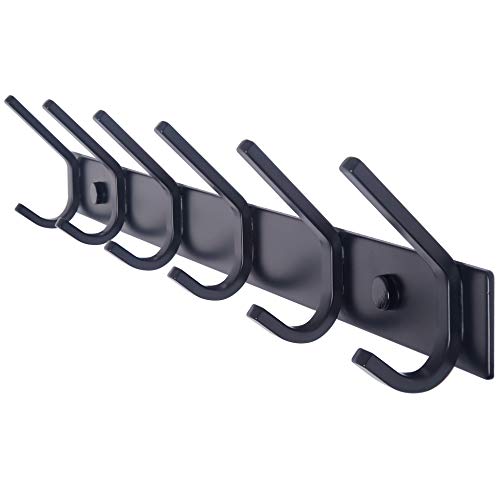
Coat Racks
Runner Rugs


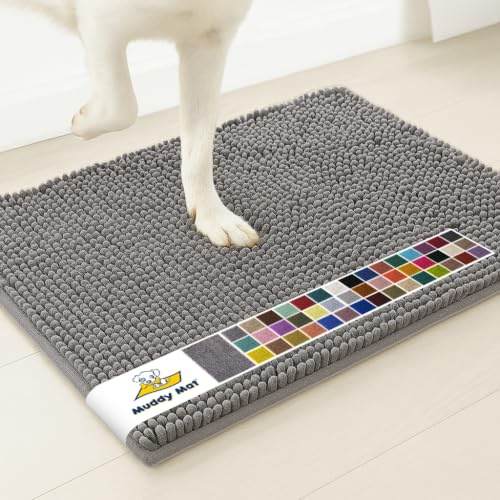
Doormats

Boot Trays


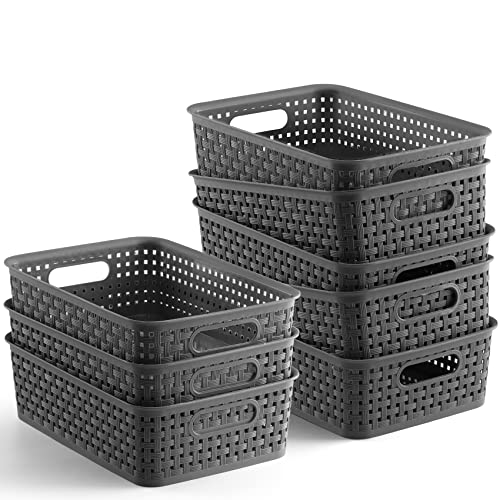
Storage Baskets

Storage Bins


Cordless Vacuums


Laundry Hampers


Floating Shelves


Gray Shades That Read Warm, Not Cold
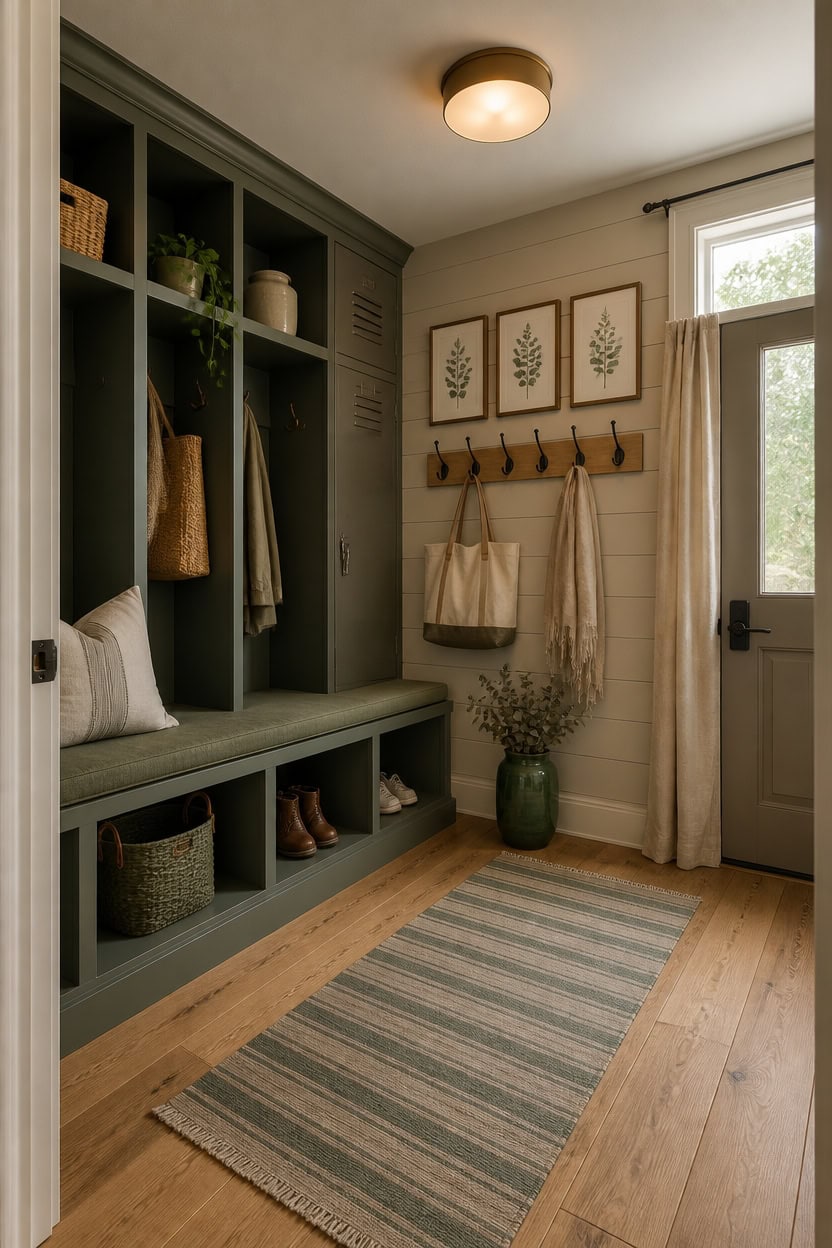
Warm grays pull from beige, taupe, or greige — not from blue or purple — and that’s what keeps them from going cold under overhead light. In a mudroom, that matters because the lighting is usually single-source and unflattering, which turns blue-based grays into something that looks like a hospital hallway. Look for paint chips labeled “greige” or check the LRV: warm grays tend to land between 50 and 65 and still hold their warmth under LED bulbs.
Test under your actual bulb: Hold the paint chip under the light fixture in your mudroom — not a window — to see if the gray stays warm or goes cool.
Look for undertones in the name: Words like “sand,” “wheat,” “stone,” and “clay” in a gray’s name usually signal warm undertones; “mist,” “slate,” and “silver” usually don’t.
Pair with wood, not metal: Warm grays look grounded next to wood-toned shelving and hooks; chrome and steel will pull out any cool undertone hiding in the color.
Avoid going too dark: A warm gray that’s too deep can still read cold in a windowless mudroom — keep walls mid-tone and save darker values for trim or cubbies.
matched from the wall in this photo — the closest Benjamin Moore shade.
the deep sage anchors the warm gray walls with just enough contrast to make the cubbies feel intentional, not accidental.
Our Favorite Fall Wreaths
 Mums and Pomegranates Artificial Floral Wreath, Red, 20"
View Price
Mums and Pomegranates Artificial Floral Wreath, Red, 20"
View Price
 24" Artificial Eucalyptus Berry Fall Front Door Wreath
View Price
24" Artificial Eucalyptus Berry Fall Front Door Wreath
View Price
 Harvest Blossom Wreath with Wood Curl Sunflowers
View Price
Harvest Blossom Wreath with Wood Curl Sunflowers
View Price
 24" Artificial Eucalyptus Autumn Wreath for Front Door
View Price
24" Artificial Eucalyptus Autumn Wreath for Front Door
View Price
 24" Fall Twig Berry Front Door Wreath
View Price
24" Fall Twig Berry Front Door Wreath
View Price
 26" Artificial Fall Pear and Peony Front Door Wreath
View Price
26" Artificial Fall Pear and Peony Front Door Wreath
View Price
 24" Farmhouse Twig Harvest Blossom and Berry Front Door Wreath
View Price
24" Farmhouse Twig Harvest Blossom and Berry Front Door Wreath
View Price
 26" Handcrafted Fall Pumpkin Front Door Wreath
View Price
26" Handcrafted Fall Pumpkin Front Door Wreath
View Price
 Faux 30" Wreath
View Price
Faux 30" Wreath
View Price
 26" Faux Fall Pumpkin Front Door Wreath
View Price
26" Faux Fall Pumpkin Front Door Wreath
View Price
 Gisello Handcrafted Faux 26" Wreath
View Price
Gisello Handcrafted Faux 26" Wreath
View Price
 Artificial Fall 28" Floral Wreath
View Price
Artificial Fall 28" Floral Wreath
View Price
 Faux Foliage 30" Wreath
View Price
Faux Foliage 30" Wreath
View Price
 Handcrafted Faux 26" Peony Leaves Fall Wreath
View Price
Handcrafted Faux 26" Peony Leaves Fall Wreath
View Price
 18" Farmhouse Fall Pinecone Wreath for Front Door
View Price
18" Farmhouse Fall Pinecone Wreath for Front Door
View Price
 26" Harvest Wreath with Pumpkin and Berry Accents
View Price
26" Harvest Wreath with Pumpkin and Berry Accents
View Price
 24" Fall Harvest Pumpkin Front Door Wreath
View Price
24" Fall Harvest Pumpkin Front Door Wreath
View Price
 26" Fall Peony Floral Wreath for Front Door
View Price
26" Fall Peony Floral Wreath for Front Door
View Price
 26" Fall Peony Eucalyptus Berry Floral Wreath for Front Door
View Price
26" Fall Peony Eucalyptus Berry Floral Wreath for Front Door
View Price
 24" Faux Fall Pumpkin Berry Wreath for Front Door
View Price
24" Faux Fall Pumpkin Berry Wreath for Front Door
View Price
 26" Faux Wreath
View Price
26" Faux Wreath
View Price
 26" Farmhouse Twig Harvest Blossom Eucalyptus Berry Fall Wreath
View Price
26" Farmhouse Twig Harvest Blossom Eucalyptus Berry Fall Wreath
View Price
 22" Farmhouse Autumn Foliage Harvest Blossom Eucalyptus Berry Twig Wreath
View Price
22" Farmhouse Autumn Foliage Harvest Blossom Eucalyptus Berry Twig Wreath
View Price
 26" Faux Fall Pumpkin Peony Floral Wreath for Front Door
View Price
26" Faux Fall Pumpkin Peony Floral Wreath for Front Door
View Price
 26" Farmhouse Fall Harvest Twig Berry Front Door Wreath
View Price
26" Farmhouse Fall Harvest Twig Berry Front Door Wreath
View Price
 24" Farmhouse Fall Harvest Blossom Daisy Grass Front Door Wreath
View Price
24" Farmhouse Fall Harvest Blossom Daisy Grass Front Door Wreath
View Price
 Farmhouse Blossom Cluster Foliage Berry Fall Wreath for Front Door
View Price
Farmhouse Blossom Cluster Foliage Berry Fall Wreath for Front Door
View Price
 Faux Peony and Sedum 24" Wreath
View Price
Faux Peony and Sedum 24" Wreath
View Price
 Farmhouse Fall Harvest Foliage Berry Front Door Wreath
View Price
Farmhouse Fall Harvest Foliage Berry Front Door Wreath
View Price
 Haunted Hill Farm 24" Lighted Black and White Ghost Halloween Wreath
View Price
Haunted Hill Farm 24" Lighted Black and White Ghost Halloween Wreath
View Price
 Fall Peony Pumpkin Wreath with Eucalyptus Leaves
View Price
Fall Peony Pumpkin Wreath with Eucalyptus Leaves
View Price
 Dried Natural Maize 25" Wreath
View Price
Dried Natural Maize 25" Wreath
View Price
 26" Faux Fall Pumpkin Berry Front Door Wreath
View Price
26" Faux Fall Pumpkin Berry Front Door Wreath
View Price
 26" Farmhouse Birch Blossom Fall Foliage Berry Pinecone Wreath
View Price
26" Farmhouse Birch Blossom Fall Foliage Berry Pinecone Wreath
View Price
 20" Artificial Fall Ball Ornament Pumpkin Wreath for Front Door
View Price
20" Artificial Fall Ball Ornament Pumpkin Wreath for Front Door
View Price
 Handcrafted Faux Berry 26" Wreath
View Price
Handcrafted Faux Berry 26" Wreath
View Price
 32" Harvest Sunflowers and Pumpkins Wreath
View Price
32" Harvest Sunflowers and Pumpkins Wreath
View Price
 Faux 30" Wreath
View Price
Faux 30" Wreath
View Price
 Fall Decor Wreaths for Front Door, Set of 2
View Price
Fall Decor Wreaths for Front Door, Set of 2
View Price
 24" Farmhouse Mini Eucalyptus Blossom Berry Wreath for Front Door
View Price
24" Farmhouse Mini Eucalyptus Blossom Berry Wreath for Front Door
View Price
Moody Greens That Make a Mudroom Feel Like Yours
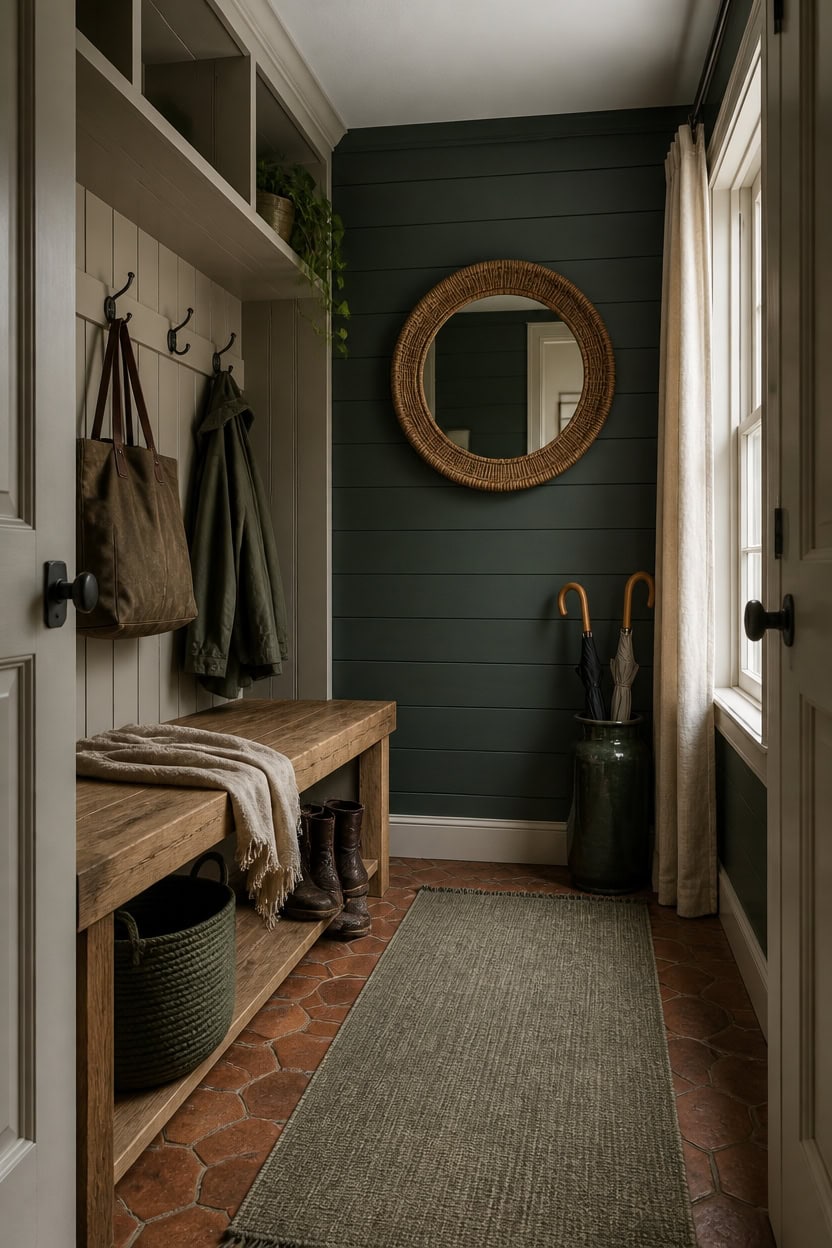
Moody greens — hunter, forest, and dark sage — work in a mudroom because they absorb visual clutter instead of competing with it. A deep green wall turns the mess of coats, boots, and bags into something that reads as intentional, the way dark library walls make stacked books look curated instead of chaotic. If you’re worried about a small mudroom feeling closed in, cap the color at the chair rail or keep it on one wall behind the bench.
Choose green with gray in it: Blue-greens go bright under daylight and flat at night — gray-based greens like forest or dark sage stay consistent across light conditions.
Go deeper than you think: Moody greens need depth to work — a pale version of the same hue will just look like an undercoat, not a choice.
Let the trim breathe: Pair dark green walls with white or warm cream trim so the room doesn’t close in on itself — the contrast does the work contrast is supposed to do.
Ground it with natural material: Rattan, raw wood, and linen stop a moody green from reading as formal or cold — texture is what makes it feel lived in.
matched from this photo — the closest Benjamin Moore shade.
the warm gray pulls the deep green off the wall and gives each cubby a grounded, framed look.
Our Favorite Umbrella Stands
 Metal Umbrella Stands with Engraved Artwork, Set of 2
View Price
Metal Umbrella Stands with Engraved Artwork, Set of 2
View Price
 Chadwicks Ceramic Umbrella Stand
View Price
Chadwicks Ceramic Umbrella Stand
View Price
 Modern Square Metal Freestanding Umbrella Stand
View Price
Modern Square Metal Freestanding Umbrella Stand
View Price
 Metal Umbrella Stand with Drip Tray
View Price
Metal Umbrella Stand with Drip Tray
View Price
 Pavlinka Metal Freestanding Umbrella Stand
View Price
Pavlinka Metal Freestanding Umbrella Stand
View Price
 Handmade Rattan Umbrella Stand
View Price
Handmade Rattan Umbrella Stand
View Price
 Dubreuil Ceramic Umbrella Stand
View Price
Dubreuil Ceramic Umbrella Stand
View Price
 Iasha Iron Freestanding Umbrella Stand
View Price
Iasha Iron Freestanding Umbrella Stand
View Price
 Modern Brass Tone Rectangular Freestanding Umbrella Holder
View Price
Modern Brass Tone Rectangular Freestanding Umbrella Holder
View Price
 BirdRock Home Decorative Freestanding Umbrella Stand
View Price
BirdRock Home Decorative Freestanding Umbrella Stand
View Price
 Palacio Iron 4-Hook Umbrella Stand
View Price
Palacio Iron 4-Hook Umbrella Stand
View Price
 Freestanding Black Indoor Umbrella Holder
View Price
Freestanding Black Indoor Umbrella Holder
View Price
 Reveles Round Freestanding Umbrella Stand
View Price
Reveles Round Freestanding Umbrella Stand
View Price
 Heston Glass Freestanding Umbrella Stand
View Price
Heston Glass Freestanding Umbrella Stand
View Price
 Solid Wood Freestanding Umbrella Stand
View Price
Solid Wood Freestanding Umbrella Stand
View Price
 Freestanding Coat Rack with Umbrella Stand and 8 Hooks
View Price
Freestanding Coat Rack with Umbrella Stand and 8 Hooks
View Price
 Ayran Steel Freestanding Umbrella Stand
View Price
Ayran Steel Freestanding Umbrella Stand
View Price
 Mcauliffe Metal Freestanding Umbrella Stand
View Price
Mcauliffe Metal Freestanding Umbrella Stand
View Price
 Skyller Umbrella Stand
View Price
Skyller Umbrella Stand
View Price
 Ceramic Freestanding Umbrella Stand
View Price
Ceramic Freestanding Umbrella Stand
View Price
 20 Inch Metal Freestanding Umbrella and Cane Holder
View Price
20 Inch Metal Freestanding Umbrella and Cane Holder
View Price
 Deonta Porcelain Freestanding Umbrella Stand
View Price
Deonta Porcelain Freestanding Umbrella Stand
View Price
 Perlis Freestanding Umbrella Stand
View Price
Perlis Freestanding Umbrella Stand
View Price
 Deonta Flower Blossom Umbrella Stand
View Price
Deonta Flower Blossom Umbrella Stand
View Price
 Desimir Umbrella Stand
View Price
Desimir Umbrella Stand
View Price
 Barrett Metal Freestanding Umbrella Stand
View Price
Barrett Metal Freestanding Umbrella Stand
View Price
 Vital Porcelain Freestanding Umbrella Stand
View Price
Vital Porcelain Freestanding Umbrella Stand
View Price
 Yamazaki Home Brick Umbrella Stand
View Price
Yamazaki Home Brick Umbrella Stand
View Price
 Mind Reader Mesh Umbrella Stand
View Price
Mind Reader Mesh Umbrella Stand
View Price
 Stainless Steel Freestanding Umbrella Stand
View Price
Stainless Steel Freestanding Umbrella Stand
View Price
 Cat Parade Metal Freestanding Umbrella Stand
View Price
Cat Parade Metal Freestanding Umbrella Stand
View Price
 Rogich Steel Freestanding Umbrella Stand
View Price
Rogich Steel Freestanding Umbrella Stand
View Price
 Metal Freestanding Umbrella Stand
View Price
Metal Freestanding Umbrella Stand
View Price
 Couto Free Standing Umbrella Holder
View Price
Couto Free Standing Umbrella Holder
View Price
 21 Inch Freestanding Umbrella Rack
View Price
21 Inch Freestanding Umbrella Rack
View Price
 Panigrahy Ceramic Freestanding Umbrella Stand
View Price
Panigrahy Ceramic Freestanding Umbrella Stand
View Price
 Metal Freestanding Umbrella Stand
View Price
Metal Freestanding Umbrella Stand
View Price
 Yamazaki Home Umbrella Stand
View Price
Yamazaki Home Umbrella Stand
View Price
 Commercial Metal Umbrella Holder
View Price
Commercial Metal Umbrella Holder
View Price
 Terrazzo Umbrella Stand
View Price
Terrazzo Umbrella Stand
View Price
How Much Color Is Too Much in a Small Mudroom?
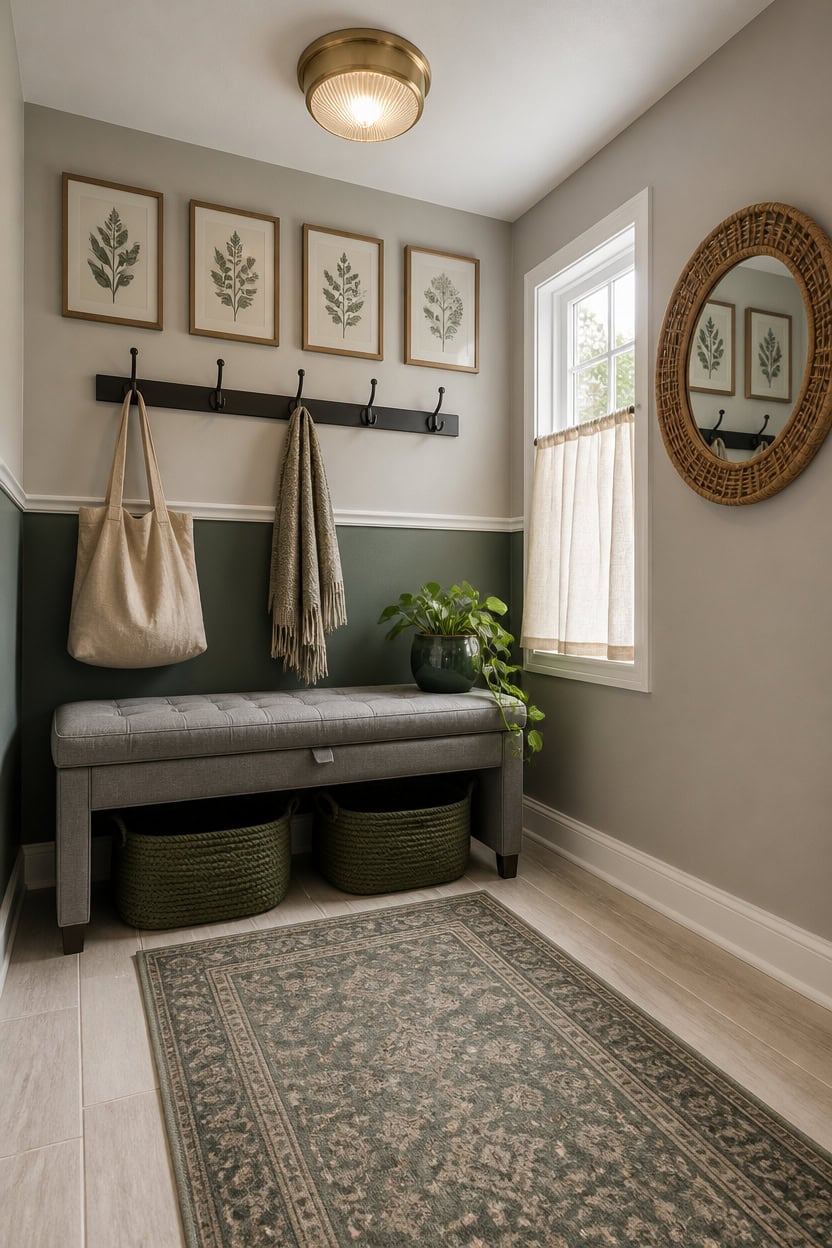
One wall of color is usually the right ceiling for a small mudroom — not because more is wrong, but because a compact entry space needs one visual anchor, not four competing ones. When every wall is the same deep shade, the room contracts instead of wrapping you in it. Pick the wall behind the bench or the hooks, go full depth there, and let the other walls breathe in a lighter neutral.
One saturated wall: The wall your eye lands on first — usually behind the bench — carries the color; the rest hold the neutral.
Stop at the chair rail: In a very small mudroom, take the deep color only to chair-rail height and paint above it in the lighter companion shade.
Let trim reset the boundary: White or warm cream trim between a saturated wall and a neutral one visually contains the color so it reads as deliberate, not overwhelming.
Keep the floor light: A pale floor in a small mudroom reflects light upward and keeps a single bold wall from tipping into cave territory.
the gray-green depth anchors the small mudroom without pulling the walls inward.
the warm gray gives the color story room to breathe without breaking the gray and green pairing.
Washable Entry Rugs for This Palette
Machine-washable Rugs USA best sellers in this palette's colors, linked in 3' x 5', the size for a mudroom or entry that sees muddy boots.
 Bayberry Spill Proof Vintage Washable Rug – Green Grey
View Price
Bayberry Spill Proof Vintage Washable Rug – Green Grey
View Price
 Keyara Spill Proof Washable Rug – Stone
View Price
Keyara Spill Proof Washable Rug – Stone
View Price
 Vintage Medallion Washable Rug – Light Grey
View Price
Vintage Medallion Washable Rug – Light Grey
View Price
 Faded Abstract Washable Rug – Blue Grey
View Price
Faded Abstract Washable Rug – Blue Grey
View Price
 Tribal Banded Washable Rug – Grey
View Price
Tribal Banded Washable Rug – Grey
View Price
 Atrium Medallion Washable Rug – Grey
View Price
Atrium Medallion Washable Rug – Grey
View Price
 Fredrika Geometric Washable Rug – Light Grey
View Price
Fredrika Geometric Washable Rug – Light Grey
View Price
 Diamond Mosaic Washable Rug – Grey
View Price
Diamond Mosaic Washable Rug – Grey
View Price
 Andrea Bordered Spill Proof Washable Rug – Charcoal
View Price
Andrea Bordered Spill Proof Washable Rug – Charcoal
View Price
 Andrea Bordered Washable Rug – Charcoal
View Price
Andrea Bordered Washable Rug – Charcoal
View Price
 Atrium Medallion Spill Proof Washable Rug – Grey
View Price
Atrium Medallion Spill Proof Washable Rug – Grey
View Price
 Stacey Washable Diamond Rug – Light Grey
View Price
Stacey Washable Diamond Rug – Light Grey
View Price
 Moroccan Trellis Washable Rug – Grey
View Price
Moroccan Trellis Washable Rug – Grey
View Price
 Sylvie Spill Proof Washable Rug – Light Grey
View Price
Sylvie Spill Proof Washable Rug – Light Grey
View Price
 Diamond Mosaic Spill Proof Washable Rug – Grey
View Price
Diamond Mosaic Spill Proof Washable Rug – Grey
View Price
 Faded Abstract Spill Proof Washable Rug – Blue Grey
View Price
Faded Abstract Spill Proof Washable Rug – Blue Grey
View Price
 Shannon Spill Proof Washable Rug – Grey
View Price
Shannon Spill Proof Washable Rug – Grey
View Price
 Plated Medallion Washable Rug – Light Grey
View Price
Plated Medallion Washable Rug – Light Grey
View Price
 Regency Stripes Washable Rug – Charcoal
View Price
Regency Stripes Washable Rug – Charcoal
View Price
 Medallion Washable Rug – Light Grey
View Price
Medallion Washable Rug – Light Grey
View Price
 Monochrome Bordered Indoor/Outdoor Rug – Grey
View Price
Monochrome Bordered Indoor/Outdoor Rug – Grey
View Price
 Melrose Checked Rug – Charcoal
View Price
Melrose Checked Rug – Charcoal
View Price
 Sundara Modern Plaid Indoor/Outdoor Rug – Grey Multi
View Price
Sundara Modern Plaid Indoor/Outdoor Rug – Grey Multi
View Price
 Cranbury Plush Textured Washable Rug – Green
View Price
Cranbury Plush Textured Washable Rug – Green
View Price
 Cape May Plush Textured Washable Rug – Green
View Price
Cape May Plush Textured Washable Rug – Green
View Price
 Jungle Washable Rug – Sage Green
View Price
Jungle Washable Rug – Sage Green
View Price
 Keyara Spill Proof Washable Rug – Green
View Price
Keyara Spill Proof Washable Rug – Green
View Price
 Myrtle Spill Proof Washable Vintage Rug – Sage Green
View Price
Myrtle Spill Proof Washable Vintage Rug – Sage Green
View Price
 Speckled Wool-Blend Rug – Verdant Green
View Price
Speckled Wool-Blend Rug – Verdant Green
View Price
 Persian Vintage Rug – Green
View Price
Persian Vintage Rug – Green
View Price
 Melrose Checked Rug – Moss
View Price
Melrose Checked Rug – Moss
View Price
 Floral Fringed Rug – Olive
View Price
Floral Fringed Rug – Olive
View Price
 Shafali Tiled Trellis Rug – Green
View Price
Shafali Tiled Trellis Rug – Green
View Price
 Tropical Foliage Indoor/Outdoor Rug – Green Multicolor
View Price
Tropical Foliage Indoor/Outdoor Rug – Green Multicolor
View Price
 Petra High-Low Wool-Blend Rug – Verdant Green
View Price
Petra High-Low Wool-Blend Rug – Verdant Green
View Price
 Aylin Diamond Tasseled Rug – Green
View Price
Aylin Diamond Tasseled Rug – Green
View Price
 Rasali Checkered Box Rug – Green
View Price
Rasali Checkered Box Rug – Green
View Price
 Melrose Checked Rug – Green
View Price
Melrose Checked Rug – Green
View Price
 Downing Plaid Wool Rug by Nate Berkus – Green
View Price
Downing Plaid Wool Rug by Nate Berkus – Green
View Price
 Sade Solid Shag Rug – Green
View Price
Sade Solid Shag Rug – Green
View Price
Budget Realistic for a Gray and Green Mudroom Refresh
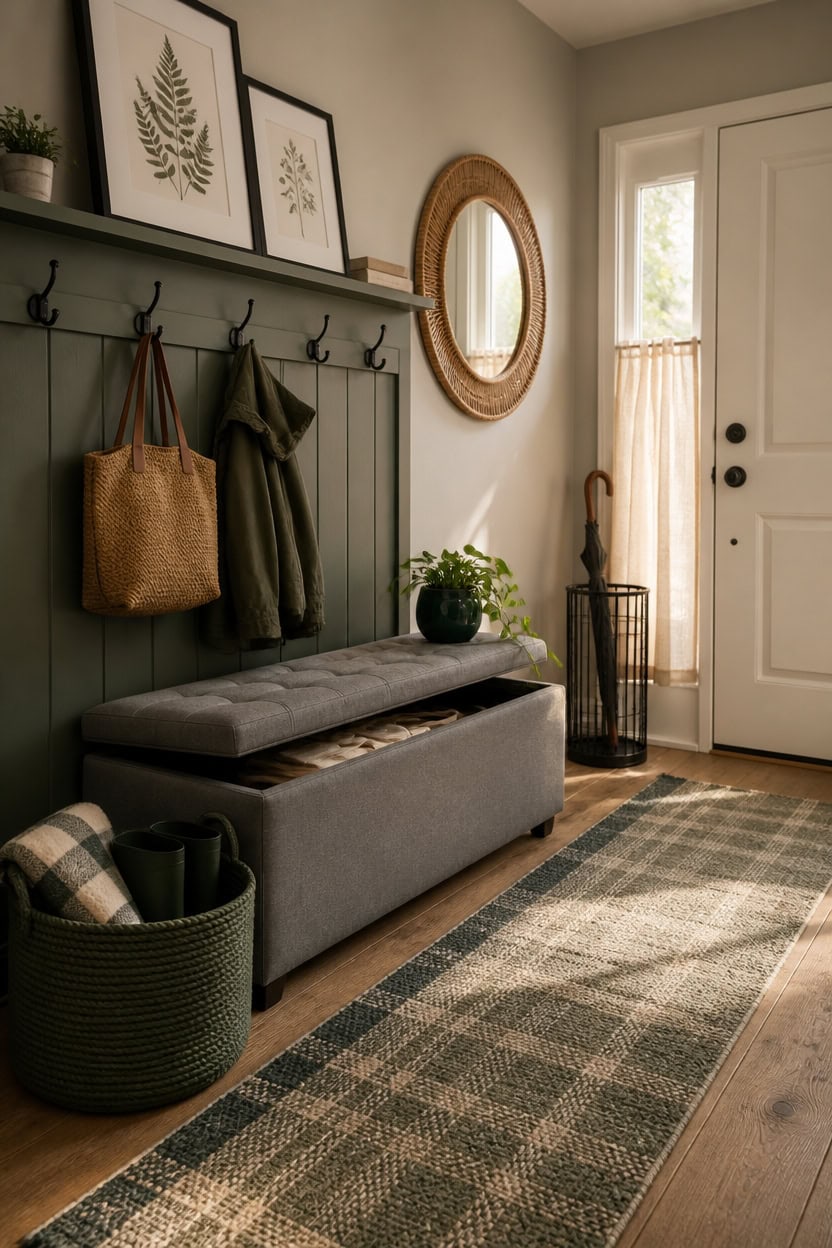
A gray and green mudroom refresh costs between $300 and $800 for most homeowners working with an existing bench and built-in hooks — paint, a few key decor swaps, and one or two new storage pieces get you most of the way there. The biggest budget trap is buying everything new when the bones of the space already work; replacing textiles, adding a runner, and repainting one wall delivers 80% of the visual change for about 20% of a full renovation cost. If your bench is solid and your hooks are functional, spend your money on the surfaces and soft goods that actually show.
Paint first, shop second: A $60 gallon of gray-green paint on the feature wall changes the whole room before you spend a dollar on decor.
Runner over full rug: A 2×6 washable runner costs a fraction of a custom-cut rug and handles the same daily mudroom traffic.
One statement basket: A single forest green storage basket costs under $30 and anchors the color story without buying a full set.
Skip the matching set trap: Coordinated mudroom sets at big-box stores are marked up 40-60% over buying individual pieces that do the same job.
the muted gray-green adds depth to the mudroom without requiring any new furniture to justify the color.
the warm gray keeps the budget refresh feeling intentional and pulled-together rather than half-finished.
Our Favorite Flush Mount Lights
 Chantey Linen Flush Mount
View Price
Chantey Linen Flush Mount
View Price
 Flaire 2-Light Fabric Semi Flush Mount
View Price
Flaire 2-Light Fabric Semi Flush Mount
View Price
 Flaire 4-Light 18" Linen Blend Semi Flush Mount
View Price
Flaire 4-Light 18" Linen Blend Semi Flush Mount
View Price
 Armande Linen LED Flush Mount
View Price
Armande Linen LED Flush Mount
View Price
 Randall Acrylic LED Flush Mount
View Price
Randall Acrylic LED Flush Mount
View Price
 Arjit Acrylic LED Flush Mount
View Price
Arjit Acrylic LED Flush Mount
View Price
 Adeyne 1-Light 10" Glass Semi Flush Mount
View Price
Adeyne 1-Light 10" Glass Semi Flush Mount
View Price
 Boatner Flush Mount with Clear Hammered Glass
View Price
Boatner Flush Mount with Clear Hammered Glass
View Price
 Wilbrecht Glass Semi Flush Mount
View Price
Wilbrecht Glass Semi Flush Mount
View Price
 Salley 5-Light 11" Crystal Flush Mount
View Price
Salley 5-Light 11" Crystal Flush Mount
View Price
 Leanni 3-Light 12" Modern Crystal Flush Mount
View Price
Leanni 3-Light 12" Modern Crystal Flush Mount
View Price
 Amadi 13.5" 2-Light Lantern Semi Flush Mount
View Price
Amadi 13.5" 2-Light Lantern Semi Flush Mount
View Price
 Hubbardton 12" 4-Light Modern Farmhouse Open-Frame Pagoda Lantern Semi Flush Mount
View Price
Hubbardton 12" 4-Light Modern Farmhouse Open-Frame Pagoda Lantern Semi Flush Mount
View Price
 Lepe 3-Light Dimmable Black Cage Semi Flush Mount
View Price
Lepe 3-Light Dimmable Black Cage Semi Flush Mount
View Price
Gray and Green Mudroom Layouts That Actually Function
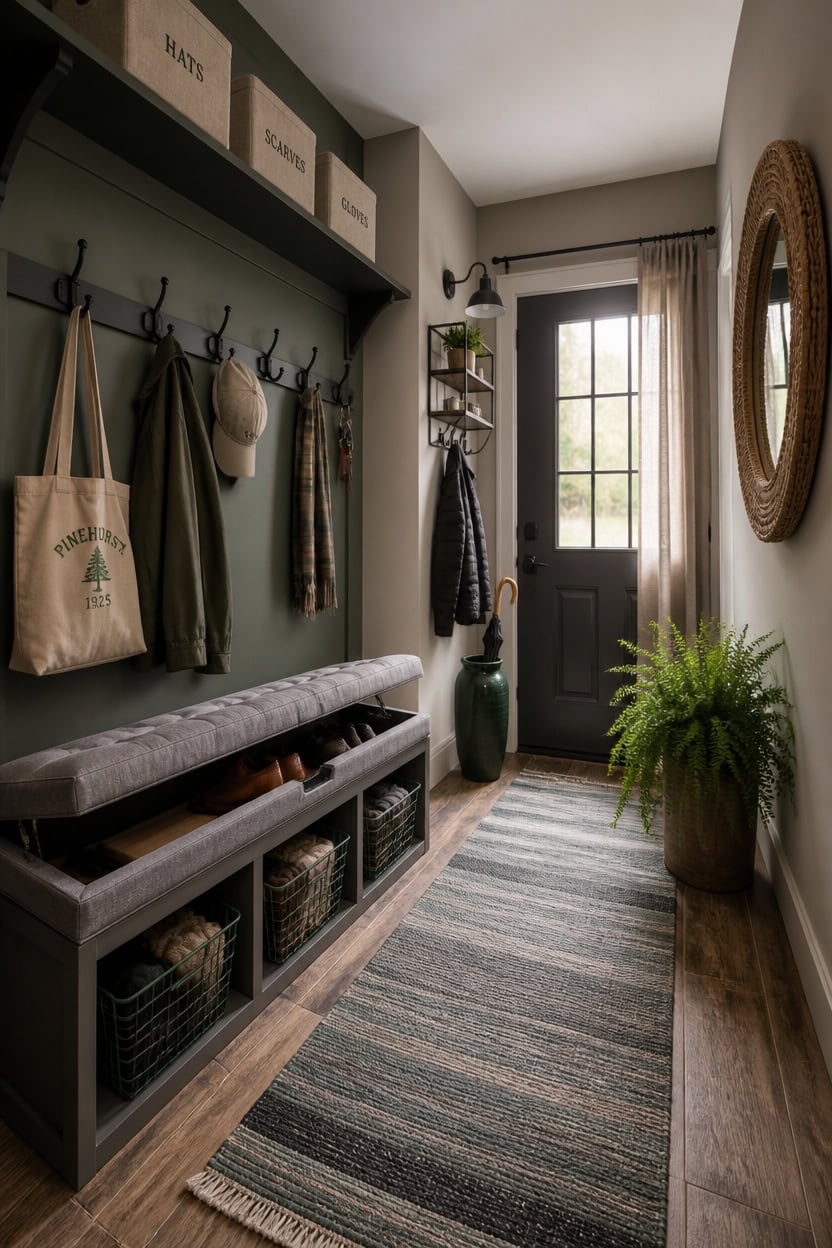
Zones built around the door — not the wall — are what keep mudrooms functional when daily use is the real design brief. Placing hooks at actual use height (54–60 inches for adults, 42 inches for kids) eliminates the daily chaos of dropped bags and missed hangers. A 12-inch-deep bench positioned within arm’s reach of the hook zone means sitting to remove shoes happens naturally instead of on the floor.
Zone by task, not aesthetics: Group hooks, bench, and floor storage in one 4-6 foot run rather than scattering pieces across the room.
Bench placement first: Anchor the bench directly below the hook rail so the drop zone and the sit zone share the same 24-inch footprint.
Vertical before horizontal: In a narrow mudroom, wall-mounted hooks and shelves recover floor space that a cabinet or console would eat permanently.
Keep the path clear: Leave at least 36 inches of walking clearance between the bench and any opposite wall to avoid a bottleneck at the door.
the muted gray-green visually defines the primary drop zone and makes the hook rail feel intentional rather than installed as an afterthought.
matched from the wall in this photo — the closest Benjamin Moore shade.
Our Favorite Coat Racks
 Adosinda Sturdy Wooden 8-Hook Freestanding Coat Rack
View Price
Adosinda Sturdy Wooden 8-Hook Freestanding Coat Rack
View Price
 Coat Rack with Umbrella Holder and 12 Hooks
View Price
Coat Rack with Umbrella Holder and 12 Hooks
View Price
 Shamita 68 Inch Solid Wood 7-Hook Freestanding Coat Rack
View Price
Shamita 68 Inch Solid Wood 7-Hook Freestanding Coat Rack
View Price
 Jedriel 8-Hook Adjustable Wooden Coat Rack
View Price
Jedriel 8-Hook Adjustable Wooden Coat Rack
View Price
 Aiydan Solid Wood Freestanding 8-Hook Coat Rack
View Price
Aiydan Solid Wood Freestanding 8-Hook Coat Rack
View Price
 8-Hook Coat Rack with Storage Shelves
View Price
8-Hook Coat Rack with Storage Shelves
View Price
 14-Hook Steel Freestanding Coat Rack, 3 Heights
View Price
14-Hook Steel Freestanding Coat Rack, 3 Heights
View Price
 Solid Wood Freestanding 8-Hook Coat Rack
View Price
Solid Wood Freestanding 8-Hook Coat Rack
View Price
 Freestanding Metal Coat Rack with Adjustable T-Bar and Marble Base
View Price
Freestanding Metal Coat Rack with Adjustable T-Bar and Marble Base
View Price
 Solid Wood Tree-Shaped Coat Rack with 12 Hooks
View Price
Solid Wood Tree-Shaped Coat Rack with 12 Hooks
View Price
 Rotating Solid Wood Coat Rack with 3 Shelves and 9 Hooks
View Price
Rotating Solid Wood Coat Rack with 3 Shelves and 9 Hooks
View Price
 Casimir Cactus Solid Wood Coat Rack
View Price
Casimir Cactus Solid Wood Coat Rack
View Price
 Solid Wood Coat Rack with Removable Laundry Basket
View Price
Solid Wood Coat Rack with Removable Laundry Basket
View Price
 Solid Wood Freestanding 6-Hook Coat Rack
View Price
Solid Wood Freestanding 6-Hook Coat Rack
View Price
 Houma Freestanding 8-Hook Coat Rack
View Price
Houma Freestanding 8-Hook Coat Rack
View Price
 Ryhmes Iron Freestanding 20-Hook Coat Rack
View Price
Ryhmes Iron Freestanding 20-Hook Coat Rack
View Price
 Arine Solid Wood Freestanding Valet Stand
View Price
Arine Solid Wood Freestanding Valet Stand
View Price
 Ameeta 8-Hook Solid Wood Coat Rack
View Price
Ameeta 8-Hook Solid Wood Coat Rack
View Price
 Marriott 11-Hook Freestanding Coat Rack, Tobacco
View Price
Marriott 11-Hook Freestanding Coat Rack, Tobacco
View Price
 Nauvoo 67 Inch Brushed Steel Coat Tree
View Price
Nauvoo 67 Inch Brushed Steel Coat Tree
View Price
 Janiya 8-Hook Solid Wood Freestanding Coat Rack
View Price
Janiya 8-Hook Solid Wood Freestanding Coat Rack
View Price
 Gerlien Standing Coat Rack
View Price
Gerlien Standing Coat Rack
View Price
 Anaja Solid Wood Freestanding 8-Hook Coat Rack
View Price
Anaja Solid Wood Freestanding 8-Hook Coat Rack
View Price
 Trikomou Solid Wood 8-Hook Freestanding Coat Rack
View Price
Trikomou Solid Wood 8-Hook Freestanding Coat Rack
View Price
 Adjustable 68 Inch Freestanding Coat Rack
View Price
Adjustable 68 Inch Freestanding Coat Rack
View Price
 Johnstown 11-Hook Metal Freestanding Coat Rack
View Price
Johnstown 11-Hook Metal Freestanding Coat Rack
View Price
 65 Inch Freestanding Coat Rack with Rotating Storage Shelves
View Price
65 Inch Freestanding Coat Rack with Rotating Storage Shelves
View Price
 Helmfried Metal Freestanding Coat Rack
View Price
Helmfried Metal Freestanding Coat Rack
View Price
 Beladora Steel 8-Hook Coat Rack with Marble Base
View Price
Beladora Steel 8-Hook Coat Rack with Marble Base
View Price
 360-Degree Rotating Coat Rack with Mirror
View Price
360-Degree Rotating Coat Rack with Mirror
View Price
 Lakwanzaa 6-Hook Coat Rack
View Price
Lakwanzaa 6-Hook Coat Rack
View Price
 Rotating Solid Wood Coat Rack with Storage Shelves and 9 Hooks
View Price
Rotating Solid Wood Coat Rack with Storage Shelves and 9 Hooks
View Price
 Metal Freestanding Coat Rack, Black
View Price
Metal Freestanding Coat Rack, Black
View Price
 Donan 8-Hook Freestanding Coat Rack
View Price
Donan 8-Hook Freestanding Coat Rack
View Price
 Deionta Solid Wood Freestanding 8-Hook Coat Rack
View Price
Deionta Solid Wood Freestanding 8-Hook Coat Rack
View Price
 Darrias 5-Hook Freestanding Coat Rack with Marble Base
View Price
Darrias 5-Hook Freestanding Coat Rack with Marble Base
View Price
 Wooden 11-Hook Coat Rack with Round Base
View Price
Wooden 11-Hook Coat Rack with Round Base
View Price
Wall Storage Worth Installing in a Gray and Green Mudroom
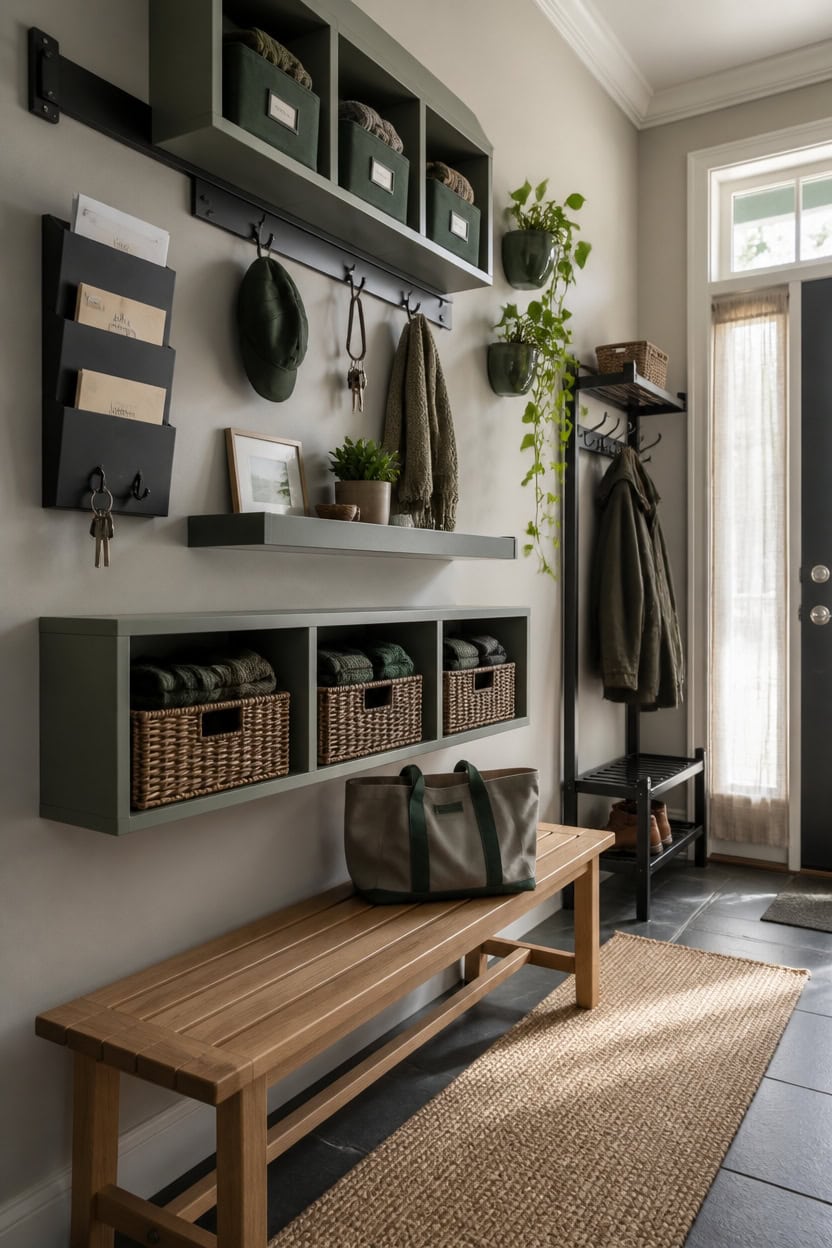
Floating shelves and wall-mounted systems do more functional work in a mudroom than freestanding furniture ever could, because vertical space above 72 inches is almost always wasted in an entry zone. A wall system anchored with a French cleat or heavy-duty rail lets you adjust shelf heights as your storage needs shift — without patching drywall when the setup stops working. In a gray and green mudroom, limiting hardware finishes to matte black or brushed nickel prevents visual competition with the wall color.
Mount at compression points: Install shelves above the hook rail (68–72 inches) for bags and bins, not at eye level where they block sightlines and make the space feel cluttered.
One rail, multiple functions: A modular wall rail system with interchangeable hooks, shelves, and baskets gives you a single install that handles coats, mail, keys, and seasonal gear without separate anchor points.
Box shelves over open planks: Closed-back floating cubbies contain clutter better than open shelves in a mudroom — loose items stay contained instead of shifting and falling onto the bench below.
Limit shelf depth to 10–12 inches: Deeper shelves in a narrow entryway eat into walking clearance; shallower shelves hold bins and baskets without becoming a hazard.
the muted gray-green turns recessed shelf backs into deliberate color moments rather than unfinished-looking gaps.
matched from the wall in this photo — the closest Benjamin Moore shade.
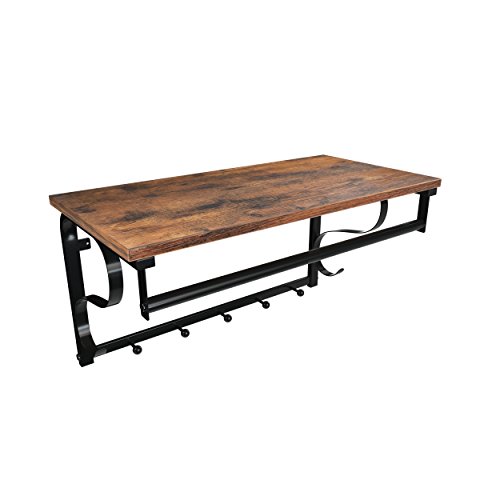 VASAGLE Coat Rack Wall Mount, Wall Hooks with Shelf, Hanging Rail, 5 Hooks
View Price
VASAGLE Coat Rack Wall Mount, Wall Hooks with Shelf, Hanging Rail, 5 Hooks
View Price
 Yunkeeper Black Fabric Cubby Storage Bins,13x13x13 Inches,Cube Organizer Bin Foldable Storage Boxes with Dual Handles Fabric Organizer Box and collapsible Storage basket,Set of 3,Green
View Price
Yunkeeper Black Fabric Cubby Storage Bins,13x13x13 Inches,Cube Organizer Bin Foldable Storage Boxes with Dual Handles Fabric Organizer Box and collapsible Storage basket,Set of 3,Green
View Price
 Solrot Grey Floating Shelves for Wall Decor, 36 in Shelf with Lip Set of 2
View Price
Solrot Grey Floating Shelves for Wall Decor, 36 in Shelf with Lip Set of 2
View Price
 DLQuarts Solid Wood Mail Organizer with Key Holder for Wall, Mail Sorter Wall Mounted, Decorative Wooden Key and Mail Holder with 3 Hooks, Matte Black
View Price
DLQuarts Solid Wood Mail Organizer with Key Holder for Wall, Mail Sorter Wall Mounted, Decorative Wooden Key and Mail Holder with 3 Hooks, Matte Black
View Price
 Onlytak Large Wicker Storage Basket, Metal Frame, Set of 2, Washable Waterproof, 15" x 10.3" x 5.2", Brown Color, Woven Basket for Pantry, Toilet, Bathroom, Bedroom, Patio
View Price
Onlytak Large Wicker Storage Basket, Metal Frame, Set of 2, Washable Waterproof, 15" x 10.3" x 5.2", Brown Color, Woven Basket for Pantry, Toilet, Bathroom, Bedroom, Patio
View Price
 Dahey Small Wall Planters, 2 Pack Ceramic Holder with Artificial Succulents
View Price
Dahey Small Wall Planters, 2 Pack Ceramic Holder with Artificial Succulents
View Price
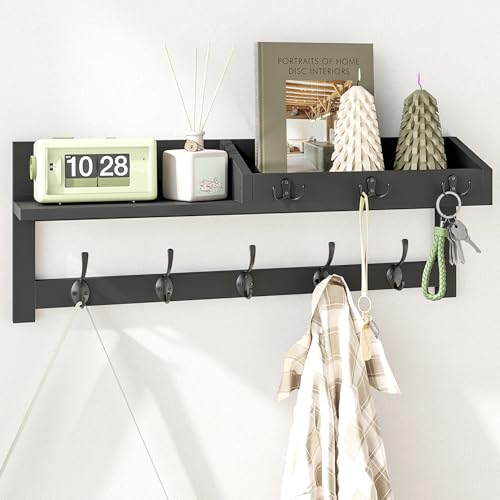 AMBIRD Wall Hooks with Shelf, 26.57 Inch Entryway Wood Coat Hooks for Wall, Coat Rack Wall Mount Rack with 5 Dual Hooks 3 Key Hooks Mail Organizer and Key Rack Key Holder (Black)
View Price
AMBIRD Wall Hooks with Shelf, 26.57 Inch Entryway Wood Coat Hooks for Wall, Coat Rack Wall Mount Rack with 5 Dual Hooks 3 Key Hooks Mail Organizer and Key Rack Key Holder (Black)
View Price
Our Favorite Full-Length Mirrors
 Arch Free Standing Full Length Mirror - Basics by Wayfair™
View Price
Arch Free Standing Full Length Mirror - Basics by Wayfair™
View Price
 Vertell Oversize Rectangle Full Length Metal Mirror with Stand
View Price
Vertell Oversize Rectangle Full Length Metal Mirror with Stand
View Price
 Arched Metal Oversized Full Length Mirror - Basics by Wayfair™
View Price
Arched Metal Oversized Full Length Mirror - Basics by Wayfair™
View Price
 Shatterproof Arch Full Length Mirror - Basics by Wayfair™
View Price
Shatterproof Arch Full Length Mirror - Basics by Wayfair™
View Price
 Arched Metal Oversized Full Length Mirror with Stand
View Price
Arched Metal Oversized Full Length Mirror with Stand
View Price
 Mirta Rectangle Metal Full Length Mirror
View Price
Mirta Rectangle Metal Full Length Mirror
View Price
 Large Oversized Arched Floor Mirror with Stand
View Price
Large Oversized Arched Floor Mirror with Stand
View Price
 Arched Metal Oversized Full-Length Mirror
View Price
Arched Metal Oversized Full-Length Mirror
View Price
The Right Flooring to Ground a Gray and Green Mudroom
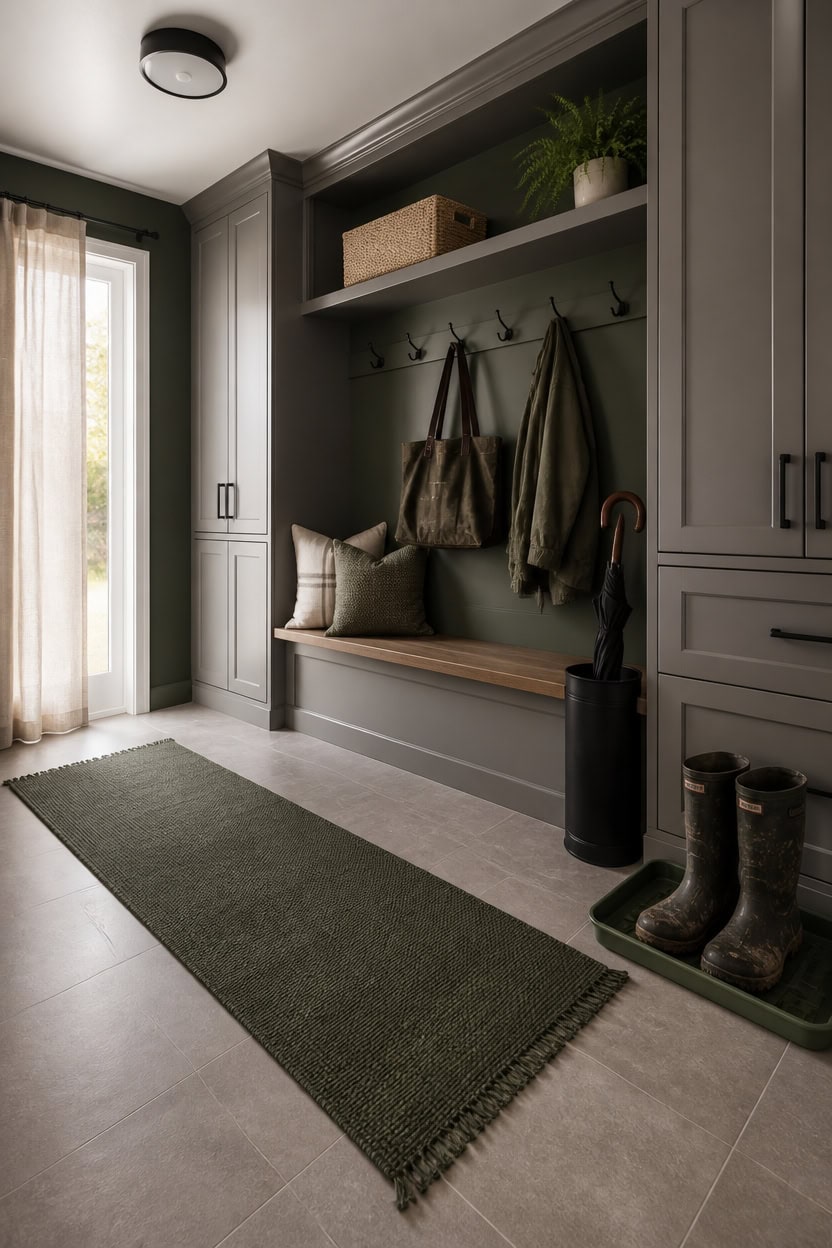
Porcelain tile in a warm gray or slate tone is the most durable and water-resistant flooring choice for a mudroom, and it performs better than wood, vinyl, or stone under the repeated abuse of wet boots and tracked-in dirt. Larger format tiles (18×18 or 24×24) reduce grout lines, which means less scrubbing in a space that earns every cleaning it gets. If you want the gray and green color story to extend to the floor, a hexagonal gray tile with green grout adds personality without requiring a decorative rug you’ll replace yearly.
Size up the tile format: Large-format tile (18×18 minimum) makes a mudroom feel wider and cuts down on grout maintenance in a high-traffic zone.
Skip high-gloss finishes: Matte or textured tile surfaces hide dirt between cleanings; glossy floors show every footprint within an hour.
Layer with a washable runner: A cotton or low-pile runner over tile at the entry point protects the floor surface and adds green into the floor plane without a permanent commitment.
Warm the gray with undertone matching: Choose a gray tile with a slight warm undertone so it reads as stone-adjacent rather than cold concrete under mudroom lighting.
matched from the wall in this photo — the closest Benjamin Moore shade.
the muted gray-green anchors the storage zone and makes the flooring read as intentionally grounded rather than default.
Our Favorite Shoe Storage
 30-Pair Fluted Shoe Storage Cabinet
View Price
30-Pair Fluted Shoe Storage Cabinet
View Price
 Clie 16-Pair Shoe Storage Cabinet
View Price
Clie 16-Pair Shoe Storage Cabinet
View Price
 30-Pair Shoe Cabinet
View Price
30-Pair Shoe Cabinet
View Price
 Ishpreet 5-Tier Shoe Storage Cabinet with Doors and Drawer
View Price
Ishpreet 5-Tier Shoe Storage Cabinet with Doors and Drawer
View Price
 Cerina Boho Natural Rattan Shoe Storage Cabinet
View Price
Cerina Boho Natural Rattan Shoe Storage Cabinet
View Price
 Millan 16-Pair Shoe Storage Cabinet
View Price
Millan 16-Pair Shoe Storage Cabinet
View Price
 Abbi 48-60 Pair Stackable Shoe Rack with Adjustable Shelves
View Price
Abbi 48-60 Pair Stackable Shoe Rack with Adjustable Shelves
View Price
 Millan 12-Pair Shoe Storage Cabinet
View Price
Millan 12-Pair Shoe Storage Cabinet
View Price
 Modern Minimalist Large Capacity Shoe Cabinet
View Price
Modern Minimalist Large Capacity Shoe Cabinet
View Price
 Modern Minimalist Large Capacity Shoe Cabinet, Wide
View Price
Modern Minimalist Large Capacity Shoe Cabinet, Wide
View Price
 20-Pair Shoe Storage Cabinet
View Price
20-Pair Shoe Storage Cabinet
View Price
 Acanthe 24-Pair Shoe Storage Cabinet with 2 Shutter Doors
View Price
Acanthe 24-Pair Shoe Storage Cabinet with 2 Shutter Doors
View Price
 Alheide 5-Tier 20-Pair Shoe Rack
View Price
Alheide 5-Tier 20-Pair Shoe Rack
View Price
 Vertical Wood Shoe Rack and Organizer for Entryway
View Price
Vertical Wood Shoe Rack and Organizer for Entryway
View Price
 47 Inch Fluted Entryway Shoe Storage Bench with 4 Doors
View Price
47 Inch Fluted Entryway Shoe Storage Bench with 4 Doors
View Price
 42.6 Inch Modern Farmhouse Upholstered Shoe Storage Bench
View Price
42.6 Inch Modern Farmhouse Upholstered Shoe Storage Bench
View Price
 16-Pair Shoe Storage Cabinet with 2 Flip Drawers
View Price
16-Pair Shoe Storage Cabinet with 2 Flip Drawers
View Price
 24-Pair Shoe Storage Cabinet with Flip Drawers
View Price
24-Pair Shoe Storage Cabinet with Flip Drawers
View Price
 16-Pair Shoe Storage Cabinet with 2 Flip Drawers, Wide
View Price
16-Pair Shoe Storage Cabinet with 2 Flip Drawers, Wide
View Price
 39 Inch Shoe Bench with Storage and LED Light
View Price
39 Inch Shoe Bench with Storage and LED Light
View Price
 Entryway Shoe Storage Bench with Cushion and 4 Doors
View Price
Entryway Shoe Storage Bench with Cushion and 4 Doors
View Price
 Alcester Lismore 20-Pair Shoe Storage Cabinet
View Price
Alcester Lismore 20-Pair Shoe Storage Cabinet
View Price
 33 Inch 3-Tier Stackable Metal Shoe Rack
View Price
33 Inch 3-Tier Stackable Metal Shoe Rack
View Price
 Lasherrie Shoe Storage Cabinet with 3 Flip Drawers
View Price
Lasherrie Shoe Storage Cabinet with 3 Flip Drawers
View Price
 32 Inch 2-Tier Stackable Wire Grid Shoe Rack
View Price
32 Inch 2-Tier Stackable Wire Grid Shoe Rack
View Price
 24-Pair Shoe Storage Cabinet
View Price
24-Pair Shoe Storage Cabinet
View Price
 3-Tier Shoe Storage Cabinet with Flip Drawers, 16-20 Pairs
View Price
3-Tier Shoe Storage Cabinet with Flip Drawers, 16-20 Pairs
View Price
 31.5 Inch Wood Shoe Storage Cabinet
View Price
31.5 Inch Wood Shoe Storage Cabinet
View Price
 3-Tier 16-Pair Stackable Bamboo Shoe Rack
View Price
3-Tier 16-Pair Stackable Bamboo Shoe Rack
View Price
 Kendricks 24-Pair Shoe Storage Cabinet
View Price
Kendricks 24-Pair Shoe Storage Cabinet
View Price
 8-Pair Shoe Storage Bench
View Price
8-Pair Shoe Storage Bench
View Price
 Darlington 36-Pair Free Standing Shoe Storage Cabinet
View Price
Darlington 36-Pair Free Standing Shoe Storage Cabinet
View Price
 3-Tier Solid Wood Shoe Rack
View Price
3-Tier Solid Wood Shoe Rack
View Price
 Arney 10-Pair Shoe Storage Bench with Adjustable Shelves
View Price
Arney 10-Pair Shoe Storage Bench with Adjustable Shelves
View Price
 Chada 30-Pair Rattan Shoe Storage Cabinet with 3 Doors
View Price
Chada 30-Pair Rattan Shoe Storage Cabinet with 3 Doors
View Price
 32-40 Pair Stackable Shoe Rack with Adjustable Shelves
View Price
32-40 Pair Stackable Shoe Rack with Adjustable Shelves
View Price
 44 Inch Ultra Long 2-Tier 15-Pair Shoe Rack
View Price
44 Inch Ultra Long 2-Tier 15-Pair Shoe Rack
View Price
 12-Tier Wide Free Standing Shoe Storage Cabinet
View Price
12-Tier Wide Free Standing Shoe Storage Cabinet
View Price
 24-Pair Shoe Storage Cabinet with 4 Doors and 2 Drawers
View Price
24-Pair Shoe Storage Cabinet with 4 Doors and 2 Drawers
View Price
 Anteus Storage Shoe Bench with Coat Rack and Seat Cushion
View Price
Anteus Storage Shoe Bench with Coat Rack and Seat Cushion
View Price
Lighting That Makes Gray and Green Come Alive
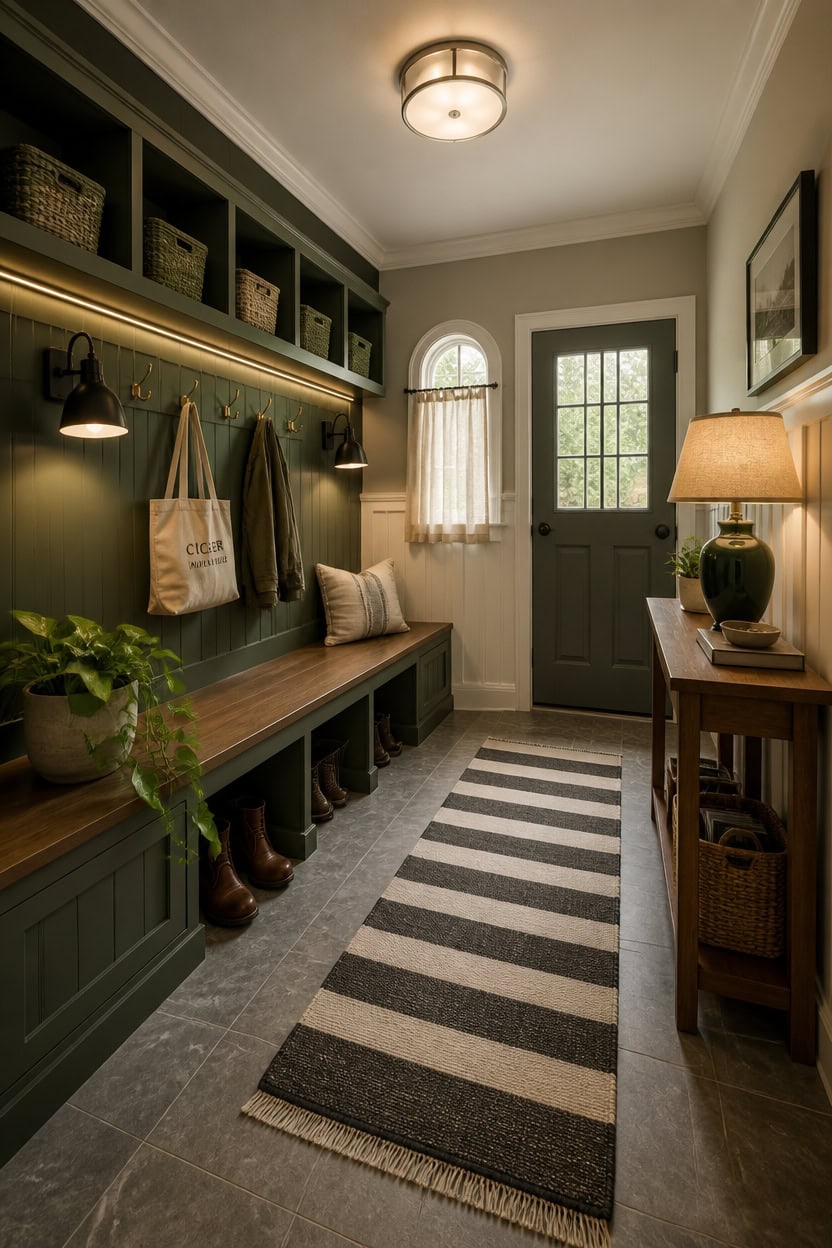
Warm white or soft yellow-toned light sources make gray and green mudroom colors read as intentional rather than accidental. Cool or blue-toned LEDs flatten gray into something closer to concrete and strip green of its warmth, turning a carefully chosen palette into a forgettable one. A 2700K–3000K bulb temperature is the target range for any fixture you install or replace in this space.
Match bulb temperature to palette: Bulbs in the 2700K–3000K range bring out the warm undertones in gray tile and keep green looking earthy rather than clinical.
Layer your light sources: A ceiling fixture handles general coverage, but a wall sconce or under-cabinet strip light adds depth and eliminates the flat, single-source look most mudrooms default to.
Point light at the green wall: Directing even one focused light source toward a green accent wall amplifies the color and makes the whole room feel more finished.
Use dimmer-compatible fixtures: Mudroom lighting that dims lets you cut the harshness during low-traffic hours without swapping out bulbs or fixtures.
matched from the wall in this photo — the closest Benjamin Moore shade.
the muted green surface reflects warm light back into the room and gives the lighting a visible focal point to work with.
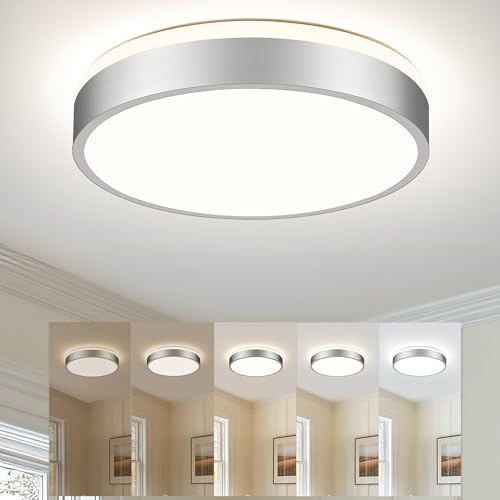 Ken & Ricky 12" Modern Flush Mount Ceiling Light,Brush Nickel,1 Pack
View Price
Ken & Ricky 12" Modern Flush Mount Ceiling Light,Brush Nickel,1 Pack
View Price
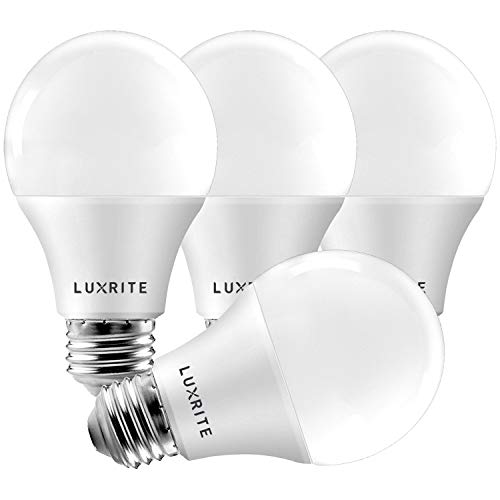 LUXRITE A19 LED Light Bulb 60W Equivalent 800LM, 2700K Warm White (4 Pack)
View Price
LUXRITE A19 LED Light Bulb 60W Equivalent 800LM, 2700K Warm White (4 Pack)
View Price
 Modern LED Wall Sconces, 3000K Warm White Hardwired Wall Lights Set of 2
View Price
Modern LED Wall Sconces, 3000K Warm White Hardwired Wall Lights Set of 2
View Price
 Abani Madeline 20” Table Lamp – Green Ceramic Base with Wheat Linen Tapered Shade, E26 2-Way Bulb Included – Modern Bedside Lamp for Bedroom, Living Room or Nightstand
View Price
Abani Madeline 20” Table Lamp – Green Ceramic Base with Wheat Linen Tapered Shade, E26 2-Way Bulb Included – Modern Bedside Lamp for Bedroom, Living Room or Nightstand
View Price
 Under Cabinet LED Lighting Kit for Kitchen Cabinet Counters Shelf Closet. 6 PCS 12 Inches Light Strip with Adapter Switch Dimmer Extension Cable. Plug in. Dimmable. 1500 Lumen. Warm White 2700K
View Price
Under Cabinet LED Lighting Kit for Kitchen Cabinet Counters Shelf Closet. 6 PCS 12 Inches Light Strip with Adapter Switch Dimmer Extension Cable. Plug in. Dimmable. 1500 Lumen. Warm White 2700K
View Price
 Dijiahua 2 Pack Modern Pendant Lights, 1-Light Hanging Light Fixture with 2-Tiers Beige Linen Fabric Drum Lamp Shade,Boho Farmhouse Adjustable Mini Ceiling Chandelier for Kitchen Island Hallway
View Price
Dijiahua 2 Pack Modern Pendant Lights, 1-Light Hanging Light Fixture with 2-Tiers Beige Linen Fabric Drum Lamp Shade,Boho Farmhouse Adjustable Mini Ceiling Chandelier for Kitchen Island Hallway
View Price
 Goo-Ki Antique Brass Coat Rack Wall Mount, Heavy Duty Zinc Wall Mounted Coat Hooks with Escutcheon Backplate, Vintage Hat and Towel Hanger Rail for Entryway, Bathroom and Mudroom (5 Hooks)
View Price
Goo-Ki Antique Brass Coat Rack Wall Mount, Heavy Duty Zinc Wall Mounted Coat Hooks with Escutcheon Backplate, Vintage Hat and Towel Hanger Rail for Entryway, Bathroom and Mudroom (5 Hooks)
View Price
 Kingwillow Baskets Woven Maize Storage Bins Set of 3 (Green,Rectangular)
View Price
Kingwillow Baskets Woven Maize Storage Bins Set of 3 (Green,Rectangular)
View Price
Removable Wallpaper for This Palette
Removable designer wallpaper from Wallshoppe, picked to match this palette. An easy way to add pattern to any room, and every design is available as a sample.
 The Queens Lace' Wallpaper by Sarah Jessica Parker – Silver
View Price
The Queens Lace' Wallpaper by Sarah Jessica Parker – Silver
View Price
 The Queens Lace' Wallpaper by Sarah Jessica Parker – Pepper
View Price
The Queens Lace' Wallpaper by Sarah Jessica Parker – Pepper
View Price
 Bellport Madras Large Wallpaper by Chris Benz – Blue
View Price
Bellport Madras Large Wallpaper by Chris Benz – Blue
View Price
 Townhouse Wallpaper by Sarah Jessica Parker – Peacock
View Price
Townhouse Wallpaper by Sarah Jessica Parker – Peacock
View Price
 Pacifico Palm Wallpaper by Nathan Turner – Ivory
View Price
Pacifico Palm Wallpaper by Nathan Turner – Ivory
View Price
 Pacifico Palm Wallpaper by Nathan Turner – Green on Indigo
View Price
Pacifico Palm Wallpaper by Nathan Turner – Green on Indigo
View Price
 Arance Dolci Wallpaper by Carly Beck – Pink
View Price
Arance Dolci Wallpaper by Carly Beck – Pink
View Price
 Buka Patchwork Wallpaper by Chris Benz – Green
View Price
Buka Patchwork Wallpaper by Chris Benz – Green
View Price
 The Queens Lace' Wallpaper by Sarah Jessica Parker – Misty Blue
View Price
The Queens Lace' Wallpaper by Sarah Jessica Parker – Misty Blue
View Price
 Townhouse Wallpaper by Sarah Jessica Parker – Pearl on Charcoal
View Price
Townhouse Wallpaper by Sarah Jessica Parker – Pearl on Charcoal
View Price
 Pacifico Palm Wallpaper by Nathan Turner – Pink
View Price
Pacifico Palm Wallpaper by Nathan Turner – Pink
View Price
 Townhouse Wallpaper by Sarah Jessica Parker – Pearl on Parchment
View Price
Townhouse Wallpaper by Sarah Jessica Parker – Pearl on Parchment
View Price
 El Quijote Wallpaper by Chris Benz – Multi / Blue / Green
View Price
El Quijote Wallpaper by Chris Benz – Multi / Blue / Green
View Price
 Monroe Street Wallpaper by Chris Benz – Yellow
View Price
Monroe Street Wallpaper by Chris Benz – Yellow
View Price
 Lafayette Patchwork Wallpaper by Chris Benz – Teal
View Price
Lafayette Patchwork Wallpaper by Chris Benz – Teal
View Price
 Barbara Ann Wallpaper by Wallshoppe – Army Green
View Price
Barbara Ann Wallpaper by Wallshoppe – Army Green
View Price
 The Queens Lace' Wallpaper by Sarah Jessica Parker – Oyster
View Price
The Queens Lace' Wallpaper by Sarah Jessica Parker – Oyster
View Price
 Pacifico Palm Wallpaper by Nathan Turner – Peach
View Price
Pacifico Palm Wallpaper by Nathan Turner – Peach
View Price
 Fiddle Fig Wallpaper by Nathan Turner – Indigo
View Price
Fiddle Fig Wallpaper by Nathan Turner – Indigo
View Price
 Sweet Caroline Wallpaper by Wallshoppe – Fog
View Price
Sweet Caroline Wallpaper by Wallshoppe – Fog
View Price
 Townhouse Wallpaper by Sarah Jessica Parker – Morning Dew on Misty Blue
View Price
Townhouse Wallpaper by Sarah Jessica Parker – Morning Dew on Misty Blue
View Price
 Best Fronds Wallpaper by Wallshoppe – Storm
View Price
Best Fronds Wallpaper by Wallshoppe – Storm
View Price
 Arance Dolci Wallpaper by Carly Beck – Orange
View Price
Arance Dolci Wallpaper by Carly Beck – Orange
View Price
 Lemons Wallpaper by Nathan Turner – Peacock
View Price
Lemons Wallpaper by Nathan Turner – Peacock
View Price
 Pacifico Palm Wallpaper by Nathan Turner – Onyx
View Price
Pacifico Palm Wallpaper by Nathan Turner – Onyx
View Price
 Townhouse Wallpaper by Sarah Jessica Parker – Silver on Sage
View Price
Townhouse Wallpaper by Sarah Jessica Parker – Silver on Sage
View Price
 Pinstripe Wallpaper by Sugar Paper – Grey
View Price
Pinstripe Wallpaper by Sugar Paper – Grey
View Price
 Small Dumbo Wallpaper by Chris Benz – Black
View Price
Small Dumbo Wallpaper by Chris Benz – Black
View Price
 Sidewalk Wallpaper by Chris Benz – Green
View Price
Sidewalk Wallpaper by Chris Benz – Green
View Price
 Best Fronds Wallpaper by Wallshoppe – Gray
View Price
Best Fronds Wallpaper by Wallshoppe – Gray
View Price
 Townhouse Wallpaper by Sarah Jessica Parker – Pearl on Deep Navy
View Price
Townhouse Wallpaper by Sarah Jessica Parker – Pearl on Deep Navy
View Price
 Lafayette Patchwork Wallpaper by Chris Benz – Green
View Price
Lafayette Patchwork Wallpaper by Chris Benz – Green
View Price
 Sweet Caroline Wallpaper by Wallshoppe – Green
View Price
Sweet Caroline Wallpaper by Wallshoppe – Green
View Price
 Lemons Wallpaper by Nathan Turner – White
View Price
Lemons Wallpaper by Nathan Turner – White
View Price
 Pacifico Palm Wallpaper by Nathan Turner – Sky Blue
View Price
Pacifico Palm Wallpaper by Nathan Turner – Sky Blue
View Price
 Mums for Marion Wallpaper by Sarah Jessica Parker – Navy
View Price
Mums for Marion Wallpaper by Sarah Jessica Parker – Navy
View Price
 Bloc Wallpaper by Wallshoppe – Stone
View Price
Bloc Wallpaper by Wallshoppe – Stone
View Price
 Fleur De Camomille Wallpaper by Sarah Jessica Parker – Parchment
View Price
Fleur De Camomille Wallpaper by Sarah Jessica Parker – Parchment
View Price
 Eleanor Rigby Wallpaper by Wallshoppe – Storm
View Price
Eleanor Rigby Wallpaper by Wallshoppe – Storm
View Price
 Fiddle Fig Wallpaper by Nathan Turner – White
View Price
Fiddle Fig Wallpaper by Nathan Turner – White
View Price
What to Do When Your Gray and Green Mudroom Has No Natural Light
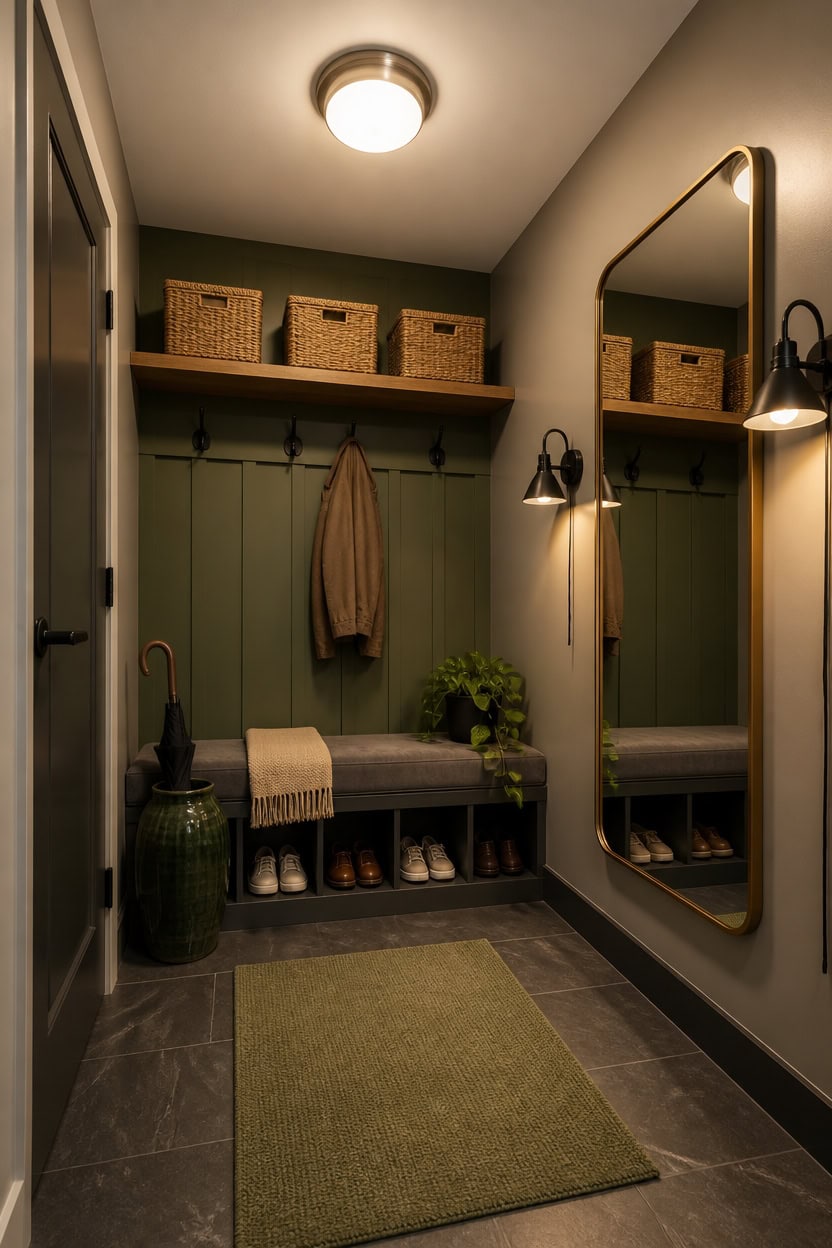
Mirror placement does more work in a windowless mudroom than any other single fix — position one large mirror on the wall opposite the entry door to bounce artificial light across the full width of the space. Warm-toned bulbs at 2700K–3000K are non-negotiable here because cool LEDs will make gray read as concrete and green read as mold in a space with zero daylight correction. If your ceiling height allows, stack your light sources vertically — a flush mount above, a sconce at shoulder height — so the room has a light gradient instead of one flat pool.
Mirror placement: A 24×36 or larger mirror on the wall opposite the entry multiplies existing light without adding a single fixture.
Bulb temperature: Stay at 2700K–3000K to keep gray warm and green earthy — cool-toned bulbs turn both colors muddy with no daylight to correct them.
Layer two sources minimum: One ceiling fixture alone creates shadows at floor level where mudrooms store most of their clutter — add a wall sconce or plug-in light at mid-height.
Use light paint values: Choose gray and green shades with an LRV above 50 so the walls reflect light back into the room rather than absorbing it.
this warm mid-tone gray has an LRV of 58, making it one of the highest-reflecting grays that still reads as a true color in a no-window space.
its muted, low-saturation tone holds up beautifully under artificial warm light without pulling yellow or brown the way brighter greens do.
Our Favorite Hall Trees
 Farmhouse Hall Tree with Bench, Shoe Storage, Side Baskets and Hooks
View Price
Farmhouse Hall Tree with Bench, Shoe Storage, Side Baskets and Hooks
View Price
 4-in-1 Hall Tree with Cushion and Open Shoe Cabinet
View Price
4-in-1 Hall Tree with Cushion and Open Shoe Cabinet
View Price
 Farmhouse Hall Tree with Shoe Bench
View Price
Farmhouse Hall Tree with Shoe Bench
View Price
 Jaxsin Farmhouse 59 Inch Hall Tree with Bench and Shoe Storage
View Price
Jaxsin Farmhouse 59 Inch Hall Tree with Bench and Shoe Storage
View Price
 Seaside 40 Inch Hall Tree with Bench and Shoe Storage
View Price
Seaside 40 Inch Hall Tree with Bench and Shoe Storage
View Price
 Hall Tree with Storage Bench, Cabinets and Hooks
View Price
Hall Tree with Storage Bench, Cabinets and Hooks
View Price
 Rebhun LED Lighting Hall Tree with Shoe Storage
View Price
Rebhun LED Lighting Hall Tree with Shoe Storage
View Price
 Jaxsin 51 Inch Hall Tree with Bench and Shoe Storage
View Price
Jaxsin 51 Inch Hall Tree with Bench and Shoe Storage
View Price
 4-in-1 Hall Tree with 6 Golden Hooks and 2-Drawer Bench
View Price
4-in-1 Hall Tree with 6 Golden Hooks and 2-Drawer Bench
View Price
 59 Inch Farmhouse Hall Tree with Bench and Shoe Storage
View Price
59 Inch Farmhouse Hall Tree with Bench and Shoe Storage
View Price
 Thirza 39 Inch Hall Tree with Shoe Storage
View Price
Thirza 39 Inch Hall Tree with Shoe Storage
View Price
 53 Inch Hall Tree and Shoe Storage Bench with Shelves and Coat Hooks
View Price
53 Inch Hall Tree and Shoe Storage Bench with Shelves and Coat Hooks
View Price
 Chessani Hall Tree with Bench and Shoe Storage
View Price
Chessani Hall Tree with Bench and Shoe Storage
View Price
 Farmhouse 4-in-1 Hall Tree with Storage Bench
View Price
Farmhouse 4-in-1 Hall Tree with Storage Bench
View Price
 Hall Tree with Bench and Shoe Storage
View Price
Hall Tree with Bench and Shoe Storage
View Price
 Crinole 31.5 Inch Hall Tree with Bench
View Price
Crinole 31.5 Inch Hall Tree with Bench
View Price
 Amberjo 59 Inch Hall Tree with Bench and Shoe Storage
View Price
Amberjo 59 Inch Hall Tree with Bench and Shoe Storage
View Price
 Lismore 31 Inch Hall Tree with Bench and Shoe Storage
View Price
Lismore 31 Inch Hall Tree with Bench and Shoe Storage
View Price
 Arch Hall Tree with Bench, Shoe Storage and 4 Hooks
View Price
Arch Hall Tree with Bench, Shoe Storage and 4 Hooks
View Price
 Veere 38 Inch Hall Tree with Bench and Shoe Storage
View Price
Veere 38 Inch Hall Tree with Bench and Shoe Storage
View Price
 6-in-1 Farmhouse Hall Tree with Shoe Storage Bench
View Price
6-in-1 Farmhouse Hall Tree with Shoe Storage Bench
View Price
 Industrial Hall Tree with Bench, Shoe Storage and 6 Hooks
View Price
Industrial Hall Tree with Bench, Shoe Storage and 6 Hooks
View Price
 3-in-1 Hall Tree with Shoe Storage and Standing Coat Rack
View Price
3-in-1 Hall Tree with Shoe Storage and Standing Coat Rack
View Price
 Hall Tree with Bench, Shoe Storage and 4 Hooks
View Price
Hall Tree with Bench, Shoe Storage and 4 Hooks
View Price
 Ameria Hall Tree with Bench and Shoe Storage
View Price
Ameria Hall Tree with Bench and Shoe Storage
View Price
 76 Inch Farmhouse 4-in-1 Hall Tree with Bench and Shoe Storage
View Price
76 Inch Farmhouse 4-in-1 Hall Tree with Bench and Shoe Storage
View Price
 All-in-One Retro Arched Hall Tree with Adjustable Shelves
View Price
All-in-One Retro Arched Hall Tree with Adjustable Shelves
View Price
 59 Inch Farmhouse Hall Tree with Shoe Storage
View Price
59 Inch Farmhouse Hall Tree with Shoe Storage
View Price
 Farmhouse Hall Tree with Hidden Hooks, Walnut Bench and 8 Doors
View Price
Farmhouse Hall Tree with Hidden Hooks, Walnut Bench and 8 Doors
View Price
 Amonta 3-in-1 Hall Tree with Bench and Shoe Storage
View Price
Amonta 3-in-1 Hall Tree with Bench and Shoe Storage
View Price
 63 Inch Hall Tree with Bench and Hooks
View Price
63 Inch Hall Tree with Bench and Hooks
View Price
 Raimer Hall Tree with Flip-Up Bench and Shoe Cabinet
View Price
Raimer Hall Tree with Flip-Up Bench and Shoe Cabinet
View Price
 75 Inch Hall Tree with Built-In LED Light and 3 Large Cabinets
View Price
75 Inch Hall Tree with Built-In LED Light and 3 Large Cabinets
View Price
 Modern All-in-One Arched Hall Tree with Adjustable Shelves
View Price
Modern All-in-One Arched Hall Tree with Adjustable Shelves
View Price
 59 Inch Farmhouse LED Hall Tree with Bench and 16 Shoe Shelves
View Price
59 Inch Farmhouse LED Hall Tree with Bench and 16 Shoe Shelves
View Price
 Versatile 3-in-1 Hall Tree with 6 Hooks and Walnut Storage Bench
View Price
Versatile 3-in-1 Hall Tree with 6 Hooks and Walnut Storage Bench
View Price
 38 Inch Hall Tree with Bench and Shoe Storage
View Price
38 Inch Hall Tree with Bench and Shoe Storage
View Price
 4-in-1 Entryway Hall Tree with Bench, Shoe Storage and Coat Hooks
View Price
4-in-1 Entryway Hall Tree with Bench, Shoe Storage and Coat Hooks
View Price
 Starlin 102 Inch Entryway Hall Tree with Shelves and Glass Doors
View Price
Starlin 102 Inch Entryway Hall Tree with Shelves and Glass Doors
View Price
 3-in-1 Hall Tree with Shoe Storage and Standing Coat Rack
View Price
3-in-1 Hall Tree with Shoe Storage and Standing Coat Rack
View Price
Bench Styles That Belong in a Gray and Green Mudroom
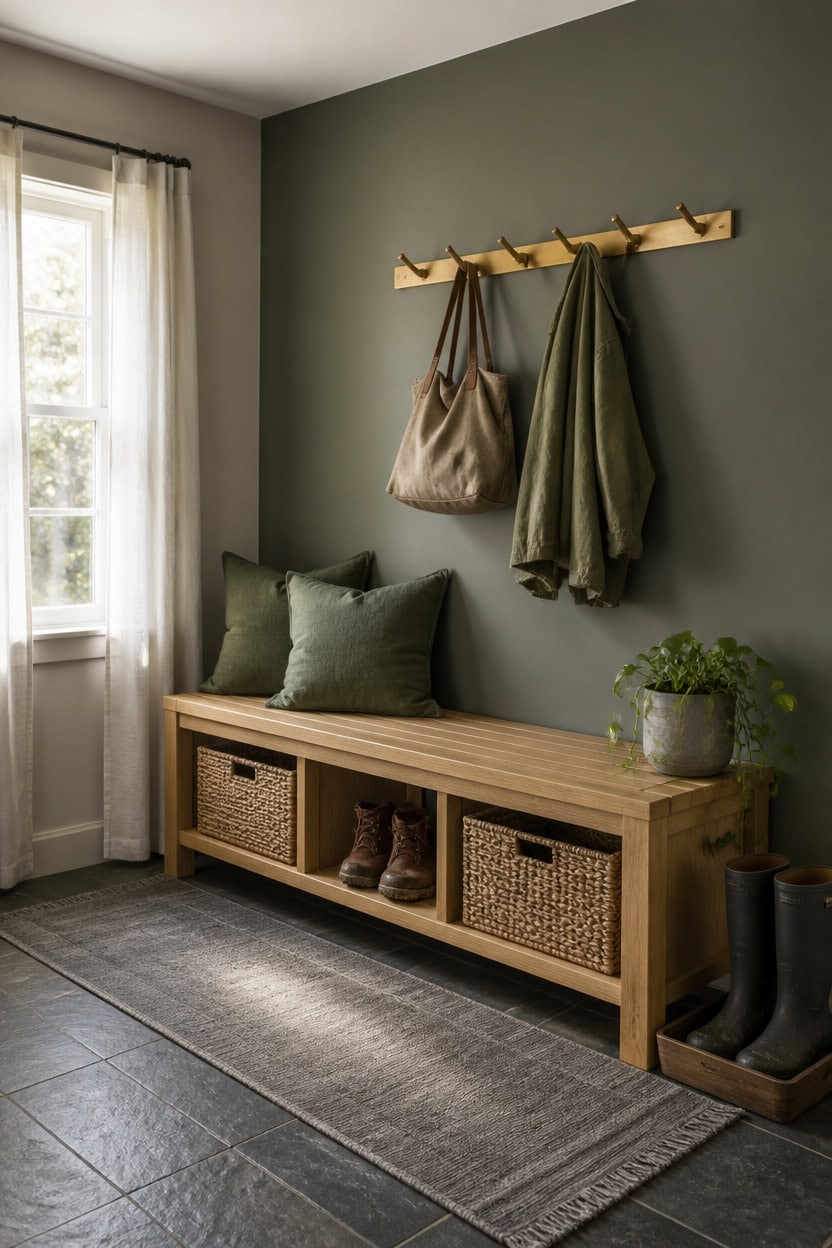
Benches in a gray and green mudroom do the most work when they combine a flat seat with visible storage underneath — a bench without storage is just an obstacle. Slatted wood benches in natural oak or walnut add organic warmth that keeps the gray from reading cold, while upholstered benches in neutral linen or textured fabric soften the visual weight of painted walls. Size it to your wall, not your preference — a bench that’s too short for the space creates a floating, unfinished look that no styling can fix.
Wood vs. upholstered: Wood benches hold up better in a high-traffic mudroom; upholstered benches work when the space doubles as an everyday drop zone with lower foot traffic.
Under-bench storage: Open cubbies let you grab shoes fast; closed baskets keep the mess hidden — choose based on whether you actually put things away or just pile them.
Bench length: Match bench length to 70–80% of the wall it sits against so the space reads intentional rather than cramped or sparse.
Seat height: Stick to 17–19 inches for comfortable boot-pulling — anything lower forces an awkward squat that makes the whole routine harder.
this muted, low-saturation green makes the bench feel anchored and framed rather than floating against a flat wall.
matched from the wall in this photo — the closest Benjamin Moore shade.
Our Favorite Vacuum Cleaners
 Shark Rotator Professional Lift-Away Upright Vacuum NV501
View Price
Shark Rotator Professional Lift-Away Upright Vacuum NV501
View Price
 Shark Navigator® Lift-Away® Deluxe Upright Vacuum with Large Dust Cup Capacity, HEPA Filter, Swivel Steering, Upholstery Tool & Crevice Tool
View Price
Shark Navigator® Lift-Away® Deluxe Upright Vacuum with Large Dust Cup Capacity, HEPA Filter, Swivel Steering, Upholstery Tool & Crevice Tool
View Price
 BISSELL CleanView Compact Upright Vacuum, Lightweight with Powerful Suction and Removable Extension Wand 3508
View Price
BISSELL CleanView Compact Upright Vacuum, Lightweight with Powerful Suction and Removable Extension Wand 3508
View Price
 Shark Rocket Ultra-Light Corded Bagless Vacuum for Carpet and Hard Floor Cleaning with Swivel Steering
View Price
Shark Rocket Ultra-Light Corded Bagless Vacuum for Carpet and Hard Floor Cleaning with Swivel Steering
View Price
 Electrolux Ergorapido Pet Cordless 2-in-1 Stick Vacuum in Red
View Price
Electrolux Ergorapido Pet Cordless 2-in-1 Stick Vacuum in Red
View Price
 Shark Pet Cordless Stick Vacuum with XL Dust Cup, LED Headlights, Removable Handheld Vac, and Crevice Tool
View Price
Shark Pet Cordless Stick Vacuum with XL Dust Cup, LED Headlights, Removable Handheld Vac, and Crevice Tool
View Price
 BISSELL Lithium Ion Bagless Handheld Vacuum, Purple, 2390
View Price
BISSELL Lithium Ion Bagless Handheld Vacuum, Purple, 2390
View Price
 Kenmore 200 Series Bagged Canister Vacuum with AllergenSeal System - BC4002
View Price
Kenmore 200 Series Bagged Canister Vacuum with AllergenSeal System - BC4002
View Price
 Miele Classic C1 Turbo Team Canister Vacuum
View Price
Miele Classic C1 Turbo Team Canister Vacuum
View Price
 Kenmore Elite Ultra Plush 700 Series Bagged Canister Vacuum
View Price
Kenmore Elite Ultra Plush 700 Series Bagged Canister Vacuum
View Price
 MOVA P10 Pro Ultra Robot Vacuum and Mop, Extenable Mop, Edge-to-Edge Cleaning,13000 Pa Suction, CleanLift System, Hot Water - White
View Price
MOVA P10 Pro Ultra Robot Vacuum and Mop, Extenable Mop, Edge-to-Edge Cleaning,13000 Pa Suction, CleanLift System, Hot Water - White
View Price
 Roborock Q10 X5+ Robot Vacuum and Mop, Self-Emptying, 10,000Pa Suction, Obstacle Avoidance, Dual Anti-Tangle System
View Price
Roborock Q10 X5+ Robot Vacuum and Mop, Self-Emptying, 10,000Pa Suction, Obstacle Avoidance, Dual Anti-Tangle System
View Price
 Roborock QV 35S Robot Vacuum and Mop, 10,000Pa Suction Vacuum Cleaner, Self-Emptying, Self-Washing & Air Drying, 10mm Mop Lifting
View Price
Roborock QV 35S Robot Vacuum and Mop, 10,000Pa Suction Vacuum Cleaner, Self-Emptying, Self-Washing & Air Drying, 10mm Mop Lifting
View Price
Hardware Worth Spending More On
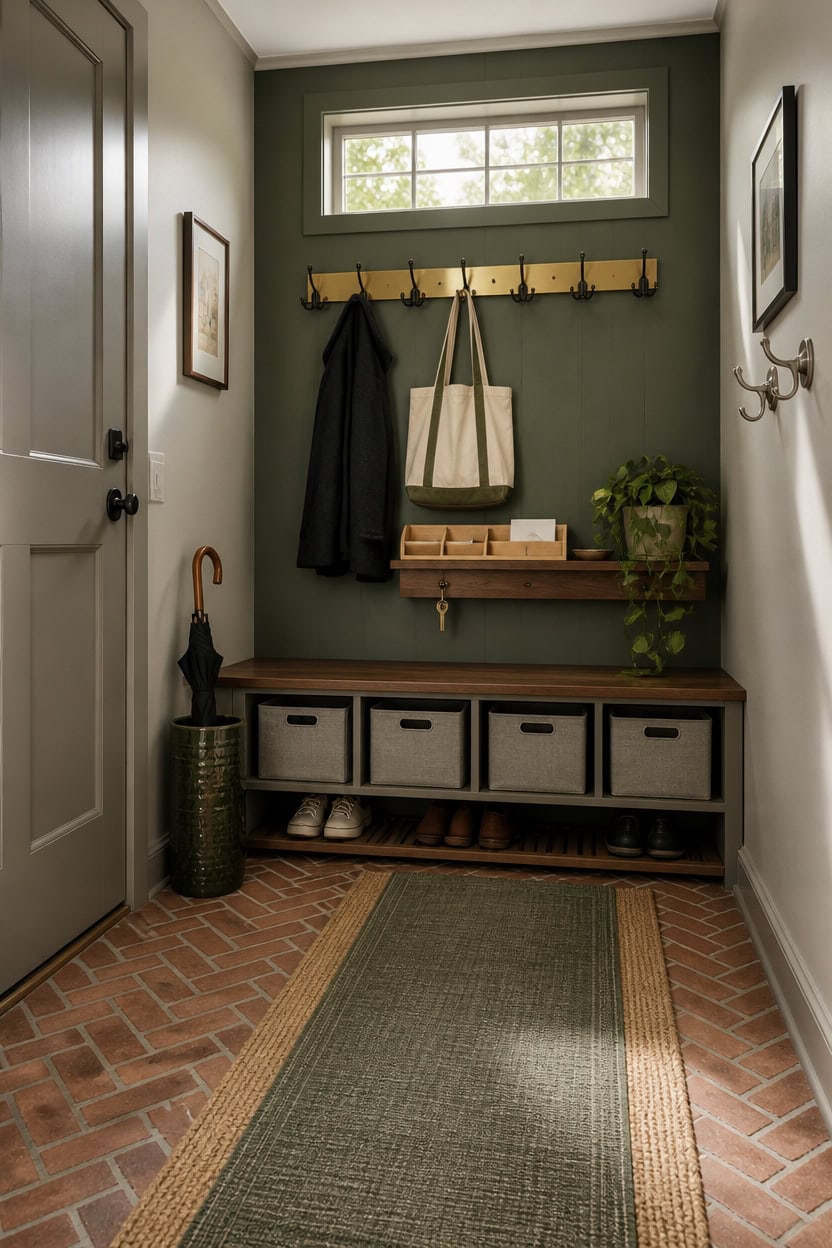
Hooks, knobs, and coat rails are the one place in a mudroom where spending an extra $20–$40 makes a visible difference every single day. Cheap zinc hooks bend under the weight of a wet winter coat within a season, and the finish chips off in high-humidity entryways faster than anywhere else in the house. Brushed nickel, matte black, and unlacquered brass are the three finishes that hold up — pick one and repeat it across every hook, rail, and knob in the space so the room reads pulled-together instead of collected over time.
Finish durability: Brushed and matte finishes hide fingerprints and water spots better than polished ones — critical in a space where wet hands grab things daily.
Weight rating: Look for hooks rated for at least 25 lbs each; anything less will pull from the wall under a loaded backpack or heavy coat.
Spacing: Mount hooks 6–8 inches apart so coats don’t overlap and crowd — overlapping defeats the whole organizational system.
Consistency: One finish across all hardware unifies the room; mixing metals in a mudroom reads as unfinished, not curated.
the muted green makes hardware stand out as an intentional design feature rather than a functional afterthought.
the warm mid-tone gray grounds the green accent wall and keeps the hardware finish from competing with the background color.
Plants That Survive a Mudroom and Look Good Doing It
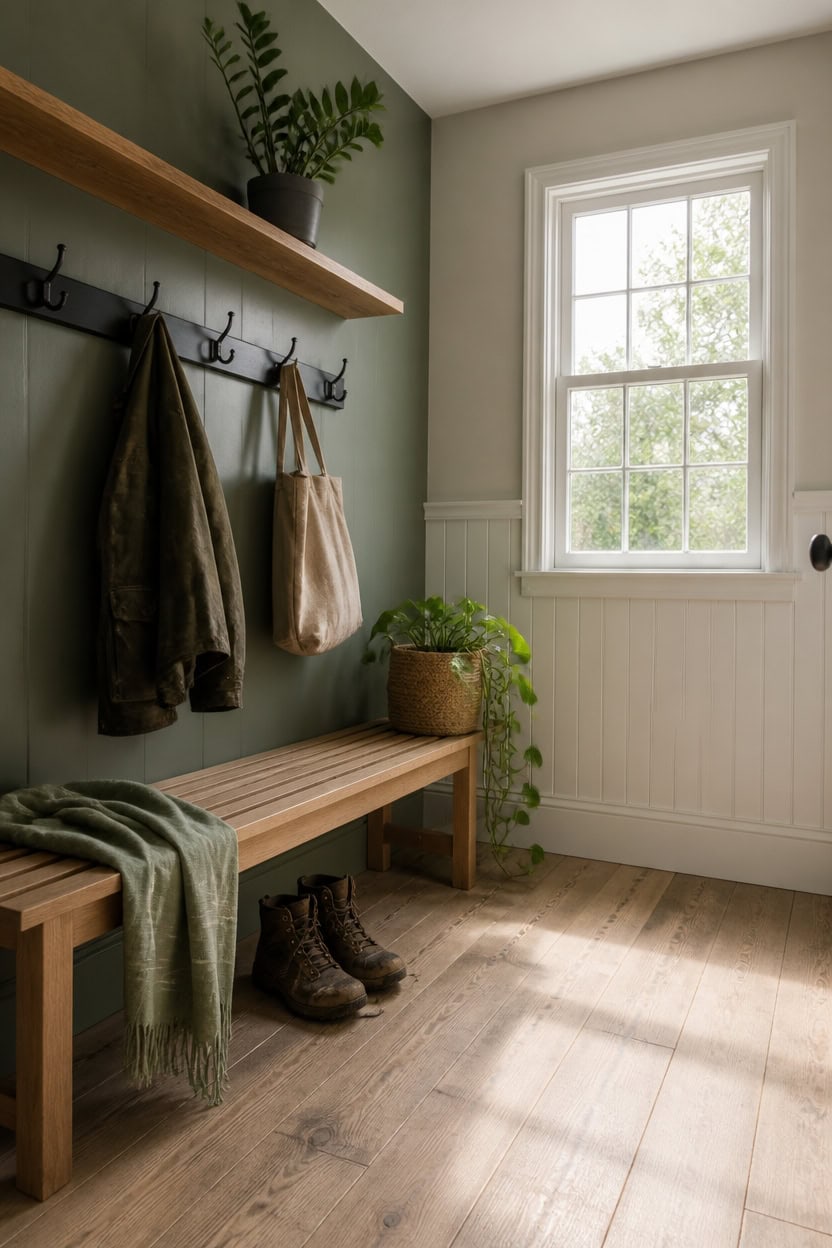
Pothos, ZZ plants, and cast iron plants are the three species most likely to survive a mudroom — low light, irregular watering, and temperature swings from door drafts don’t faze them. Most mudrooms sit near exterior doors where temps can drop 10–15 degrees every time someone comes in, which kills tropical humidity-lovers fast. Stick to a single medium-sized plant on a shelf or bench rather than a cluster; one healthy plant reads intentional, three struggling ones read neglected.
Light reality check: If your mudroom has no window, ZZ plants and cast iron plants are your only reliable options — pothos needs at least indirect light to stay full.
Pot placement: Keep pots off the floor where boots, bags, and water track in — a wall shelf or built-in cubby top keeps them safe and visible.
Pot finish: Matte ceramic or stoneware in gray or green blends with the mudroom palette without competing with hardware or hooks.
Size discipline: One 6-inch pot does more for the space than multiple small ones — scale up the plant, not the quantity.
the muted green makes a potted plant placed nearby look like a deliberate design moment rather than an afterthought.
the warm mid-tone gray keeps the green plant and green accent wall from overwhelming the space.
When to Paint Everything and When to Pull Back
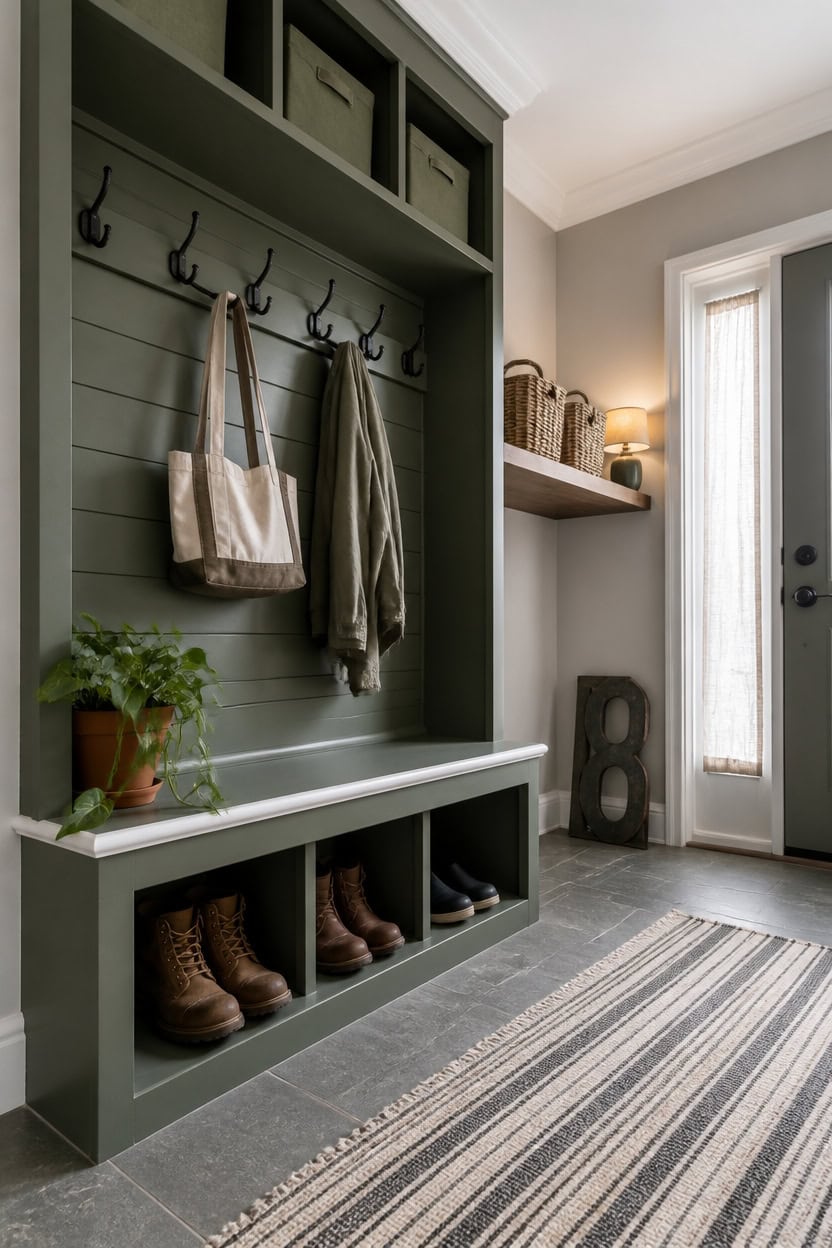
Paint every surface only when the room has something worth framing — save all-over color for mudrooms with built-in storage walls, paneling, or architectural detail that benefits from a unified finish. In a basic mudroom with floating hooks and a bench, full-coverage paint flattens the space and removes any visual break between surfaces. The smarter move is to paint one wall boldly and keep the remaining walls in a neutral that steps back.
Full paint = architectural rooms: If your mudroom has built-in cubbies, shiplap, or a ceiling with visible beams, painting everything in one color ties it together — that’s when all-over works.
Pull back = bare rooms: A mudroom with just hooks and a bench reads better with one painted accent wall and three neutral walls — the hardware becomes the focal point, not the paint.
Ceiling rule: Paint the ceiling the same neutral as the receding walls, not the accent color — keeping the ceiling light makes the space feel taller rather than closed in.
Trim decision: In gray-and-green mudrooms, white trim pulls the eye to the door frame and bench edges, which sharpens the whole color story without adding another color.
the muted green gives the hardware wall enough depth to read as intentional rather than a place where coats just happen to hang.
matched from the wall in this photo — the closest Benjamin Moore shade.
Textures That Keep Gray and Green From Feeling Flat
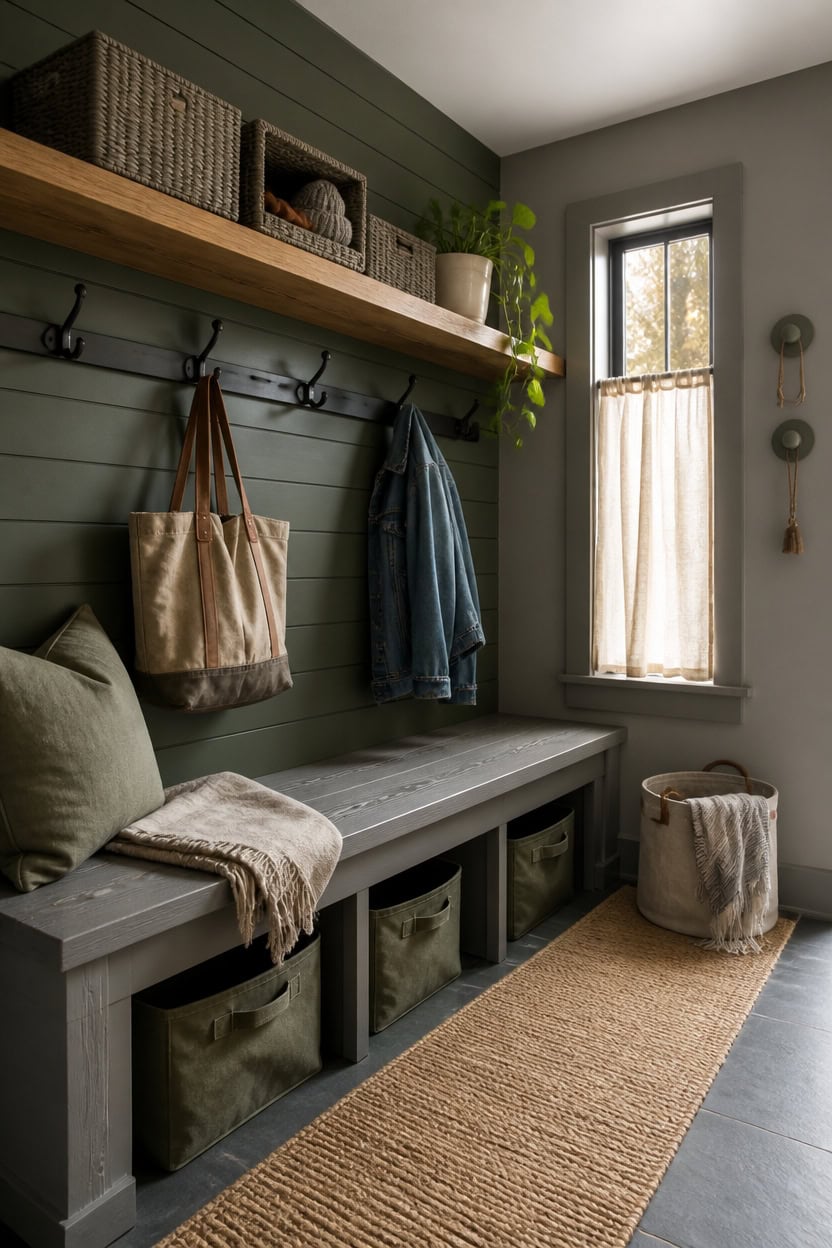
Linen, jute, matte ceramic, and raw wood are the materials that stop gray and green from reading as a cold, corporate color scheme. Rough-textured surfaces scatter light unevenly, which adds warmth that smooth painted walls and shiny hardware can’t provide on their own. Layer at least three different textures at different heights — floor, wall, and hook level — so the eye moves through the space rather than settling on flat surfaces.
Rough against smooth: Pair a woven jute runner with a painted shaker bench — the contrast between the two surfaces makes both materials register more clearly.
Matte over gloss: Choose matte black hooks and ceramic bins over shiny chrome or lacquered finishes — matte surfaces absorb light and keep the palette from feeling slick.
Natural wood as a bridge: A raw or oiled oak shelf between the green accent wall and the gray walls adds a warm neutral that ties both colors together without introducing a third paint color.
Fabric softens corners: A cotton canvas bin or linen storage basket at bench level breaks up the hard edges of painted wood and wall — softness at eye level changes how the whole room feels.
the muted, earthy green reads as intentional rather than trendy and holds its depth even against heavily textured surfaces like shiplap or woven baskets hung on it.
matched from the wall in this photo — the closest Benjamin Moore shade.
Real Mudrooms That Nailed This Color Combination
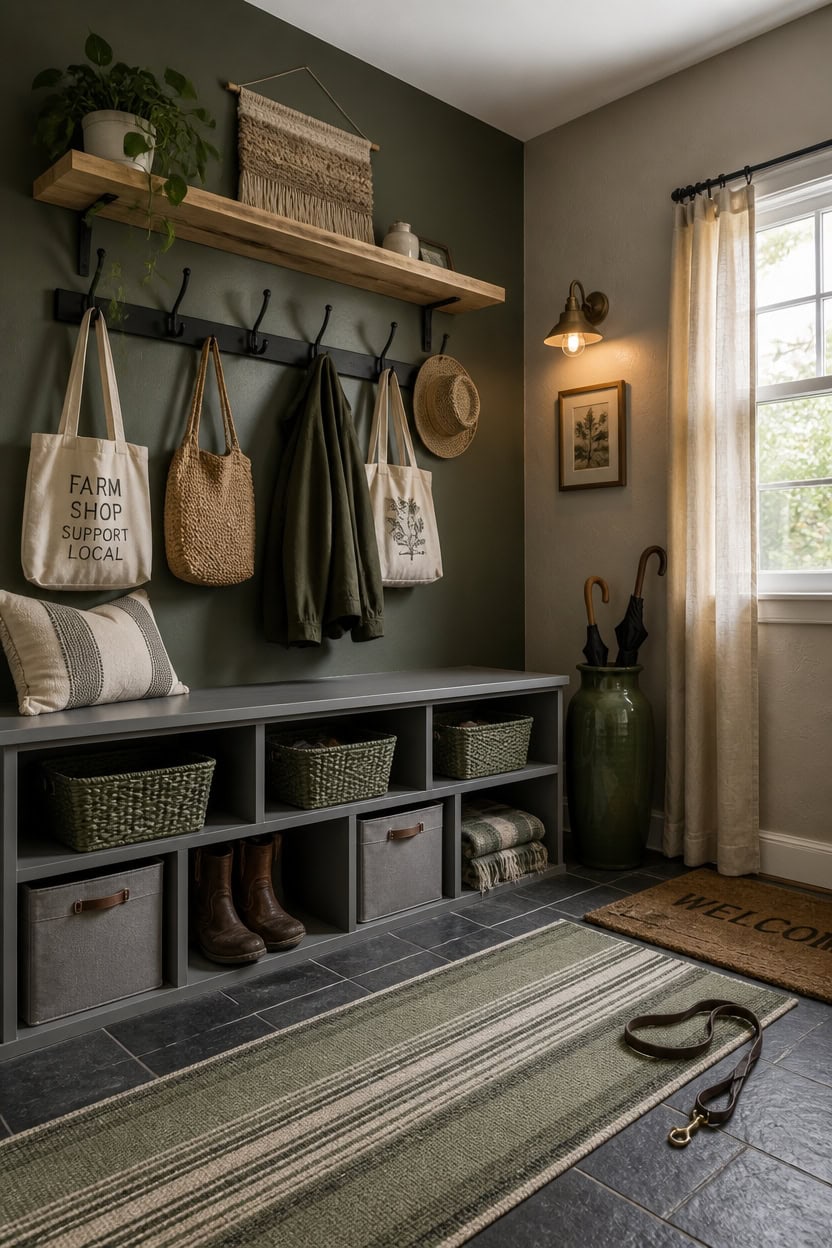
Real mudrooms that got this right share one consistent trait: gray does the heavy lifting on large surfaces while green shows up only at accent scale — a single wall, a row of painted cubbies, or a grouping of bins. That ratio keeps the space from feeling like a color experiment and more like a deliberate, lived-in room. If you flip it and lead with too much green, the mudroom starts to read as a garden shed rather than a functional entry point.
Gray on structure, green on storage: Use gray on walls and bench surfaces, then bring green in through bins, baskets, and a single accent wall behind the hook rail.
Keep lighting warm: Real mudrooms that photograph well use warm-toned bulbs — cool white lighting makes gray walls look blue and green look sickly.
Repeat the green in threes: Three green objects at different heights — a low bin, a mid-level basket, a high hook strip — makes the color feel intentional rather than random.
Skip the matching set: Rooms that feel real mix a painted green wall with natural-toned accessories rather than buying everything in the same shade of green from one collection.
this muted, dusty green grounds the hook wall without competing with everything hung on it.
this warm mid-tone gray ties the gray-and-green palette together without pulling the room cold or beige.
The One Design Rule That Makes This Color Pairing Work
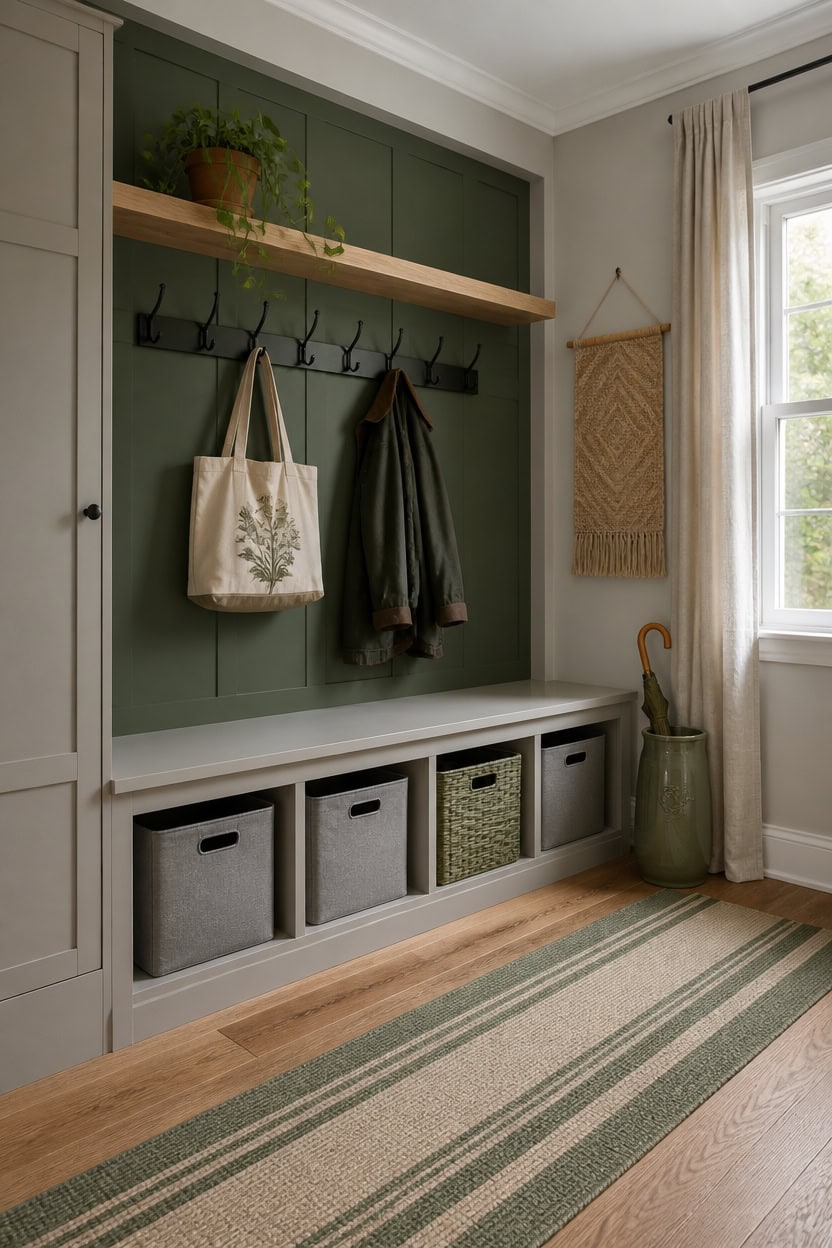
Proportion does the actual work in a gray and green mudroom — gray needs to cover at least 60 percent of visible surface area before green is introduced anywhere. That ratio keeps the room reading as a structured, functional entry rather than a decorating project in progress. Once you lock in the 60/40 split, green stops feeling like a color choice you have to defend and starts feeling like the room was always supposed to look this way.
Anchor gray to architecture: Apply gray to walls, bench tops, and built-in cubbies — surfaces that define the room’s structure before anything is hung or stored.
Cap green at two surfaces: Choose no more than two green surfaces or object groupings — one accent wall and one set of bins, for example — to prevent green from competing with itself.
Vary the value, not the hue: Use one green in muted and saturated versions rather than mixing multiple greens, which reads as chaotic rather than layered.
Leave gray space around green: Green anchors better when gray surrounds it — avoid placing green objects directly next to each other without a gray or neutral break between them.
this muted, desaturated green holds visual weight on one wall without overpowering the coats and bags hung in front of it.
this warm mid-tone gray provides the dominant 60 percent surface coverage that makes the green accent wall feel purposeful rather than accidental.